Gear · Roundup
The Best Knife Sharpeners for Hunters
One deer will take the edge off almost any knife. What decides the second half of the job is whether you can put it back in the field.
Disclosure: Creek Cover is reader-supported. If you buy through our links we may earn a commission, at no extra cost to you. It never changes which pick we tell a beginner to start with. Full disclosure.
Quick picks at a glance
Tap a pick to read the full write-up, or the price button to check it on Amazon.
- 1
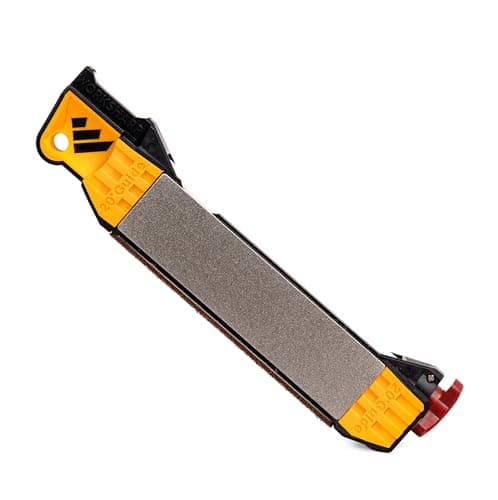
Coarse and fine diamond plates, a ceramic rod, a leather strop and built-in angle guides, all in a tool that fits a pack pocket. Nothing else here covers the full range in the field.
Best for: The best all-round hunting sharpener9.3 - 2
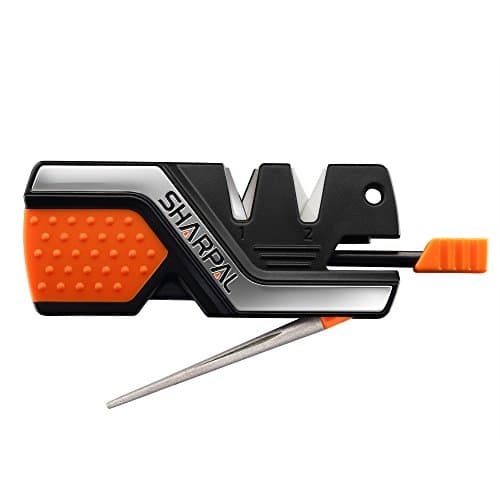
Carbide and ceramic slots plus a diamond rod, a fire starter and a whistle, at about the price of a sandwich. If you want a sharpener that lives permanently in a pack and you cannot justify the Work Sharp, this is it.
Best for: Best pocket sharpener for the money8.9 - 3
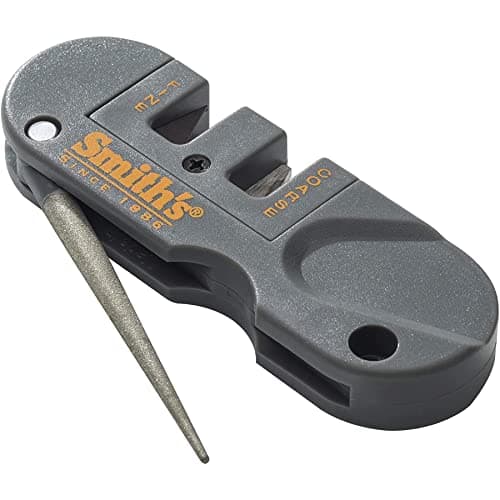
Carbide and ceramic preset slots plus a fold-out diamond rod, from the brand that has made these for decades. Dead simple, and small enough that there is no excuse for not having one.
Best for: Best simple two-stage pocket sharpener8.6 - 4
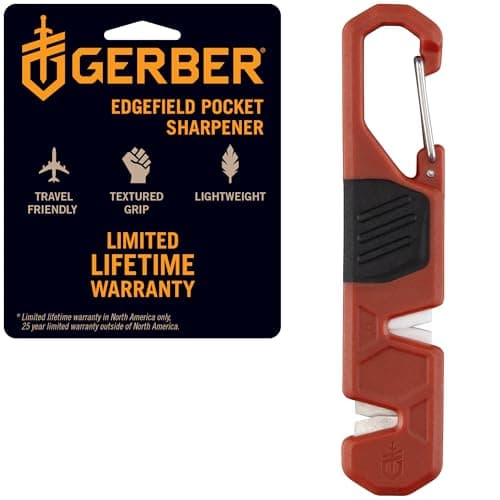
A dual-grit handheld sharpener with a proper grip, which makes it easier to use with cold or greasy hands than a small pocket unit. The one to leave in the truck rather than the pack.
Best for: Best for a truck box or camp kit8.3 - 5
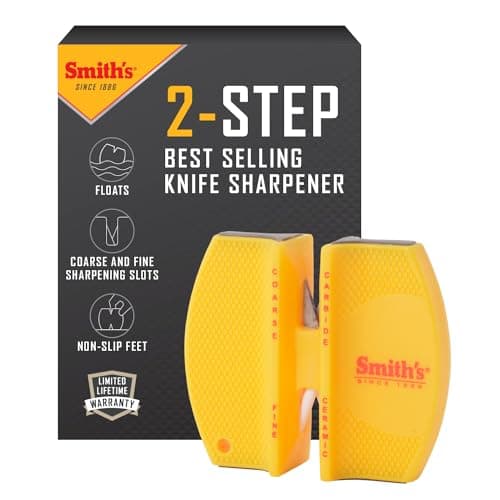
Two preset slots, coarse and fine, for less than the price of a coffee. It is the crudest tool on this page and it will still get a knife from useless to usable in ten seconds.
Best for: Cheapest sharpener that works7.9
| # | Product | Best for | Score | Price |
|---|---|---|---|---|
| 1 | Work Sharp Guided Field Sharpener Coarse and fine diamond plates, a ceramic rod, a leather strop and built-in angle guides, all in a tool that fits a pack pocket. Nothing else here covers the full range in the field. | The best all-round hunting sharpener | 9.3 | $39.95View on Amazon#ad |
| 2 | SHARPAL 101N 6-in-1 Pocket Knife Sharpener and Survival Tool Carbide and ceramic slots plus a diamond rod, a fire starter and a whistle, at about the price of a sandwich. If you want a sharpener that lives permanently in a pack and you cannot justify the Work Sharp, this is it. | Best pocket sharpener for the money | 8.9 | $12.99View on Amazon#ad |
| 3 | Smith's PP1 Pocket Pal Knife Sharpener Carbide and ceramic preset slots plus a fold-out diamond rod, from the brand that has made these for decades. Dead simple, and small enough that there is no excuse for not having one. | Best simple two-stage pocket sharpener | 8.6 | $14.30View on Amazon#ad |
| 4 | Gerber Edgefield Dual Grit Knife Sharpener A dual-grit handheld sharpener with a proper grip, which makes it easier to use with cold or greasy hands than a small pocket unit. The one to leave in the truck rather than the pack. | Best for a truck box or camp kit | 8.3 | $12.74View on Amazon#ad |
| 5 | Smith's CCKS 2-Step Knife Sharpener Two preset slots, coarse and fine, for less than the price of a coffee. It is the crudest tool on this page and it will still get a knife from useless to usable in ten seconds. | Cheapest sharpener that works | 7.9 | $6.99View on Amazon#ad |
Most beginners buy a good hunting knife and no way to sharpen it, which works exactly once. Field dressing and quartering a whitetail is a surprising amount of work for a thin edge, and the second half of the job with a dull blade is slower, messier and considerably more dangerous than the first half was. The fix is cheap. Start with the Work Sharp Guided Field Sharpener above, or the Sharpal pocket tool if the budget is going elsewhere.
How we picked these
We compared abrasive type, angle control, portability and blade compatibility against the real requirement: restoring a working edge on a hunting knife, in the field, with cold hands and no bench. We weighted angle guidance heavily because freehand sharpening is a skill that takes months, and we noted steel removal honestly for each type — an aggressive sharpener that eats your blade is a false economy. We do not run edge-retention testing — our method is on the how we research and pick page, and prices here are live and dated.
Why one deer dulls a knife
It is not the meat. Meat is soft and a sharp blade goes through it without complaint. What takes an edge off is hair, hide and bone contact— hair in particular, which carries dirt and silica from the animal’s bedding, and which acts like fine sandpaper on a cutting edge. Every time your blade passes through the hide from the inside, it is dragging through that.
This is also the argument for the replaceable-blade knives in the beginner knife roundup. A replaceable-blade design sidesteps sharpening entirely: you snap in a fresh blade mid-job and carry on. If you own one of those, you need a sharpener far less. If you own a fixed or folding blade — a Buck 110, a Morakniv — you need one, and the whole rest of this page applies.
Pull-through, guided, or stone
| Type | Skill needed | Steel removed | Best for |
|---|---|---|---|
| Pull-through carbide | None | A lot | Emergency rescue of a very dull blade |
| Pull-through ceramic | None | Little | Quick touch-up between uses |
| Guided field sharpener | Very little | Controlled | The right answer for most hunters |
| Diamond rod | Some | Moderate | Serrations, gut hooks, curved bellies |
| Bench stones, freehand | Months of practice | Whatever you choose | People who enjoy sharpening |
The important line in that table is steel removed. A carbide pull-through slot scrapes metal off aggressively — it will rescue a badly dull knife in seconds, and used every trip it will visibly change the shape of a good blade within a couple of seasons. Use carbide when the edge is genuinely gone; use ceramic or a strop for everything else.
Sharpen before the hunt, touch up during it
Touching up an edge in the field
Three things and you are done. Keep the angle consistent — this matters far more than the angle you pick. Most hunting knives are ground somewhere around 20 degrees per side, and a guided sharpener holds that for you. Use light pressure; you are realigning and refining an edge, not grinding a new one, and pressing hard mostly produces a wire burr that folds over on the first cut. And finish on the finest thing you have — a ceramic rod or a leather strop — because that is what turns a rough sharp edge into one that slices hide cleanly.
Test it on paper, not on your thumb. A blade that cuts a hanging sheet of paper cleanly will go through hide. A blade that tears the paper needs another pass. And clean the knife before you sharpen it: fat and hair in the abrasive is how a sharpener stops working after one season.
What to skip for now
Skip electric belt sharpeners for a first season — excellent tools, and very easy to remove far too much steel with before you know what you are doing. Skip full bench stone sets unless sharpening is something you actually want to learn as a hobby; the guided field sharpener produces a better result faster for anyone who does not. And skip sharpening a replaceable-blade knife at all: change the blade, keep the old one for the cardboard jobs. Pair the sharpener with a knife worth maintaining and game bags for what comes after.
The picks in detail
Work Sharp Guided Field Sharpener
9.3/10Best for: The best all-round hunting sharpener
Coarse and fine diamond plates, a ceramic rod, a leather strop and built-in angle guides, all in a tool that fits a pack pocket. Nothing else here covers the full range in the field.
- Type
- Guided multi-stage field sharpener
- Abrasives
- Diamond, ceramic, leather strop
- Angle guides
- Built in, 20 and 25 degrees
- Best for
- Field use and bench touch-ups
- Angle guides remove the skill barrier completely
- Covers everything from a dull edge to a stropped finish
- Small enough to carry every hunt
- Several times the price of a pull-through
- Takes longer than a pull-through, because it is doing it properly
SHARPAL 101N 6-in-1 Pocket Knife Sharpener and Survival Tool
8.9/10Best for: Best pocket sharpener for the money
Carbide and ceramic slots plus a diamond rod, a fire starter and a whistle, at about the price of a sandwich. If you want a sharpener that lives permanently in a pack and you cannot justify the Work Sharp, this is it.
- Type
- Pocket, multi-slot
- Abrasives
- Carbide, ceramic, diamond rod
- Extras
- Fire starter, whistle
- Best for
- Emergency field touch-up
- The cheapest thing here that will actually restore a working edge
- Diamond rod handles serrations and gut hooks
- Light and small enough to forget you are carrying it
- Carbide slots remove a lot of steel - use sparingly
- No angle control on the slots
Smith's PP1 Pocket Pal Knife Sharpener
8.6/10Best for: Best simple two-stage pocket sharpener
Carbide and ceramic preset slots plus a fold-out diamond rod, from the brand that has made these for decades. Dead simple, and small enough that there is no excuse for not having one.
- Type
- Pocket, preset slots
- Abrasives
- Carbide, ceramic, diamond rod
- Rod
- Fold-out, tapered
- Best for
- Quick touch-ups
- Preset angles mean no technique required
- Fold-out rod is genuinely useful on curved blades
- Proven design that has been on the market for years
- Carbide is aggressive on thin hunting blades
- No strop stage, so the edge is workmanlike rather than fine
Gerber Edgefield Dual Grit Knife Sharpener
8.3/10Best for: Best for a truck box or camp kit
A dual-grit handheld sharpener with a proper grip, which makes it easier to use with cold or greasy hands than a small pocket unit. The one to leave in the truck rather than the pack.
- Type
- Handheld, dual grit
- Grip
- Full-hand, textured
- Best for
- Camp and vehicle kit
- Blade types
- Straight edges
- Real grip you can hold with wet hands
- Two grits covers repair and refinement
- Bright color so it does not vanish in a bag
- Too bulky for a pocket
- No serration or gut-hook capability
Smith's CCKS 2-Step Knife Sharpener
7.9/10Best for: Cheapest sharpener that works
Two preset slots, coarse and fine, for less than the price of a coffee. It is the crudest tool on this page and it will still get a knife from useless to usable in ten seconds.
- Type
- Two-slot pull-through
- Abrasives
- Carbide and ceramic
- Angle
- Preset
- Best for
- Kitchen, camp, spare
- Almost free, so keep one everywhere
- Genuinely fast when a blade is badly dull
- Nothing to learn or set up
- Removes far more steel than necessary
- Repeated use will visibly reshape a good blade over time
Prices shown are from Amazon as of Sep 5, 2026 and change often — the button always goes to the current listing. Some links may earn us a commission at no extra cost to you. How this works.
Frequently asked questions
Why does a hunting knife dull so fast on one deer?
Hair, hide and bone contact - not the meat. Deer hair carries dirt and silica from bedding, which acts like fine sandpaper on a cutting edge every time the blade passes through the hide. Meat itself does almost nothing to a sharp blade.
What is the best knife sharpener for hunting?
A guided field sharpener that carries diamond, ceramic and a strop in one pocket-sized unit. The built-in angle guides mean you do not need freehand sharpening skill to get a working edge back, and it is small enough to carry every hunt - which matters, because the moment you need it is halfway through an animal.
Are pull-through knife sharpeners bad for knives?
Carbide pull-through slots remove a lot of steel very quickly. That is exactly what you want on a badly dull blade and exactly what you do not want as routine maintenance - used every trip they will visibly reshape a good knife within a couple of seasons. Use carbide for rescue and ceramic or a strop for upkeep.
What angle should you sharpen a hunting knife?
Around 20 degrees per side covers most hunting knives, but consistency matters far more than the exact number. An edge sharpened at a consistent 25 degrees outperforms one wandering between 15 and 25. A guided sharpener holds the angle for you, which is why it is the sensible choice for beginners.
Sources
Keep reading
Not sure where to start?
The beginner gear checklist walks you through exactly what a first-season hunter needs — essentials first, nice-to-haves later, with one safe-default pick per category.