Gear · Comparison
Treestand vs Ground Blind
The first real gear decision a deer hunter makes, and the one most likely to be made by whichever your friend owns. Here is the honest decision rule.
Disclosure: Creek Cover is reader-supported. If you buy through our links we may earn a commission, at no extra cost to you. It never changes which pick we tell a beginner to start with. Full disclosure.
Quick picks at a glance
Tap a pick to read the full write-up, or the price button to check it on Amazon.
- 1
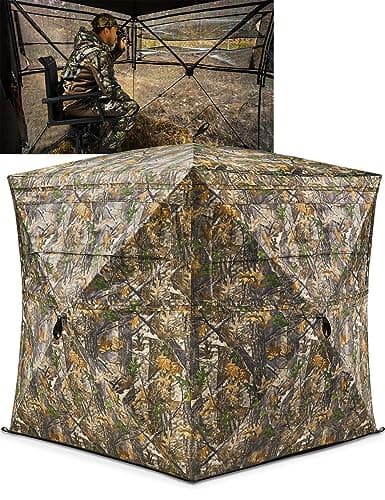
See-through walls solve the ground blind's biggest weakness — you can watch approaching deer without opening a window and betraying movement. Sets up in minutes, hides a beginner's fidgeting, and there is nothing to fall out of.
Best for: The safer, easier first season9.0 - 2
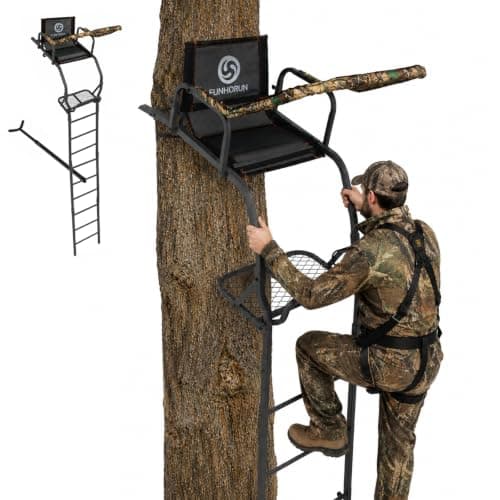
A ladder stand is the right treestand for a beginner — no climbing technique to learn, a stable platform, and 15 feet of height that puts your scent and your outline above a deer's normal attention. Wear the harness every single time.
Best for: Getting your scent above the deer8.8
| # | Product | Best for | Score | Price |
|---|---|---|---|---|
| 1 | TIDEWE 270° See-Through Ground Blind See-through walls solve the ground blind's biggest weakness — you can watch approaching deer without opening a window and betraying movement. Sets up in minutes, hides a beginner's fidgeting, and there is nothing to fall out of. | The safer, easier first season | 9.0 | $109.99View on Amazon#ad |
| 2 | FUNHORUN 15ft Ladder Tree Stand A ladder stand is the right treestand for a beginner — no climbing technique to learn, a stable platform, and 15 feet of height that puts your scent and your outline above a deer's normal attention. Wear the harness every single time. | Getting your scent above the deer | 8.8 | $159.99View on Amazon#ad |
Should a beginner use a treestand or a ground blind? A ground blind, for most first-season hunters. It removes fall risk entirely, works on ground with no suitable trees, conceals the movement every beginner makes, and shelters you from weather so you sit longer. A treestand wins on scent and visibility, and is the better long-term tool — but height is a skill and a risk you can add in year two.
That is the recommendation. The reasoning matters more than the verdict, because the right answer genuinely flips depending on what your ground looks like. We cover each option in depth on its own page — the best treestands for beginners and the best ground blinds for beginners — and this page is about choosing between them.
Head to head
| Factor | Treestand | Ground blind | Winner |
|---|---|---|---|
| Scent management | Height lifts your scent cone above a deer's nose at close range | You are in the scent stream at nose height | Treestand, clearly |
| Concealing movement | Deer rarely look up, but you are silhouetted and exposed | Opaque walls hide everything you do inside | Blind, clearly |
| Field of view | Excellent — you see over brush and terrain | Restricted to your windows | Treestand |
| Safety | Falls are the leading cause of hunting injury | Nothing to fall from | Blind, and it is not close |
| Weather | Fully exposed to wind and rain | Blocks wind and rain, so you sit hours longer | Blind |
| Terrain flexibility | Requires a straight, healthy, correctly placed tree | Works anywhere you can stand it up | Blind |
| Setup time before it works | Deer accept a stand quickly | Needs brushing in, ideally days to weeks | Treestand |
| Hunting with a child or partner | Two-person stands exist but are awkward | Comfortably fits two, with chairs | Blind |
| Mobility | Ladder stands are fixed; climbers and saddles are mobile | Pop-up blinds move, but re-brushing costs you | Roughly even |
| Shot angle | Downward angle compresses the vital area | Broadside, level, familiar from practice | Blind |
The scent argument for height
This is the real case for a treestand, and it is a genuine one. Your scent leaves you and drifts downwind in a widening cone. At ground level that cone hits deer at nose height immediately. Fifteen or twenty feet up, the cone travels further before it descends, so deer inside about forty yards frequently pass underneath it.
The important caveat: height does not defeat the wind, it buys distance. A deer at 150 yards directly downwind will smell you from a treestand exactly as it would from the ground. Thermals — air rising as the ground warms in the morning and sinking as it cools in the evening — also carry scent in ways that a stand does not fix. You still hunt the correct wind either way, as our deer hunting guide covers, and a scent-control spray is still a margin-buyer rather than a solution.
For a bowhunter this matters more than for a rifle hunter, simply because bow range demands the deer come close. If your first season is with a bow — see how to start bow hunting — the scent argument for height carries more weight than it does for someone shooting at 120 yards.
The movement argument for blinds
Here is what nobody tells a first-season hunter: you will fidget. Sitting genuinely motionless for four hours is a learned skill, and beginners have not learned it. You will shift your weight, check your phone, adjust a strap, and reach for a snack — and in a treestand every one of those is visible to any deer that happens to be looking.
A ground blind eliminates that entire failure mode. Inside opaque walls you can move reasonably freely, drink coffee, and shift position without consequence. For someone who has never done this before, that single property probably saves more hunts than height gains.
Three rules make a blind work, and skipping any of them is why people conclude blinds do not:
- Brush it in. A black hexagon that appeared overnight in a field edge reads as wrong. Pile branches and grass against the sides so it blends into the background.
- Set it up early. Deer accept a blind that has been there for a week far more readily than one that arrived that morning. Where you can, place it well before the season.
- Close the back windows. Light coming through behind you turns you into a silhouette in the window you are shooting from. Open only what you need, and wear dark clothing inside — this is the one place a black top beats camo.
A blind is the only realistic option for hunting with a kid
Safety, which is not a tie
Falls from treestands are the leading cause of serious hunting injuries, well ahead of firearm incidents. That is not a reason never to use one — millions of hunters use stands safely every season — but it is a reason to treat the decision honestly rather than as a pure performance comparison.
If you do choose a stand, the rules are non-negotiable and simple:
- Wear a full-body harness from the moment your feet leave the ground until they are back on it — not just while seated. Most falls happen climbing in and out. See our harness guide.
- Use a lifeline so you are attached during the entire climb, not only at the top.
- Raise and lower your weapon on a haul line, unloaded. Never climb with it.
- Inspect straps and welds every season. Ratchet straps degrade in UV and a stand left up year-round is a stand you should not trust without checking.
- Tell someone exactly where you are and when you will be back.
A ground blind's safety profile is essentially "do not get run over and be visible to other hunters." On public land during a firearms season, hang blaze orange on or near the blind where regulations require it.
Let the terrain decide
In practice this is the factor that should drive the decision more than any philosophical argument about scent versus movement.
| Your ground | Choose | Why |
|---|---|---|
| Mature timber, straight trees, deer trails | Treestand | Trees are available and height gives you visibility through the woods. |
| Open field edges, food plots, pasture | Ground blind | Often no suitable tree where you need to be, and deer are at distance anyway. |
| Marsh, prairie, cutover, young pines | Ground blind | Nothing to climb. The decision makes itself. |
| Public land you must hunt mobile | Climber or saddle | A blind is too heavy to carry and too permanent to leave. |
| Steep terrain and thick brush | Treestand | Height is the only way to see anything at all. |
| Late season, brutal wind and cold | Ground blind | Shelter is what lets you sit the hours that produce. |
The decision rule
Buy a ground blind first if any of these are true: you hunt open ground or field edges, there are no good trees where the deer are, you are taking a child or a partner, you know you struggle to sit still, or falls genuinely worry you. That covers most first-season hunters, and it is why a blind is our safe-default pick above.
Buy a ladder stand first if you hunt mature timber with straight trees, you are bowhunting and need deer inside thirty yards, and you are confident you will wear a harness every single time without exception. Height is a real advantage and a ladder stand is the safest way for a beginner to get it.
Most hunters end up owning both within a few seasons, and use whichever the wind and the weather call for on a given morning. That is the correct end state — this page is only about which one to buy first. Work the rest of your kit against the beginner gear checklist.
The picks in detail
TIDEWE 270° See-Through Ground Blind
9.0/10Best for: The safer, easier first season
See-through walls solve the ground blind's biggest weakness — you can watch approaching deer without opening a window and betraying movement. Sets up in minutes, hides a beginner's fidgeting, and there is nothing to fall out of.
- Type
- Hub-style pop-up
- Visibility
- 270° see-through walls
- Setup
- Minutes, no tools
- Best for
- Field edges, open ground, kids
- No fall risk — the single biggest safety argument
- Works where there is no climbable tree
- Blocks wind and rain, which extends how long you can sit
- Needs brushing in and ideally a week for deer to accept it
- Ground-level scent is far harder to manage
FUNHORUN 15ft Ladder Tree Stand
8.8/10Best for: Getting your scent above the deer
A ladder stand is the right treestand for a beginner — no climbing technique to learn, a stable platform, and 15 feet of height that puts your scent and your outline above a deer's normal attention. Wear the harness every single time.
- Type
- Ladder stand
- Height
- 15 ft
- Setup
- Two people, once per season
- Best for
- Timber with straight trees
- Height lifts your scent cone above deer at close range
- Wider field of view than any ground blind
- Deer accept a stand faster than a new blind
- Falls are the leading cause of hunting injuries — harness mandatory
- Fixed in place; a two-person job to move
Prices shown are from Amazon as of Sep 5, 2026 and change often — the button always goes to the current listing. Some links may earn us a commission at no extra cost to you. How this works.
Frequently asked questions
Should a beginner use a treestand or a ground blind?
A ground blind, for most first-season hunters. It removes fall risk, works where there are no climbable trees, conceals the fidgeting beginners inevitably do, and shelters you from weather so you sit longer. A treestand is better on scent and visibility, and is worth adding once you have a season behind you.
Does a treestand really help with scent?
Yes, at close range. Your scent leaves you in a widening cone, and from 15 to 20 feet up that cone often passes over deer inside about 40 yards. It buys distance rather than defeating the wind - a deer 150 yards directly downwind will smell you either way, and thermals still carry scent unpredictably.
Do deer get spooked by ground blinds?
They do if the blind appears suddenly and is not brushed in. Pile branches and grass against the sides so it blends into the background, and set it up days or weeks before you hunt it where you can. Deer accept a blind that has been part of the landscape far more readily than a new one.
Are treestands dangerous?
Falls from treestands are the leading cause of serious hunting injuries, ahead of firearm incidents. They are used safely by millions of hunters, but only with discipline: a full-body harness from the moment you leave the ground, a lifeline for the whole climb, a haul line for your unloaded weapon, and annual strap inspection.
Sources
Keep reading
Not sure where to start?
The beginner gear checklist walks you through exactly what a first-season hunter needs — essentials first, nice-to-haves later, with one safe-default pick per category.