Gear · Roundup
The Best Meat Grinders for Wild Game
Half of your first deer becomes burger whether you plan for it or not. This is the machine that decides whether that burger is worth eating.
Disclosure: Creek Cover is reader-supported. If you buy through our links we may earn a commission, at no extra cost to you. It never changes which pick we tell a beginner to start with. Full disclosure.
Quick picks at a glance
Tap a pick to read the full write-up, or the price button to check it on Amazon.
- 1
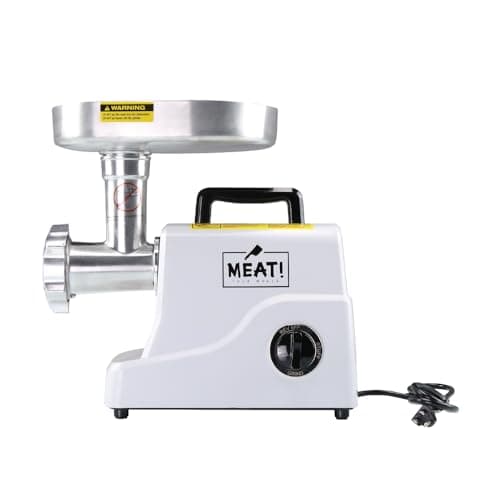
The simplest honest machine on this page: a #12 head, a stated 500 watts, 4 pounds a minute, three settings and nothing else to think about. It is the grinder to buy if you want the job done and do not want a hobby.
Best for: The best first grinder for one deer a year9.1 - 2
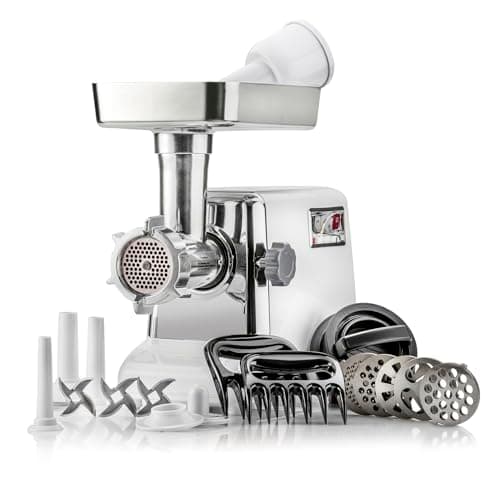
Four grinding plates, a stuffing plate, three blades, sausage tubes, a kubbe attachment and a patty press for less than the bare machines around it - plus a three-year repair warranty, which is the longest cover in the entry tier.
Best for: Best kit for the money8.8 - 3
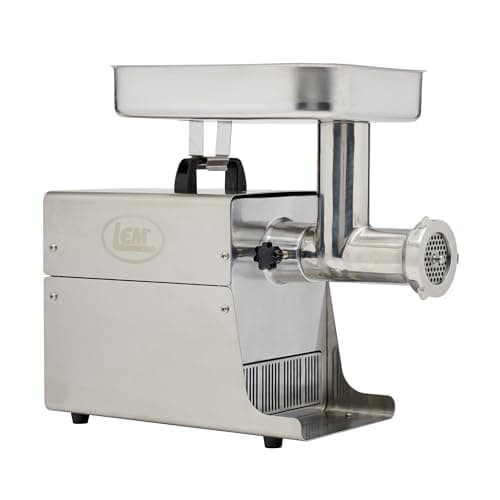
The machine most experienced deer hunters end up owning. A half-horsepower motor rated at 7 pounds a minute, a stainless housing, a built-in circuit breaker and a five-year warranty - and an auger designed to swallow chunks rather than make you cube them.
Best for: Best buy-once grinder9.0 - 4
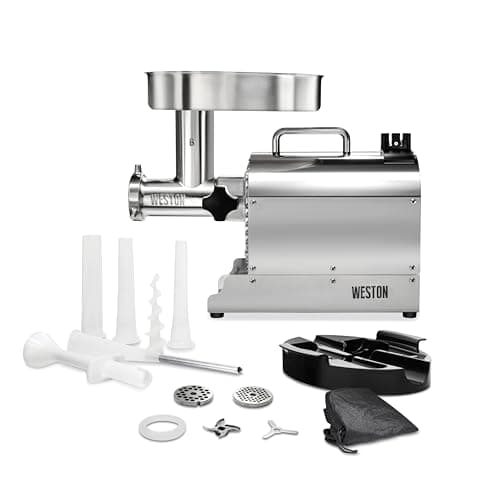
The one spec here that no entry machine has: an air-cooled, permanently lubricated motor. That is what lets you run through a full lug of trim in one push instead of stopping every ten minutes to let a sealed motor cool down.
Best for: Best for grinding without stopping8.6 - 5
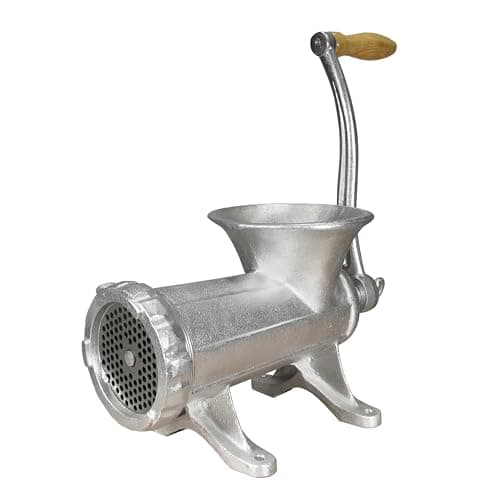
A tinned cast-iron clamp grinder with a 4 by 5 inch hopper that Weston rates at 3 to 4 pounds a minute if you keep cranking. It costs a fraction of any motor on this page and it works at a camp with no outlet.
Best for: Best with no power, and the cheapest way in7.9 - 6
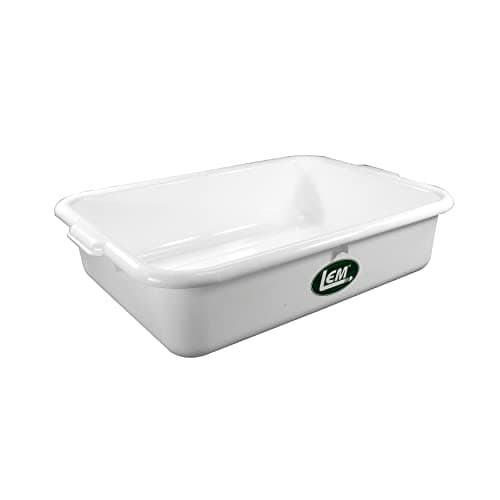
An NSF-certified HDPE tub rated to 50 pounds that holds a deer's worth of trim, goes in the freezer to chill it, and stacks. Nothing else on grinding day fails as visibly as running out of clean containers.
Best for: The accessory that makes grinding day work8.4
| # | Product | Best for | Score | Price |
|---|---|---|---|---|
| 1 | MEAT! 500 Watt Pro-Grade Meat Grinder #12 The simplest honest machine on this page: a #12 head, a stated 500 watts, 4 pounds a minute, three settings and nothing else to think about. It is the grinder to buy if you want the job done and do not want a hobby. | The best first grinder for one deer a year | 9.1 | $189.95View on Amazon#ad |
| 2 | STX International Turboforce 3000 Series #12 Four grinding plates, a stuffing plate, three blades, sausage tubes, a kubbe attachment and a patty press for less than the bare machines around it - plus a three-year repair warranty, which is the longest cover in the entry tier. | Best kit for the money | 8.8 | $159.75View on Amazon#ad |
| 3 | LEM Products BigBite #8 (0.5 HP) The machine most experienced deer hunters end up owning. A half-horsepower motor rated at 7 pounds a minute, a stainless housing, a built-in circuit breaker and a five-year warranty - and an auger designed to swallow chunks rather than make you cube them. | Best buy-once grinder | 9.0 | $419.99View on Amazon#ad |
| 4 | Weston Pro Series #8 (0.75 HP, 10-0801-W) The one spec here that no entry machine has: an air-cooled, permanently lubricated motor. That is what lets you run through a full lug of trim in one push instead of stopping every ten minutes to let a sealed motor cool down. | Best for grinding without stopping | 8.6 | $578.95View on Amazon#ad |
| 5 | Weston #22 Manual Tinned Meat Grinder A tinned cast-iron clamp grinder with a 4 by 5 inch hopper that Weston rates at 3 to 4 pounds a minute if you keep cranking. It costs a fraction of any motor on this page and it works at a camp with no outlet. | Best with no power, and the cheapest way in | 7.9 | $72.76View on Amazon#ad |
| 6 | LEM Products Heavy Duty Meat Lug An NSF-certified HDPE tub rated to 50 pounds that holds a deer's worth of trim, goes in the freezer to chill it, and stacks. Nothing else on grinding day fails as visibly as running out of clean containers. | The accessory that makes grinding day work | 8.4 | $35.73View on Amazon#ad |
The rest of the meat chain on this site is about getting your animal cold and keeping it that way: field dressing, game bags, a cooler with the drain open, and finally a vacuum sealer to put it away. A grinder is the one machine in that chain that changes what the meat actually is. Steaks and roasts come off the animal already decided; burger is made. And a first-time hunter almost always underestimates how much of a deer ends up in that category — every scrap off the neck, the shanks, the flank, the rib meat and every trimming from the roasts goes into one pile, and that pile is the meat you will eat most of.
How we picked these
We compared published head size, stated motor output, manufacturer grinding rate, included plates, warranty and cooling design against one job: turning the trim off a whole deer into burger in an afternoon, in a kitchen or a garage, without cooking the motor. We weighted honest, published specs above headline wattage, because the single most misleading number in this category is the watt figure printed on the box — and one machine on this page carries a 3,000-watt claim next to a manufacturer page that puts the real draw at 800 to 1,200 watts.
Every product here was confirmed as a live, in-stock listing before it went on the page, and every spec quoted comes from the manufacturer's own published figures. We do not run a test kitchen and we do not pretend to — our method is on the how we research and pick page. Prices are live and dated; the price brackets in the writing are qualitative on purpose, because a number typed into an article is stale the week after it is written.
Do you actually need a grinder?
Honestly: not for your first deer. A processor will take the animal, and for a beginner that is often the right call — you are learning enough already. The case for owning a grinder is simpler than the gear marketing makes it: it is about control and about the second deer. You decide what goes in, what fat goes with it, how coarse it is, and whether the burger from your animal is actually your animal. Shops process a lot of deer quickly, and while a good one keeps orders separate, you are trusting a system you cannot see.
The arithmetic is not complicated either. A grinder in the entry tier costs roughly what one processing bill costs in a lot of the country, so the machine has paid for itself somewhere around your second animal — and it keeps going after that. If you fill one tag every few years, pay the processor. If you expect to fill a tag most seasons, or you hunt with people who do, buy the grinder.
There is a second, quieter reason. Grinding is the step where a beginner finally understands what they are holding. You see exactly how much usable meat came off the animal, you find the silverskin you left on, and it makes the next one better. The first deer teaches you to hunt; the first grinding session teaches you to butcher.
What #8 and #12 actually mean
Grinders are sized by a number — #5, #8, #12, #22, #32 — and beginners reliably read it as a power rating. It is not. The number describes the size of the grinding head, and specifically the diameter of the plate that fits it. STX gives the figure plainly: the plates on a size #12 grinder are 2-5/8 inches across, and that is the standard for the size. A #8 head takes a smaller plate; a #22 takes a much larger one.
What the number really tells you is throat size — how big a piece of meat you can drop in without trimming it first. It correlates loosely with capacity, but only loosely, and the LEM on this page is the proof: the BigBite #8 is rated at 7 pounds a minute, faster than several #12 machines, because its auger is designed to grab larger chunks and feed them through a smaller head. Buy on the published rate and the motor, and treat the head number as a convenience spec rather than a performance one.
| What you process a year | What to buy | Why |
|---|---|---|
| Nothing yet - one tag, maybe | Nothing; pay the processor | A grinder is the second-deer purchase, not the first |
| One deer, some small game | An entry #12 electric | The whole grind is under an hour of machine time |
| A deer every season, plus sausage | A LEM-class #8 with a real warranty | Buy-once machine; the auger design outruns its head size |
| Two or more animals, or you help friends | An air-cooled motor (Weston Pro class) | Continuous running without a cooldown stop |
| No power at camp, or almost no budget | A #22 manual clamp grinder | Works anywhere; the cost is your arm |
The four specs that matter
Real motor output, not the number on the box.This category has a wattage problem. Manufacturers quote a peak or “max” figure that the motor can touch momentarily, and the number on the front of the box can be two or three times what the machine actually draws while it is working. STX is refreshingly straight about this on its own product page — the 3000 Series is sold on “3000 W Max” and STX states the real draw is 800 to 1,200 watts under load. Compare stated horsepower or a stated pounds-per-minute rate instead; both are harder to inflate.
Cooling. A sealed consumer motor heats up and needs a rest. An air-cooled motor does not, which is exactly why Weston puts it in the headline spec for the Pro Series. If you are grinding one deer's trim, a sealed motor with a break halfway is fine. If you are doing two animals back to back, or you are the person in the group with the grinder, cooling is the spec that decides whether the day is one push or five.
What plates come in the box. Good burger is usually two passes: a coarse plate to break the meat down, then a finer plate for texture. Machines vary more than you would expect. The MEAT! ships a 10 mm coarse and a 4.5 mm fine plus a stuffing plate; the STX ships 4, 7 and 10 mm plus a stuffing plate; the Weston Pro ships two, and its coarsest is 7 mm rather than the 10 mm the cheaper machines include. Extra plates are inexpensive to buy later — just do not assume the expensive machine comes with more of them.
Reverse. It sounds like a gimmick and it is not. Sinew and silverskin wrap the auger and stall the machine, and on a grinder without reverse the fix is a full head teardown with your hands covered in cold fat. Reverse backs the jam out in a second. Both entry machines here publish it as a control setting — the MEAT! lists grinding, stuffing and reverse; the STX lists high, low and reverse — and on grinding day it is worth more than any accessory in the box. Check for it before you buy anything not on this page.
The single biggest mistake: not trimming the silverskin
Fat: the part nobody warns you about
Venison is extremely lean, and ground venison with nothing added to it cooks dry and crumbles. Every extension service that publishes on home game processing says the same thing in slightly different words. Penn State Extension recommends adding one part high-quality pork fat to three or four parts venison before grinding. University of Florida IFAS Extension puts it as a range: mix 10% to 30% by weight of beef or pork fat with game meat to be ground. New Mexico State University's home deer-processing circular lands in the middle at about 10% to 15%.
In practice, most people settle somewhere near the bottom of that range for burger — enough to keep it from falling apart in a pan — and go higher for sausage, where the fat is doing more work. Ask a butcher counter for pork fat or beef suet; it is inexpensive and often free for the asking. If you would rather not add any, the alternative is not “lean burger” but a different plan for the meat: pure ground venison is fine in chili, in sauces and anywhere it is cooked wet, and it is disappointing as a patty.
This is also the point where the yield number becomes real. Boneless venison comes out at roughly 48% of field-dressed weight — that figure is from a 2017 Ohio Division of Wildlife study of 115 deer reported by the National Deer Association, where bucks averaged about 130 pounds field-dressed and yielded a little over 62 pounds of meat. A meaningful share of that is trim. Buy fat with the grinder, not after it.
How to grind venison so it isn't mush
Cold is the whole trick. UF/IFAS is explicit that meat should be ground at refrigerated temperatures rather than at room temperature, and the practical version most processors use is colder still: cut the trim into strips, spread them on a tray and get them firm — nearly crunchy at the edges but not frozen solid — before anything goes in the hopper. Put the auger, blade and plate in the freezer at the same time. Warm meat smears instead of cutting; the fat renders against the plate, and what comes out the other side is paste.
Two passes beats one. Run everything through the coarse plate first, mix your fat in by hand at that stage, then run it again through the fine plate. The second pass distributes the fat evenly and gives you the texture people recognize as burger. If the meat has warmed up between passes, put it back in the freezer for twenty minutes — it is not a wasted step.
Sanitation is not optional.UF/IFAS advises sanitizing every surface and every piece of equipment you plan to use, grinders included, and the reason is specific to grinding: it takes surface bacteria from the outside of the meat and mixes it all the way through. That is also why ground game has its own cooking rule. Where a venison steak can be served pink, UF/IFAS states plainly that ground meat needs to be cooked to a well-done temperature of 160°F. Tell whoever cooks it.
Package it the day you grind it. Ground meat has more surface area exposed to air than any other cut, which makes it the first thing in the freezer to go leathery. It is the cut that most rewards a vacuum sealer, and the one to freeze flat rather than in a lump — a flat pack thaws in minutes and stacks like a book.
What to skip
Skip the stand-mixer grinder attachments as your main plan. They work, and if you already own the mixer it is a reasonable way to grind a few pounds and find out whether you enjoy this. But they are slow, the throat is small, and asking a kitchen mixer to push 40 pounds of venison through in an afternoon is asking a great deal of a machine you also make bread with.
Skip the sub-$60 no-name electric grinders. The problem is not that they cannot grind — it is that when the auger jams on sinew there is no reverse, no circuit breaker and no warranty worth claiming, and the machine that stalls halfway through your first deer is not a bargain. This is the same logic as the rest of the gear that wastes beginners' money: the cheap version of a tool you use once a year under time pressure is the expensive version.
And skip buying a grinder before you have the things that come earlier in the chain. Cold meat, clean cuts and a sharp edge matter more to how your venison tastes than any machine you can buy, and if the money is finite it belongs in the beginner gear checklist first. The grinder is a reward for having filled a tag, not a prerequisite for trying.
The picks in detail
MEAT! 500 Watt Pro-Grade Meat Grinder #12
9.1/10Best for: The best first grinder for one deer a year
The simplest honest machine on this page: a #12 head, a stated 500 watts, 4 pounds a minute, three settings and nothing else to think about. It is the grinder to buy if you want the job done and do not want a hobby.
- Head size
- #12
- Motor
- 500 W electric
- Rate
- 4 lb/min (240 lb/hr, manufacturer)
- Plates
- Coarse 10 mm, fine 4.5 mm, plus stuffing plate
- Weight
- 16 lb
- Rate and wattage are stated plainly - no peak-output marketing number to decode
- #12 head takes chunks of trim without you cubing everything to fingertip size
- Grinding, stuffing and reverse, and that is the whole control set
- Two plates and three tubes in the box - no kubbe maker, no patty press, no extra plates
- MEAT! does not publish a duty-cycle figure, so on a big session you work in batches and let it rest
- 500 watts is genuinely mid-tier; sinew and silverskin will still stall it if you feed it carelessly
STX International Turboforce 3000 Series #12
8.8/10Best for: Best kit for the money
Four grinding plates, a stuffing plate, three blades, sausage tubes, a kubbe attachment and a patty press for less than the bare machines around it - plus a three-year repair warranty, which is the longest cover in the entry tier.
- Head size
- #12 (2-5/8 in plates)
- Load draw
- 800-1200 W under load (STX)
- Rate
- 175-225 lb/hr on high (STX)
- Plate holes
- 4 mm, 7 mm, 10 mm, plus stuffing
- Warranty
- 3 years, parts and labor
- The most complete accessory kit at this price - plates, tubes, kubbe, patty press, claws
- Three-year repair warranty with parts and labor included
- High, low and reverse: reverse is what clears a sinew jam without a teardown
- The headline "3000 W Max" is a peak figure - STX's own page puts the real draw at 800 to 1200 watts under load
- At 12 pounds it walks on a smooth counter when it hits something tough
- Half the accessories in the box are things a hunter grinding burger will never fit
LEM Products BigBite #8 (0.5 HP)
9.0/10Best for: Best buy-once grinder
The machine most experienced deer hunters end up owning. A half-horsepower motor rated at 7 pounds a minute, a stainless housing, a built-in circuit breaker and a five-year warranty - and an auger designed to swallow chunks rather than make you cube them.
- Head size
- #8
- Motor
- 0.5 HP, 110 V, permanently lubricated
- Rate
- Up to 7 lb/min (LEM)
- Plates
- 4.5 mm, 10 mm, plus stuffing plate
- Warranty
- 5 years
- Rated at 7 lb/min - faster than machines twice its head size, because of the auger design
- Built-in circuit breaker, so an overload trips instead of burning the motor
- Five-year warranty and a stainless housing that survives being hosed down
- More than twice the price of the entry picks, and that is real money against a first-season kit
- A #8 head, not a #12 - the throat is smaller, so oversized chunks still need trimming
- LEM lists it at roughly 29 pounds; this is a machine you store, not one that lives on the counter
Weston Pro Series #8 (0.75 HP, 10-0801-W)
8.6/10Best for: Best for grinding without stopping
The one spec here that no entry machine has: an air-cooled, permanently lubricated motor. That is what lets you run through a full lug of trim in one push instead of stopping every ten minutes to let a sealed motor cool down.
- Head size
- #8
- Motor
- 0.75 HP / 560 W, air cooled
- Rate
- 4-6 lb/min (Weston)
- Plates
- Coarse 7 mm, medium 4.5 mm
- Extras
- Offset head, built-in knife sharpener, stuffing kit
- Air-cooled motor is the honest answer to "can I do the whole deer in one go?"
- Offset head design and a built-in knife sharpener - both aimed at long sessions
- Five-year warranty, and the stuffing kit includes a 10 mm snack-stick funnel
- The most expensive machine here by a wide margin, and it out-specs what one deer a year needs
- Only two plates, and the coarsest is 7 mm - most machines here include a true 10 mm coarse plate
- Heavy and physically large; there is no casual place to keep it
Weston #22 Manual Tinned Meat Grinder
7.9/10Best for: Best with no power, and the cheapest way in
A tinned cast-iron clamp grinder with a 4 by 5 inch hopper that Weston rates at 3 to 4 pounds a minute if you keep cranking. It costs a fraction of any motor on this page and it works at a camp with no outlet.
- Head size
- #22
- Hopper
- 4 x 5 in
- Rate
- 3-4 lb/min (Weston, hand-cranked)
- Plates
- 4.5 mm and 10 mm
- Weight
- 7.5 lb
- No power needed - it works in a camp kitchen or a garage with no outlet
- Cast iron with a food-safe tin coating and a nylon bearing; nothing on it to burn out
- Cheap enough to own alongside an electric machine as a backup
- The published rate assumes you never stop cranking - a full deer by hand is a genuinely long afternoon
- Tinned cast iron must be dried and lightly oiled after every wash or it will rust
- Needs a table edge it can clamp to, and it will still creep under load
LEM Products Heavy Duty Meat Lug
8.4/10Best for: The accessory that makes grinding day work
An NSF-certified HDPE tub rated to 50 pounds that holds a deer's worth of trim, goes in the freezer to chill it, and stacks. Nothing else on grinding day fails as visibly as running out of clean containers.
- Capacity
- Rated to 50 lb
- Size
- 21-3/4 x 15-1/2 x 7 in (with handles)
- Material
- Food-grade HDPE, NSF certified
- Temperature
- -30 to 183 degrees F
- One lug holds the trim off a whole deer, so the meat stays in one place instead of six mixing bowls
- Rated to -30 degrees F, so it goes in the freezer to chill meat before a grind
- NSF-certified food-grade plastic, dishwasher safe, and it stacks for storage
- The lid is sold separately, which is not obvious from the listing
- It is a big rectangular tub - awkward to store in a normal kitchen
- You will want two: one for trim going in, one for ground meat coming out
Prices shown are from Amazon as of Sep 5, 2026 and change often — the button always goes to the current listing. Some links may earn us a commission at no extra cost to you. How this works.
Frequently asked questions
What size meat grinder do you need for deer?
A #8 or #12 is the sensible range for one to two deer a year. The number describes the grinding head and plate diameter, not power - a #12 takes 2-5/8 inch plates and a bigger throat, so you trim less before feeding it. Judge capacity by the manufacturer's published pounds-per-minute figure instead, because auger design matters more than head size.
How much fat do you add to ground venison?
Extension guidance clusters around 10 to 30 percent by weight. Penn State Extension recommends one part high-quality pork fat to three or four parts venison; University of Florida IFAS gives 10 to 30 percent beef or pork fat; New Mexico State's home processing circular suggests about 10 to 15 percent. Most people use the low end for burger and more for sausage.
Why does my ground venison come out mushy?
Almost always temperature, and second to that silverskin. Meat ground warm smears rather than cuts and the fat renders against the plate. Chill the trim until it is firm at the edges, freeze the auger, blade and plate alongside it, and pull the silverskin off before anything goes in the hopper.
Is a meat grinder cheaper than paying a processor?
An entry-tier grinder costs roughly what one processing bill costs across much of the country, so it tends to pay for itself around your second animal. If you fill a tag every few seasons, pay the processor. If you expect to fill one most years, the machine wins - and you control what goes into your burger.
Do you have to cook ground venison well done?
Yes. Grinding mixes surface bacteria all the way through the meat, which is why ground meat has a different rule from a whole muscle cut. University of Florida IFAS Extension states that ground game meat needs to be cooked to a well-done temperature of 160 degrees Fahrenheit.
Sources
- MEAT! — 500 Watt #12 Grinder published specifications
- STX International — Turboforce 3000 Series size #12 specifications (load wattage, plate sizes, warranty)
- LEM Products — #8 BigBite Meat Grinder 0.5 HP specifications
- Weston Brands — Pro Series #8 Meat Grinder (10-0801-W) specifications
- Weston Brands — #22 Manual Meat Grinder (36-2201-W) specifications
- LEM Products — Heavy Duty Meat Lug specifications
- University of Florida IFAS Extension — Wild Game: Fresh Meat Processing (FY1504)
- Penn State Extension — Canning and Freezing Venison (fat ratio for grinding)
- New Mexico State University Extension — Processing Your Deer at Home (CR508)
- National Deer Association — venison yield (Ohio Division of Wildlife study, 115 deer)
Keep reading
Not sure where to start?
The beginner gear checklist walks you through exactly what a first-season hunter needs — essentials first, nice-to-haves later, with one safe-default pick per category.