Packs & Nets · Roundup
The Best Fly Fishing Nets
The only piece of gear on this site whose main purpose is the fish rather than you. Rubber mesh and a magnetic release are the two features that matter; everything else is wood finish.
Disclosure: Creek Cover is reader-supported. If you buy through our links we may earn a commission, at no extra cost to you. It never changes which pick we tell a new angler to start with. Full disclosure.
Quick picks at a glance
Tap a pick to read the full write-up, or the price button to check it on Amazon.
- 1
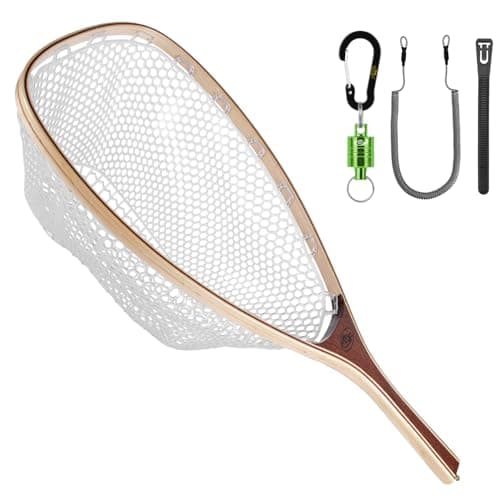
Soft rubber mesh and a magnetic release combo at a price that makes carrying a net a non-decision. The two features that matter, with nothing you are paying for that you do not need.
Best for: Best fly fishing net overall9.2 - 2
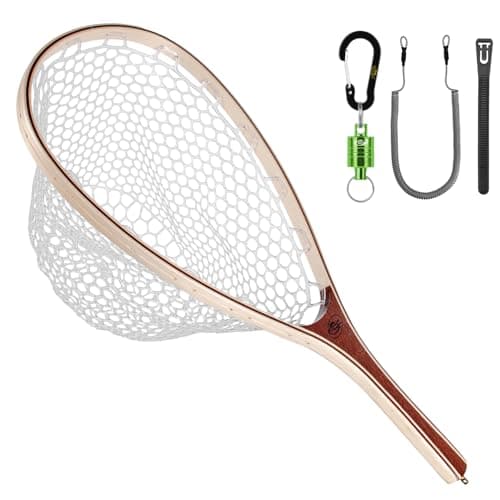
The same rubber-mesh and magnetic-release formula with a wooden frame, which is lighter in the hand than it looks and a great deal nicer to hold. The sensible upgrade if you want one good net.
Best for: Best wood-framed net9.0 - 3
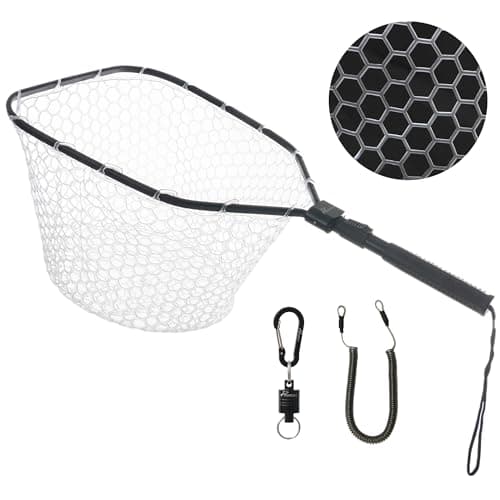
Folds down to a fraction of its length, which solves the real problem with nets on creeks — a fixed hoop catches on every branch between you and the next pool.
Best for: Best folding net for tight banks8.7 - 4
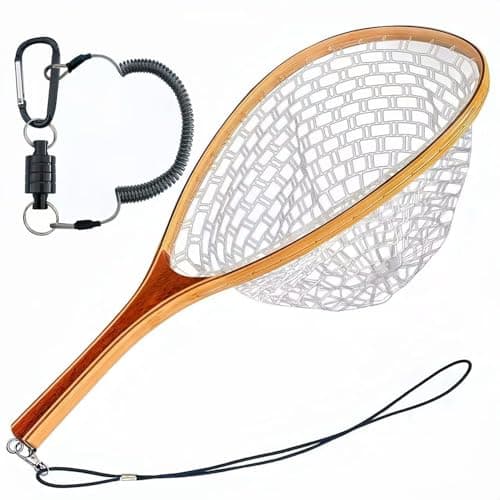
At just under two feet it is sized for the fish a creek actually produces rather than for a photograph. A small net you genuinely carry beats a big one left in the truck.
Best for: Best compact creek net8.8 - 5
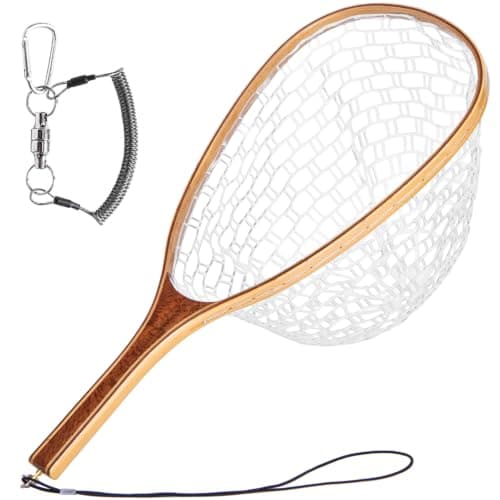
Clear rubber mesh is less visible in the water and far better looking in a photograph of a fish — a genuinely frivolous reason that a lot of people care about, honestly stated.
Best for: Best clear-mesh net for photos8.5
| # | Product | Best for | Score | Price |
|---|---|---|---|---|
| 1 | SF Fly Fishing Landing Net, Rubber Mesh with Magnetic Release Soft rubber mesh and a magnetic release combo at a price that makes carrying a net a non-decision. The two features that matter, with nothing you are paying for that you do not need. | Best fly fishing net overall | 9.2 | $27.99View on Amazon#ad |
| 2 | SF Fly Fishing Landing Net, Wood Frame with Silicone Rubber Mesh The same rubber-mesh and magnetic-release formula with a wooden frame, which is lighter in the hand than it looks and a great deal nicer to hold. The sensible upgrade if you want one good net. | Best wood-framed net | 9.0 | $27.99View on Amazon#ad |
| 3 | GOODCAT Folding Fly Fishing Net with Magnetic Release Folds down to a fraction of its length, which solves the real problem with nets on creeks — a fixed hoop catches on every branch between you and the next pool. | Best folding net for tight banks | 8.7 | $18.99View on Amazon#ad |
| 4 | SEASPRO Rubber Fly Fishing Net, Wood Handle with Magnetic Holder At just under two feet it is sized for the fish a creek actually produces rather than for a photograph. A small net you genuinely carry beats a big one left in the truck. | Best compact creek net | 8.8 | Check price on Amazon#ad |
| 5 | Wooden Fly Fishing Landing Net with Clear Soft Rubber Mesh Clear rubber mesh is less visible in the water and far better looking in a photograph of a fish — a genuinely frivolous reason that a lot of people care about, honestly stated. | Best clear-mesh net for photos | 8.5 | $26.99View on Amazon#ad |
Buy a net with soft rubber or silicone mesh and a magnetic release. Our top pick, the SF rubber-mesh net and release combo, has both for less than the cost of two fly boxes. Those two features do the whole job; the hoop shape, the frame wood and the handle length are preferences.
And carry it. A net left in the truck protects no fish at all, which is why the small nets on this list rank highly — the correct size is the one that does not annoy you enough to leave behind.
How we picked these
We compared published mesh material and hole size, frame material, overall length, whether a magnetic release is included, and packability — judged against landing wild creek trout of six to fourteen inches, in moving water, with the intention of releasing all of them. We weighted mesh material above everything else because it is the feature with measurable consequences for the fish, then packability, then frame quality. We do not conduct release mortality studies; we rely on published fisheries guidance, and our method is on the how we research and pick page. Prices here are live and dated.
Why rubber mesh is not a preference
A trout is covered in a mucus layer — slime — that is its primary defense against fungal and bacterial infection. Damage that layer and the fish may swim away looking fine and die of infection days later, which is why release mortality is invisible to the angler who caused it.
| Mesh type | Slime layer | Fins & gills | Hooks and flies |
|---|---|---|---|
| Knotted nylon | Strips it badly | Catches and splits fins | Tangles constantly |
| Knotless nylon | Better, still abrasive | Some fin damage | Still tangles |
| Soft rubber / silicone | Minimal damage | Nothing to catch on | Flies lift straight out |
Fisheries agencies and conservation bodies consistently recommend knotless rubber or silicone mesh for catch-and-release fishing, and a number of special-regulation waters now require it. The secondary benefit is purely selfish and substantial: rubber mesh does not tangle flies. Anyone who has spent four minutes picking a size 16 nymph out of knotted nylon while a trout thrashes will never go back.
Small holes matter too. Large-hole mesh lets small flies and small hooks poke through and catch. For creek fishing with size 14 to 18 flies, choose the small-hole option where a net offers both.
What size net for a creek
Nets are sold in a range that reflects fish from panfish to salmon, and the instinct is to size up for the fish you hope to catch. On creeks, do the opposite.
A hoop of roughly 11 to 14 inches and a total length under about 24 inches is right for small water. It lands anything a creek realistically produces, and — critically — it is small enough to sit on your back without catching every branch between pools. The compact pick is sized exactly for this.
Folding nets solve the snag problem differently, collapsing to a fraction of their length for the walk and opening when needed. The trade is a mechanism that can wear or jam, but on genuinely brushy creeks the folding option is a sensible call.
A long handle is useful only if you fish from a high bank or a boat. Wading a creek, you are standing next to the fish, and a long handle is just more thing to catch on things.
Magnetic releases, and why they matter
A magnetic release is two parts: a strong magnet clipped to the back of your pack or a D-ring, and a mating plate on the net handle, usually with a short bungee tether.
The point is one-handed operation. You are landing a fish with a rod in the other hand, which means any system requiring two hands — unclipping a carabiner, untying a lanyard — does not work at the moment you need it. With a magnetic release you reach back, pull, and the net is in your hand. When you let go, it swings back and reseats itself.
The bungee tether matters as much as the magnet: it means that if the net pops off while you are pushing through brush, it dangles rather than floating away down the creek. Nets without a tether get lost. If you buy a net that does not include a release — like the clear-mesh pick — buy one separately, because carrying a net in your hand all day is how nets end up left at home.
Where to clip it
How to actually use a net well
A net used badly is worse than no net. The mistakes are consistent and easy to fix.
Net the fish head-first, and let it swim in. Put the net in the water ahead of the fish and lead the fish into it. Chasing a fish from behind with the net pushes a wall of water at it and usually results in a last-second lunge that breaks your tippet.
Do not net it too early. A trout that still has energy will bounce off the hoop and tear out the hook. Let it come to the surface and turn on its side first, which takes less time than people think on light tackle.
Keep the net in the water. This is the biggest one. A netted fish should stay submerged in the net while you unhook it — the net is a holding pen, not a lifting device. A trout lifted into the air in a net bounces against the mesh and is out of water for the whole time it takes you to find your forceps.
Wet your hands first, and use forceps. Dry hands strip slime. Forceps or small pliers get a barbless hook out in a second or two — and if you have pinched your barbs down, often without touching the fish at all.
Release facing upstream. Hold it gently in the current until it swims out of your hand on its own. Do not throw it; do not squeeze it. If it sits in the shallows, cradle it upright in moving water until it goes.
What you can skip
Skip the big photogenic net unless you fish big water. It will live in your vehicle.
Skip nets with deep bags for creek fishing. A deep bag is for salmon; on a shallow net a ten-inch trout is easier to control and quicker to unhook.
Skip any net with knotted nylon mesh, however cheap. It is the one specification here with a real consequence, and the price difference is a few dollars.
Next: a sling pack to clip the net to, waders to reach the fish, and the beginner gear guide for the full kit in buying order. Fishing spinning gear? The single-hook advice in the creek lures roundup pairs with everything on this page.
A note on carrying it all. A net clips to a sling or a vest, but if you fish from a bank or a boat rather than wading upstream, a backpack organizes tackle far better — the best fishing backpack covers the packs with rod holders and included tackle boxes, and when a sling is still the better choice.
The picks in detail
SF Fly Fishing Landing Net, Rubber Mesh with Magnetic Release
9.2/10Best for: Best fly fishing net overall
Soft rubber mesh and a magnetic release combo at a price that makes carrying a net a non-decision. The two features that matter, with nothing you are paying for that you do not need.
- Mesh
- Soft rubber, small holes
- Frame
- Clear / composite
- Release
- Magnetic, included
- Best for
- Creek and stream trout
- Rubber mesh protects slime layer and does not tangle flies
- Magnetic release included rather than extra
- Small-hole mesh suits small flies
- Composite frame is less handsome than wood
- Magnet strength is adequate rather than strong
SF Fly Fishing Landing Net, Wood Frame with Silicone Rubber Mesh
9.0/10Best for: Best wood-framed net
The same rubber-mesh and magnetic-release formula with a wooden frame, which is lighter in the hand than it looks and a great deal nicer to hold. The sensible upgrade if you want one good net.
- Mesh
- Soft silicone rubber, small holes
- Frame
- Wood
- Release
- Green magnetic, included
- Wood frame is warm in hand and floats better
- Same fish-friendly rubber mesh
- Complete kit with release
- Wood needs occasional re-oiling
- Slightly bulkier than composite
GOODCAT Folding Fly Fishing Net with Magnetic Release
8.7/10Best for: Best folding net for tight banks
Folds down to a fraction of its length, which solves the real problem with nets on creeks — a fixed hoop catches on every branch between you and the next pool.
- Mesh
- Rubber
- Frame
- Folding, square
- Extended length
- 24.6"
- Release
- Magnetic
- Packs small — no snagging through brush
- Square hoop lands fish easily
- Cheapest pick here
- Folding mechanism is a wear point
- Less rigid than a fixed hoop under load
SEASPRO Rubber Fly Fishing Net, Wood Handle with Magnetic Holder
8.8/10Best for: Best compact creek net
At just under two feet it is sized for the fish a creek actually produces rather than for a photograph. A small net you genuinely carry beats a big one left in the truck.
- Length
- 23.6"
- Mesh
- Rubber
- Handle
- Wood
- Release
- Magnetic holder
- Short enough to be unobtrusive on the move
- Correctly sized for creek trout
- Wood handle, rubber mesh, magnet — all the essentials
- Too small for anything over sixteen inches
- Short handle limits reach from a high bank
Wooden Fly Fishing Landing Net with Clear Soft Rubber Mesh
8.5/10Best for: Best clear-mesh net for photos
Clear rubber mesh is less visible in the water and far better looking in a photograph of a fish — a genuinely frivolous reason that a lot of people care about, honestly stated.
- Mesh
- Clear soft rubber
- Frame
- Wood
- Best for
- Catch photos, clear water
- Clear mesh photographs well
- Still fully fish-friendly rubber
- Attractive wood frame
- No magnetic release included
- Clear mesh shows grime faster
Prices shown are from Amazon as of October 20, 2026 and change often — the button always goes to the current listing. Some links may earn us a commission at no extra cost to you. How this works.
Frequently asked questions
Why do fly fishing nets use rubber mesh?
Soft rubber or silicone mesh does not strip the protective slime layer from a trout or split its fins the way knotted nylon does, which meaningfully improves survival after release. It also does not tangle hooks and flies, so unhooking is much faster and the fish spends less time out of the water.
What size landing net do I need for trout?
A hoop of roughly 11 to 14 inches and a total length under about 24 inches for creek and small-stream fishing. That lands anything small water realistically produces and is compact enough to sit on your back without catching on branches - and the net you actually carry is the one that protects fish.
What is a magnetic net release and do I need one?
A magnet on your pack that mates with a plate on the net handle, usually with a bungee tether. It lets you grab and re-stow the net one-handed, which matters because your other hand is holding the rod with a fish on it. Without one, most people end up leaving the net behind.
How do you net a trout properly?
Put the net in the water ahead of the fish and lead it in head-first rather than chasing from behind. Wait until it has turned on its side, then keep the net submerged while you unhook with wet hands and forceps. Release it facing upstream and let it swim away on its own.
Sources
Keep reading
Not sure where to start?
The beginner gear guide walks you through exactly what a new stream angler needs — the six essentials first, nice-to-haves later, with one safe-default pick per category.