Flies · Roundup
The Best Fly Tying Vises
A vise is the one tying tool you buy once. Rotary or fixed, clamp or pedestal, and how much vise a creek angler tying size 14 nymphs actually needs.
Disclosure: Creek Cover is reader-supported. If you buy through our links we may earn a commission, at no extra cost to you. It never changes which pick we tell a new angler to start with. Full disclosure.
Quick picks at a glance
Tap a pick to read the full write-up, or the price button to check it on Amazon.
- 1
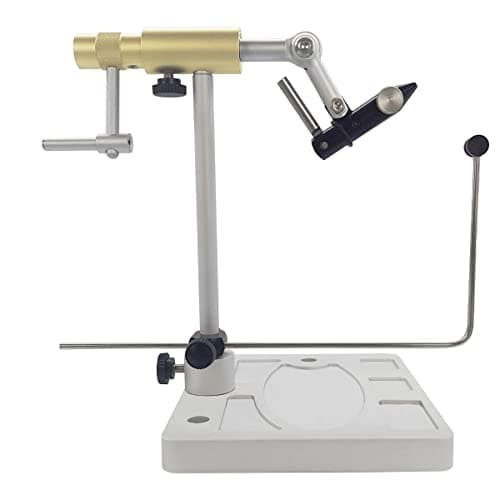
True rotary function at a price that normally buys a fixed vise. For trout flies in the sizes a creek angler actually fishes, this is as much vise as the job needs, and the rotary action makes learning even wraps far easier.
Best for: Best fly tying vise overall9.1 - 2
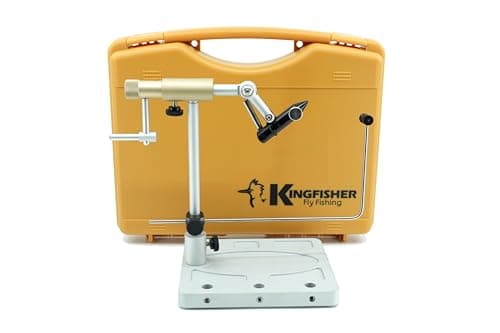
The same vise idea with the tools in the box — bobbin, scissors, whip finisher and the rest — so there is no second order before you can tie your first fly. The right buy if you own no tying tools at all.
Best for: Best fly tying vise for beginners9.0 - 3
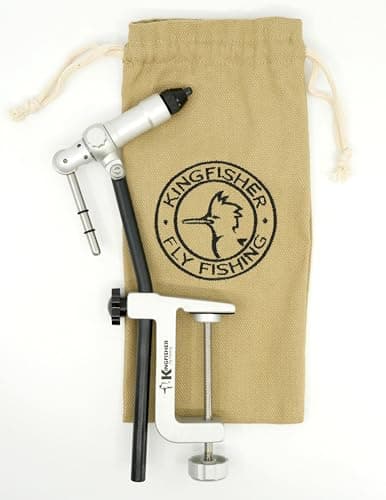
The cheapest vise here that is a real vise rather than a clamp with ambitions. If you want to find out whether tying is for you before committing, start here — the jaws hold a trout hook properly, which is the only thing that matters at the start.
Best for: Best budget fly tying vise8.5 - 4
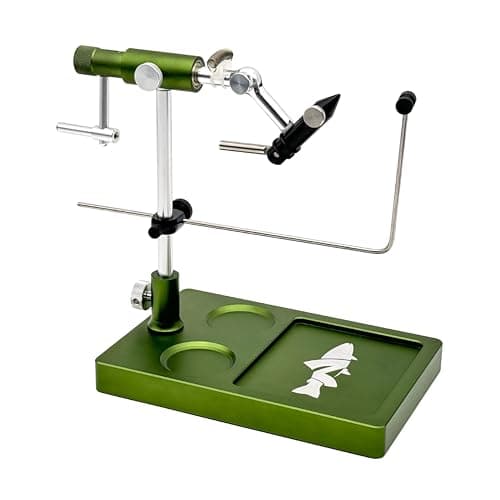
A rotary vise sold with a travel base rather than a table clamp, which is the difference between tying at the kitchen table and tying in a cabin, a truck or a hotel room the night before a trip.
Best for: Best for tying away from home8.8 - 5
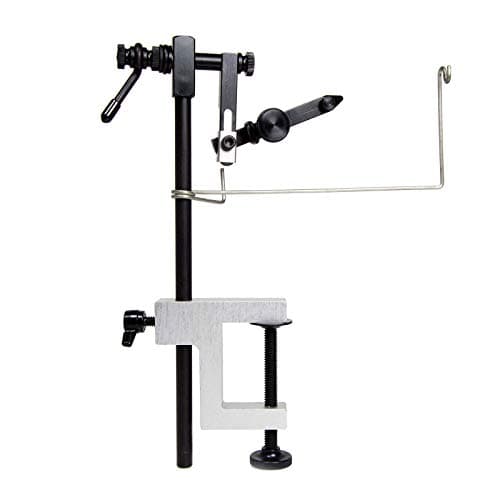
The vise a lot of tiers move to once they know they are staying. Griffin has been making these for decades and the jaws and adjustment feel it — this is where tying stops being fiddly and starts being pleasant.
Best for: Best step up from a starter vise9.0 - 6
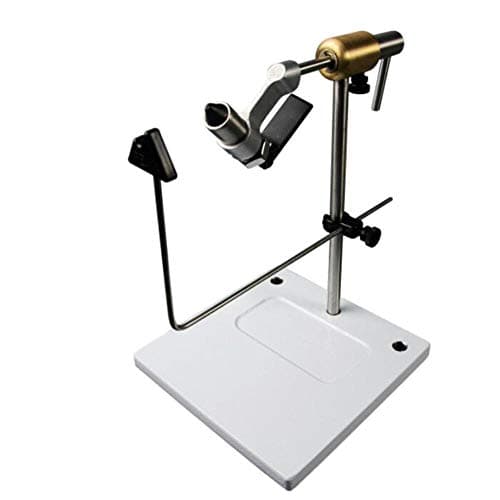
A heavy pedestal, a true rotary head and a US-made reputation for lasting decades. This is the last vise you buy, and the pedestal means you can tie anywhere on the table rather than at its edge.
Best for: Buy-it-for-life9.3
| # | Product | Best for | Score | Price |
|---|---|---|---|---|
| 1 | Kingfisher Clarkfork True Rotary Fly Tying Vise True rotary function at a price that normally buys a fixed vise. For trout flies in the sizes a creek angler actually fishes, this is as much vise as the job needs, and the rotary action makes learning even wraps far easier. | Best fly tying vise overall | 9.1 | $79.95View on Amazon#ad |
| 2 | Kingfisher Clarkfork Fly Tying Vise Kit with Tools The same vise idea with the tools in the box — bobbin, scissors, whip finisher and the rest — so there is no second order before you can tie your first fly. The right buy if you own no tying tools at all. | Best fly tying vise for beginners | 9.0 | $99.95View on Amazon#ad |
| 3 | Kingfisher Rock Creek Rotary C-Clamp Vise The cheapest vise here that is a real vise rather than a clamp with ambitions. If you want to find out whether tying is for you before committing, start here — the jaws hold a trout hook properly, which is the only thing that matters at the start. | Best budget fly tying vise | 8.5 | $39.95View on Amazon#ad |
| 4 | NIRVANA On The Fly V2 Rotary Fly Tying Vise with Travel Base A rotary vise sold with a travel base rather than a table clamp, which is the difference between tying at the kitchen table and tying in a cabin, a truck or a hotel room the night before a trip. | Best for tying away from home | 8.8 | $149.99View on Amazon#ad |
| 5 | Griffin Odyssey Spider Fly Tying Vise The vise a lot of tiers move to once they know they are staying. Griffin has been making these for decades and the jaws and adjustment feel it — this is where tying stops being fiddly and starts being pleasant. | Best step up from a starter vise | 9.0 | $127.35View on Amazon#ad |
| 6 | Peak Rotary Fly Tying Vise with Pedestal Base A heavy pedestal, a true rotary head and a US-made reputation for lasting decades. This is the last vise you buy, and the pedestal means you can tie anywhere on the table rather than at its edge. | Buy-it-for-life | 9.3 | $239.95View on Amazon#ad |
Buy the Kingfisher Clarkfork true rotary if you are buying a vise on its own, or the Clarkfork kit with tools if you own no tying tools yet. Spend under $40 on the Rock Creek if you want to test the hobby first, and spend once on the Peak with the pedestal base if you already know you will be tying in ten years.
How we picked these
We compared published rotary function, mounting type, included tools and the jaw range each maker states, judged against the flies a creek and small-stream angler actually ties: trout hooks roughly size 10 to 18, beadhead nymphs, small dries and the occasional Wooly Bugger. We weighted jaw grip on small hooks and rotary function above everything else, because those two decide whether tying a size 16 nymph is satisfying or maddening. We have not bench-tested jaw clamping force and do not claim to — our method is on the how we research and pick page, and prices here are live and dated.
Rotary or fixed — what it actually does
A fixed vise holds the hook still. You wrap thread and material around it by moving your hands, and to see the far side of the fly you take it out, turn it, and put it back.
A true rotary vise spins the hook on the axis of its own shank. That means two things. First, you can wrap a body by turning the handle rather than passing the bobbin around, which produces far more even wraps than a beginner can manage by hand. Second, you can rotate the fly to inspect it from any angle without unclamping it, which is how you catch a lumpy thorax before you varnish it.
Watch for “rotary” that only swivels. Some inexpensive vises rotate the head but not on the hook's axis, so the hook describes a circle instead of spinning in place. That is still useful for inspection and useless for wrapping. The listings that say true rotary mean the real thing.
For trout flies, rotary is a convenience, not a requirement
C-clamp or pedestal
| Mount | Needs | Strength | Weakness |
|---|---|---|---|
| C-clamp | A table edge up to its jaw depth | Rock solid, light to pack | Useless on a thick or no-edge table |
| Pedestal | Any flat surface | Tie anywhere on the table | Heavy; can slide under hard pulls |
| Travel base | Any flat surface | Packs for trips | Least rigid of the three |
Most people should start with a C-clamp because it is cheaper, lighter and more rigid, and almost every kitchen or desk has a usable edge. Measure the thickness of your table edge before buying — clamps have a stated maximum, and a thick butcher block or a table with an apron under the top will defeat one.
Pedestals win for comfort. You can put the vise in the middle of the desk, at any angle, and move it when you need the space. If you tie regularly at the same table, this is the nicer way to live, and it is the reason the Peak is set up that way.
Jaws and hook sizes that matter for trout
The jaws are the vise. Everything else is a convenience. What you want for trout flies is a set of jaws that closes securely on small, fine-wire hooks — size 14 to 18 is the range where cheap vises embarrass themselves, letting the hook rotate under thread tension exactly when you are trying to finish a head.
You do not need the big end of the range. Vises are often advertised on how large a hook they will hold, which matters for saltwater and pike flies and not at all for creek fishing. A vise that holds size 2 streamers is irrelevant if your box is nymphs and small dries.
Check the hook, not the handle, when you test grip. Clamp a small hook, then pull up on the bend with your fingers. If it slips or rolls, the jaws are not closing on the wire properly, and that vise will fight you on every fly.
How much vise you need
Under $40 buys a working rotary vise that will tie hundreds of trout flies. Around $80 buys true rotary function and better adjustment, which is where most people should land. $130 to $160 buys the step up in jaw quality that a weekly tier notices. Above $200 buys a vise that outlives the hobby, with parts and accessories still available in fifteen years.
The honest guidance: tying is cheaper than buying flies only after a couple of seasons, so the money saved by starting at $40 is real. If you already know you enjoy fiddly handwork, go straight to the true rotary and skip a step.
What else you need to start
A vise alone cannot tie a fly. You need a bobbin to hold and tension thread, scissors fine enough to trim close, a whip finisher or the patience to learn a hand whip finish, a bodkin, and hackle pliers. Then thread, hooks, beads and materials for the two or three patterns you actually fish.
If that list is daunting, buy a kit instead: our fly tying kit guide covers the boxes that include vise, tools and materials together, and the Clarkfork kit above is the vise-plus-tools version without materials. Store what you tie in a waterproof fly box — a winter's tying lives or dies on whether the box keeps water out. And if you are tying for small water, the patterns worth learning first are in our beginner trout flies guide and creek lure guide.
Where to set it up, and the light
Light matters more than the vise. Tying a size 16 nymph under a ceiling bulb is genuinely hard, and most people who find tying frustrating are fighting their lighting rather than their hands. A cheap adjustable desk lamp placed to the side, slightly above the vise, changes the hobby.
Set the jaws at mid-chest height when seated. Too low and you hunch; too high and your elbows float. A C-clamp on a desk is usually right; a pedestal on a dining table often needs the chair raised.
Put something light behind the vise. A sheet of white or pale card behind the hook makes thread, hackle tips and proportions far easier to see — the cheapest upgrade in tying, and the one every experienced tier uses.
The picks in detail
Kingfisher Clarkfork True Rotary Fly Tying Vise
9.1/10Best for: Best fly tying vise overall
True rotary function at a price that normally buys a fixed vise. For trout flies in the sizes a creek angler actually fishes, this is as much vise as the job needs, and the rotary action makes learning even wraps far easier.
- Action
- True rotary
- Mount
- C-clamp
- Best for
- Trout flies, all-round tying
- True rotary, not just a swiveling head
- Priced against fixed vises
- Right size range for trout hooks
- C-clamp needs a table edge
- No pedestal base included
Kingfisher Clarkfork Fly Tying Vise Kit with Tools
9.0/10Best for: Best fly tying vise for beginners
The same vise idea with the tools in the box — bobbin, scissors, whip finisher and the rest — so there is no second order before you can tie your first fly. The right buy if you own no tying tools at all.
- Action
- Rotary
- Includes
- Vise plus tying tools
- Best for
- A complete beginner
- Nothing else needed to start
- Tools are matched to the vise
- Cheaper than buying the pieces separately
- Tool quality is starter-grade
- Materials still have to be bought
Kingfisher Rock Creek Rotary C-Clamp Vise
8.5/10Best for: Best budget fly tying vise
The cheapest vise here that is a real vise rather than a clamp with ambitions. If you want to find out whether tying is for you before committing, start here — the jaws hold a trout hook properly, which is the only thing that matters at the start.
- Action
- Rotary
- Mount
- C-clamp
- Best for
- Trying tying out
- Lowest sensible entry price
- Holds small hooks securely
- Rotary at a budget price
- Less refined adjustment than the Clarkfork
- You may outgrow it in a season
NIRVANA On The Fly V2 Rotary Fly Tying Vise with Travel Base
8.8/10Best for: Best for tying away from home
A rotary vise sold with a travel base rather than a table clamp, which is the difference between tying at the kitchen table and tying in a cabin, a truck or a hotel room the night before a trip.
- Action
- Rotary
- Mount
- Travel base
- Best for
- Tying on the road
- Base travels, no table edge needed
- Properly portable setup
- Rotary action
- A travel base is less rigid than a heavy pedestal
- Costs more than clamp vises
Griffin Odyssey Spider Fly Tying Vise
9.0/10Best for: Best step up from a starter vise
The vise a lot of tiers move to once they know they are staying. Griffin has been making these for decades and the jaws and adjustment feel it — this is where tying stops being fiddly and starts being pleasant.
- Action
- Rotary
- Brand history
- Long-running US vise maker
- Best for
- Someone tying every week
- Noticeably better jaws and adjustment
- Established brand with parts
- Holds value
- Three times the budget pick
- More vise than occasional tiers need
Peak Rotary Fly Tying Vise with Pedestal Base
9.3/10Best for: Buy-it-for-life
A heavy pedestal, a true rotary head and a US-made reputation for lasting decades. This is the last vise you buy, and the pedestal means you can tie anywhere on the table rather than at its edge.
- Action
- True rotary
- Mount
- Pedestal base
- Best for
- A lifetime of tying
- Pedestal needs no table edge
- Rigid, repairable and long-lived
- Accessories and parts widely available
- By far the most expensive here
- Heavy — not a travel vise
Prices shown are from Amazon as of October 20, 2026 and change often — the button always goes to the current listing. Some links may earn us a commission at no extra cost to you. How this works.
Frequently asked questions
What is the best fly tying vise for a beginner?
A rotary vise with the tools included, so nothing else has to be ordered before the first fly. The important feature is jaws that hold a size 14 to 18 trout hook without rolling; the large-hook capacity advertised on many vises is irrelevant to trout fishing.
Is a rotary fly tying vise worth it?
Yes, for most tiers. A true rotary spins the hook on its own axis, which makes wrapping even bodies much easier for a beginner and lets you inspect a fly from every angle without unclamping it. Watch the wording - some cheap vises swivel the head without rotating on the hook axis.
C-clamp or pedestal base for a fly tying vise?
Start with a C-clamp: cheaper, lighter and more rigid, and most tables have a usable edge. Check your table edge thickness against the clamp's stated maximum first. A pedestal is more comfortable for regular tying because it sits anywhere on the desk, but it is heavier and costs more.
How much should I spend on a fly tying vise?
Under $40 gets a working rotary vise good for hundreds of trout flies. Around $80 gets true rotary function and better adjustment, which suits most people. Above $200 buys a vise with decades of life and available spare parts, which only makes sense if you know you will keep tying.
Sources
Keep reading
Not sure where to start?
The beginner gear guide walks you through exactly what a new stream angler needs — the six essentials first, nice-to-haves later, with one safe-default pick per category.