Flies & Lures · Roundup
The Best Trout Spinners for Streams
An inline spinner is the most effective trout lure a beginner can tie on, and the cheapest. These are the five worth owning for creek and small-stream water, the weights that match each kind of pool, and when a spoon is the better tool.
Disclosure: Creek Cover is reader-supported. If you buy through our links we may earn a commission, at no extra cost to you. It never changes which pick we tell a new angler to start with. Full disclosure.
Quick picks at a glance
Tap a pick to read the full write-up, or the price button to check it on Amazon.
- 1
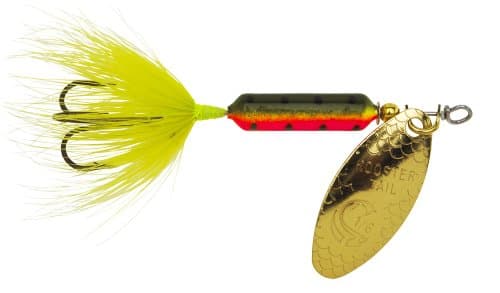
Nothing else gets a trout out of a small pool as reliably. At 1/16 oz it casts on a light ultralight rod, sinks slowly enough to fish water barely a foot deep, and the blade starts spinning almost the moment it begins to move — which is what you need when a pool is only twelve feet long. The hackle tail is not decoration; it gives the lure a soft trailing profile that keeps fish holding on a fraction longer.
Best for: Best overall — the creek trout lure, period - 2
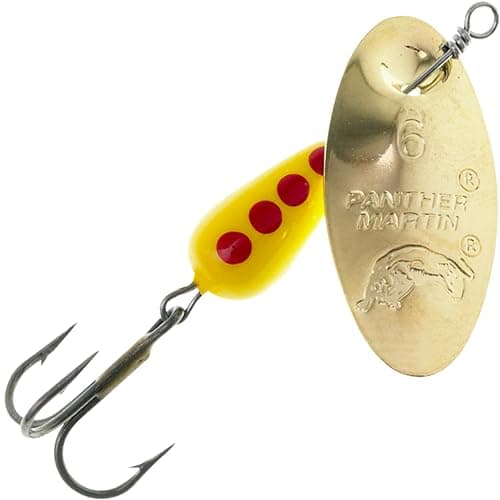
A different blade geometry to the Rooster Tail — the blade sits directly on the shaft, which makes it spin at a slower retrieve and track deeper. That is exactly what you want in a plunge pool below a drop, or in a fast chute where a lighter spinner skates across the surface instead of fishing. At 1/8 oz it also casts into a headwind, which the 1/16 oz lure will not.
Best for: Best for deeper pools and faster current - 3
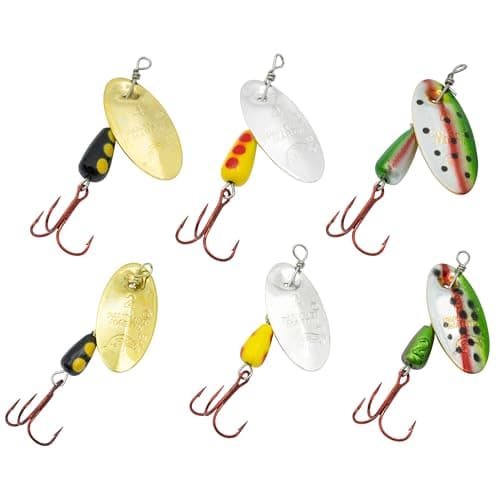
The efficient first purchase if you own no spinners at all. Six lures across both useful creek weights and a spread of finishes means you can work out what your water responds to in an afternoon rather than over a season of single-lure purchases. It costs roughly what two lures cost individually at a tackle counter, and the 1/16 oz and 1/8 oz split is exactly the pair this page recommends owning.
Best for: Best starter kit — both weights and a spread of finishes - 4
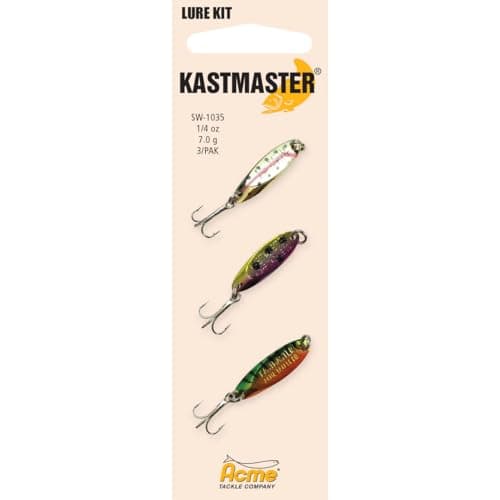
Not a spinner, and included deliberately. A Kastmaster is a dense machined-brass spoon that casts twice as far as a 1/16 oz spinner and sinks fast, which makes it the right lure for the one situation a creek spinner cannot handle: a wide slow pool, a beaver pond, or a wind-blown bank where you need to reach the far side. Three in a pack is enough to cover the sizes a small stream connects with.
Best for: Best when you need distance — a spoon, not a spinner - 5
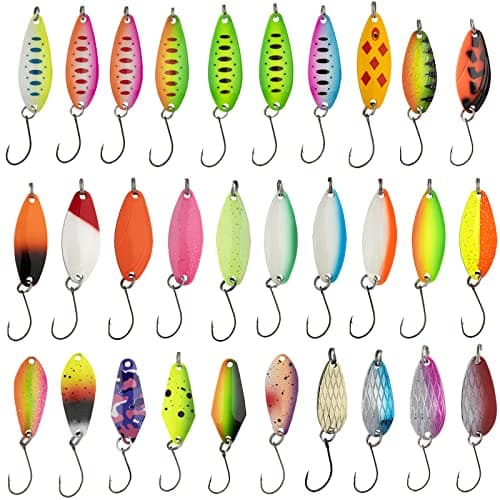
Thirty casting and trolling spoons across a range of sizes and finishes for the price of two branded lures. The finishes are not Acme's and the hooks are not as good, but for working out which size and color your particular creek or pond responds to, buying thirty cheap ones and losing half of them is the efficient experiment. Replace the winners with better versions later.
Best for: Best cheap way to learn which size and finish your water wants
| # | Product | Best for | Score | Price |
|---|---|---|---|---|
| 1 | Wordens Original Rooster Tail Spinner, 1/16 oz Nothing else gets a trout out of a small pool as reliably. At 1/16 oz it casts on a light ultralight rod, sinks slowly enough to fish water barely a foot deep, and the blade starts spinning almost the moment it begins to move — which is what you need when a pool is only twelve feet long. The hackle tail is not decoration; it gives the lure a soft trailing profile that keeps fish holding on a fraction longer. | Best overall — the creek trout lure, period | — | $14.99View on Amazon#ad |
| 2 | Panther Martin Classic Regular Gold/Yellow Inline Spinner, 1/8 oz A different blade geometry to the Rooster Tail — the blade sits directly on the shaft, which makes it spin at a slower retrieve and track deeper. That is exactly what you want in a plunge pool below a drop, or in a fast chute where a lighter spinner skates across the surface instead of fishing. At 1/8 oz it also casts into a headwind, which the 1/16 oz lure will not. | Best for deeper pools and faster current | — | $5.89View on Amazon#ad |
| 3 | Panther Martin Best of the Best Spinner Kit, 1/16 & 1/8 oz, 6 Pack The efficient first purchase if you own no spinners at all. Six lures across both useful creek weights and a spread of finishes means you can work out what your water responds to in an afternoon rather than over a season of single-lure purchases. It costs roughly what two lures cost individually at a tackle counter, and the 1/16 oz and 1/8 oz split is exactly the pair this page recommends owning. | Best starter kit — both weights and a spread of finishes | — | $29.99View on Amazon#ad |
| 4 | Acme Tackle Kastmaster Trout Spoon, 1/4 oz, 3 Pack Not a spinner, and included deliberately. A Kastmaster is a dense machined-brass spoon that casts twice as far as a 1/16 oz spinner and sinks fast, which makes it the right lure for the one situation a creek spinner cannot handle: a wide slow pool, a beaver pond, or a wind-blown bank where you need to reach the far side. Three in a pack is enough to cover the sizes a small stream connects with. | Best when you need distance — a spoon, not a spinner | — | $14.99View on Amazon#ad |
| 5 | QualyQualy Fishing Spoon Assortment, 30-Piece Trout Lure Set Thirty casting and trolling spoons across a range of sizes and finishes for the price of two branded lures. The finishes are not Acme's and the hooks are not as good, but for working out which size and color your particular creek or pond responds to, buying thirty cheap ones and losing half of them is the efficient experiment. Replace the winners with better versions later. | Best cheap way to learn which size and finish your water wants | — | $24.99View on Amazon#ad |
The best trout spinner for stream fishing is a 1/16 oz Rooster Tail — the Worden’s Original is the one lure to own if you own one. In deeper pools and faster chutes, switch to a 1/8 oz Panther Martin, whose blade spins slower and tracks deeper. If you are starting from nothing, the six-lure kit gives you both weights and several finishes for about what two lures cost at a counter.
An inline spinner is a metal blade mounted on a straight wire shaft with a weighted body and a hook at the back. Pull it through water and the blade rotates around the shaft, throwing flash and pushing out a low-frequency vibration a trout can feel through its lateral line before it ever sees the lure. That combination is why a spinner catches fish in water too stained for a fly and too shallow for a plug.
Why a spinner is the beginner’s lure
It works at the speed you can actually fish it. Most lures need a specific retrieve to come alive. A spinner works at almost any speed above a crawl, and it works on a straight retrieve with no technique at all. That means your first hour on the water is spent covering pools rather than learning a rod action.
It covers water fast, which is how you find creek trout. A small stream is a chain of short holding spots: the plunge pool, the slot under the bank, the pocket behind a boulder. Three casts into each and you move on. A spinner lets you fish a quarter mile of creek in an afternoon, and on small water the angler who covers more water catches more fish.
And it is cheap enough to fish where the trout are. Trout sit against cover — logs, roots, undercut banks, the brush you will lose lures in. A lure you are afraid to lose is a lure you fish two feet away from the fish. This is the same argument the cheap flies guide makes about nymphs, and it holds just as firmly here.
Gear note: this needs a light rod
What makes a blade work
Flash, vibration and a profile — in that order of distance. A trout feels the vibration first, from several feet away and around a boulder. It sees the flash second. It makes the decision to eat based on the overall silhouette at a foot or two. A good creek spinner has to do all three well at a slow speed in a small space.
Blade shape decides how slowly it will spin. A rounded blade set well off the shaft (the Rooster Tail pattern) starts rotating immediately and rides higher. A narrower blade mounted close to the shaft (the Panther Martin pattern) spins at an even slower retrieve and tracks deeper. Owning one of each is the real reason to buy two spinners rather than two colors of the same one.
Finish is the last variable, not the first. Silver and gold cover almost everything: silver in clear water and bright light, gold in stained water and low light. Painted and fluorescent finishes earn their place in high water after rain. If you are choosing between finishes on a lure you already like, this is a sensible tiebreaker — it is not a reason to own nine of them.
Weight is the real decision
| Weight | Fishes | Right for | Wrong for |
|---|---|---|---|
| 1/32 oz | Inches under the surface | Tiny headwater brooks, pools under a foot deep | Any wind, any current with push to it |
| 1/16 oz | A foot or so down on a slow retrieve | The default creek weight — most pools, most days | Long casts, deep plunge pools |
| 1/8 oz | Two to three feet down | Plunge pools, fast chutes, higher water after rain | Shallow gravel runs — it hangs up |
| 1/4 oz (spoon) | Fast to the bottom | Wide pools, beaver ponds, casting into wind | Everything a small creek is made of |
Two weights is a complete creek selection. A 1/16 oz for general water and a 1/8 oz for depth and current. Everything else on the rack is a refinement. If you buy the six-lure kit you have both covered in one purchase.
Spinner vs spoon
A spinner spins; a spoon wobbles.A spinner’s blade rotates around a fixed shaft and the body stays straight. A spoon is a single curved piece of metal that rocks from side to side as it moves and flutters as it falls. They are different actions and they suit different water.
Spinners win in small, shallow, broken water. They start working instantly, they fish shallow, and they are at their best in the twelve-foot pool. That describes most of a creek, which is why the top three picks here are spinners.
Spoons win on distance, depth and the drop. A dense spoon casts much further and sinks much faster, and a lot of spoon takes come as it flutters down on a tight line rather than on the retrieve. On a wide pool, a beaver pond, or a stocked lake at the bottom of the creek, that is the better tool — the lake lure roundup goes further into still water, and the broad trout lure page compares every lure category side by side.
The five compared
| Lure | Type | Weight | Buy it for |
|---|---|---|---|
| Worden's Original Rooster Tail | Inline spinner | 1/16 oz | The default creek lure |
| Panther Martin Classic | Inline spinner | 1/8 oz | Deeper pools and fast chutes |
| Panther Martin Best of the Best kit | Inline spinners | 1/16 + 1/8 oz | Starting from zero |
| Acme Kastmaster | Casting spoon | 1/4 oz | Distance and deep water |
| QualyQualy 30-piece spoon set | Casting spoons | Mixed | Learning what your water wants, cheaply |
Fishing a spinner on a creek
Cast upstream and retrieve back with the current. This is the most important sentence on the page. A spinner retrieved downstream, with the current, keeps the blade turning at a slow ground speed and brings the lure past a trout the way real prey moves. Casting downstream and dragging a lure back against the flow spins the blade too fast and shows the fish a lure fighting the river, which nothing real does.
Retrieve just fast enough to feel the blade. You should feel a steady light pulse through the rod. If it stops, speed up slightly; if the lure is skating near the surface, slow down or go heavier. That pulse is your depth gauge and your blade-is-working indicator at the same time.
Three casts per spot, then move. One along the near bank, one up the middle, one to the far seam. If a trout in a small pool wants it, it will take on the first or second pass. Standing in one place making twenty casts mostly teaches the fish what your lure looks like.
Approach from downstream and stay low. Trout face into the current, so walking up from below puts you behind them. On water this small your silhouette on the bank is the single biggest reason a pool goes dead — kneel, keep back from the edge, and cast from further away than feels necessary. The same discipline applies with a fly rod, covered in what gear to use for trout fishing.
Hooks, barbs and releasing fish
The treble hook is the one real drawback of a spinner. A three-point hook in the mouth of a seven-inch wild trout is harder to remove than a single hook, and it does more damage. If you intend to release fish, this is worth doing something about.
Two easy fixes. Crush the barbs flat with pliers — it costs you almost no hooked fish and makes removal a one-second job. Or replace the treble with a single hook of similar size, which some anglers find actually improves hook-up rates on small fish. Both take a minute per lure at the kitchen table. The hook question is one of the five grounds compared in flies vs lures for creek trout.
Check your state’s rules before you fish. Hook restrictions, barbless requirements and lure rules vary by state and often by individual stretch of water, and they change. Your state wildlife agency publishes the current regulations for the creek you plan to fish — that is the only reliable source, and it is worth two minutes before a trip.
Carry forceps. A pair of forceps turns hook removal from a fumbling job into a quick one, which matters most on the fish you intend to put back. They are part of the short list in the accessories guide, and the same tool works for spinning gear.
The picks in detail
Wordens Original Rooster Tail Spinner, 1/16 oz
Best for: Best overall — the creek trout lure, period
Nothing else gets a trout out of a small pool as reliably. At 1/16 oz it casts on a light ultralight rod, sinks slowly enough to fish water barely a foot deep, and the blade starts spinning almost the moment it begins to move — which is what you need when a pool is only twelve feet long. The hackle tail is not decoration; it gives the lure a soft trailing profile that keeps fish holding on a fraction longer.
- Type
- Inline spinner
- Weight
- 1/16 oz
- Finish
- Fire Tiger (many others available)
- Rod needed
- Ultralight
- Blade turns at the slowest retrieve of anything here
- Light enough for shallow creek pools
- Cheap enough to lose to brush without caring
- Too light to cast far in wind
- Single treble hook is awkward on small wild fish
Panther Martin Classic Regular Gold/Yellow Inline Spinner, 1/8 oz
Best for: Best for deeper pools and faster current
A different blade geometry to the Rooster Tail — the blade sits directly on the shaft, which makes it spin at a slower retrieve and track deeper. That is exactly what you want in a plunge pool below a drop, or in a fast chute where a lighter spinner skates across the surface instead of fishing. At 1/8 oz it also casts into a headwind, which the 1/16 oz lure will not.
- Type
- Inline spinner
- Weight
- 1/8 oz
- Finish
- Gold with yellow
- Best for
- Deeper pools, faster current
- Spins at a very slow retrieve and runs deeper
- Heavy enough to cast accurately in wind
- Gold blade is the better choice in stained water
- Too heavy for pools under about two feet
- Hangs up more often on a shallow gravel bottom
Panther Martin Best of the Best Spinner Kit, 1/16 & 1/8 oz, 6 Pack
Best for: Best starter kit — both weights and a spread of finishes
The efficient first purchase if you own no spinners at all. Six lures across both useful creek weights and a spread of finishes means you can work out what your water responds to in an afternoon rather than over a season of single-lure purchases. It costs roughly what two lures cost individually at a tackle counter, and the 1/16 oz and 1/8 oz split is exactly the pair this page recommends owning.
- Type
- Inline spinner
- Weights
- 1/16 and 1/8 oz
- Count
- 6 lures
- Both creek weights in one purchase
- Several finishes, so you can test what the water wants
- Cheapest route to a complete spinner selection
- You will not like every finish in the box
- Still only six lures — brush takes them
Acme Tackle Kastmaster Trout Spoon, 1/4 oz, 3 Pack
Best for: Best when you need distance — a spoon, not a spinner
Not a spinner, and included deliberately. A Kastmaster is a dense machined-brass spoon that casts twice as far as a 1/16 oz spinner and sinks fast, which makes it the right lure for the one situation a creek spinner cannot handle: a wide slow pool, a beaver pond, or a wind-blown bank where you need to reach the far side. Three in a pack is enough to cover the sizes a small stream connects with.
- Type
- Casting spoon
- Weight
- 1/4 oz
- Body
- Machined brass
- Use
- Casting from bank, or trolled
- Casts far further than any spinner here
- Sinks fast — reaches the bottom of a deep pool
- Machined body holds its finish for years
- Far too heavy for shallow creek pockets
- A flutter, not a blade — different action entirely
QualyQualy Fishing Spoon Assortment, 30-Piece Trout Lure Set
Best for: Best cheap way to learn which size and finish your water wants
Thirty casting and trolling spoons across a range of sizes and finishes for the price of two branded lures. The finishes are not Acme's and the hooks are not as good, but for working out which size and color your particular creek or pond responds to, buying thirty cheap ones and losing half of them is the efficient experiment. Replace the winners with better versions later.
- Type
- Mixed casting / trolling spoons
- Count
- 30 spoons
- Sizes
- Multiple, mixed finishes
- Use
- Casting and trolling
- Thirty lures for the price of two branded ones
- Wide size and finish spread for experimenting
- No pain when one goes into a snag
- Hooks and split rings are the weak point — check them
- Spoons, not spinners, and mostly heavier than creek water wants
Prices shown are from Amazon as of October 20, 2026 and change often — the button always goes to the current listing. Some links may earn us a commission at no extra cost to you. How this works.
Frequently asked questions
What is the best spinner for trout?
A 1/16 oz Rooster Tail. It is light enough to fish the shallow pools a creek is made of, the blade turns at the slowest retrieve you can manage, and the hackled tail gives it a profile trout commit to. For deeper pools and faster current, a 1/8 oz Panther Martin spins slower and tracks deeper.
What size spinner is best for creek trout?
1/16 oz for most water, with a 1/8 oz for plunge pools, fast chutes and high water after rain. A 1/32 oz is useful on tiny headwater brooks but will not cast in any wind. Those two weights cover a full season on small streams; everything else on the rack is a refinement.
Should I use a spinner or a spoon for trout?
A spinner in small, shallow or broken water, which is most of a creek, because it starts working instantly and fishes shallow. A spoon when you need distance or depth: a wide pool, a beaver pond, or casting into wind. Spoons also take a lot of fish on the drop, fluttering down on a tight line.
Which way do you cast a spinner for trout in a stream?
Upstream, then retrieve back with the current. That keeps the blade turning at a slow ground speed and brings the lure past the fish the way real prey moves. Casting downstream and dragging the lure back against the flow spins the blade too fast and looks unnatural.
What color spinner blade is best for trout?
Silver in clear water and bright light, gold in stained water and low light. Painted and fluorescent finishes earn their place in high, discolored water after rain. Blade color matters less than weight and retrieve speed, so get those right before buying more finishes.
Sources
Keep reading
Not sure where to start?
The beginner gear guide walks you through exactly what a new stream angler needs — the six essentials first, nice-to-haves later, with one safe-default pick per category.