Fly Rods & Reels · Roundup
The Best Fly Reels Under $200
This is the band where a reel stops being a line holder. Under $200 you can buy a sealed drag, a machined frame and a warranty that outlives the rod — and on a creek you should know honestly which of those three you will ever use.
Disclosure: Creek Cover is reader-supported. If you buy through our links we may earn a commission, at no extra cost to you. It never changes which pick we tell a new angler to start with. Full disclosure.
Quick picks at a glance
Tap a pick to read the full write-up, or the price button to check it on Amazon.
- 1
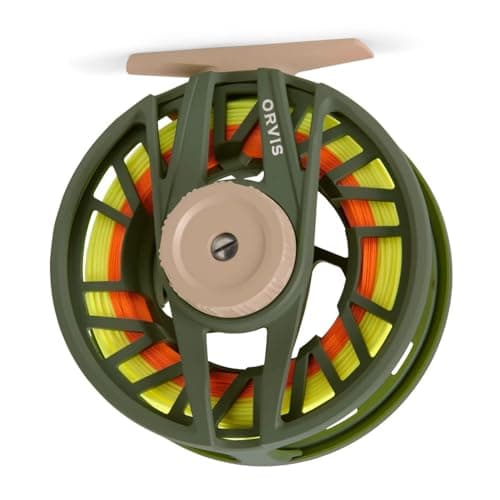
The default answer in this band. A large-arbor frame with a disc drag, from the one brand on this page you can walk into a shop and hand the reel back to. The large arbor matters in a practical way on moving water: it picks up line faster per handle turn, which is what you want when a trout runs downstream into a seam and you need to catch up. Orvis's mid-price position means you are paying some retail margin, and that margin is exactly the thing you are buying. The drag is good rather than sealed, which on a trout creek is a distinction without a difference.
Best for: Best overall under $200 — disc drag with retail support behind it - 2
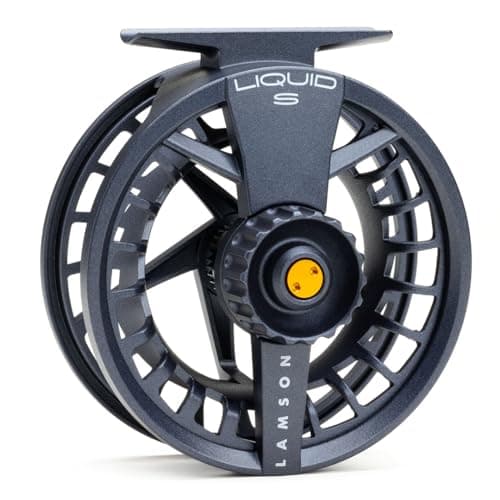
The pick if you fish light tippet and want the drag to be the part you trust. Lamson's sealed conical drag is the engineering story here: sealed means grit and water stay out, which is the actual failure mode for a reel that gets dunked in a gravel-bottomed creek, and conical means the start-up inertia is low, so the drag does not shock 6X on the first pull. The -3+ designation covers 2-weight to 4-weight, which is precisely the small-stream range and a size several makers skip. The trade is that it is the most expensive reel here.
Best for: Best drag in the band — sealed, and sized for light line weights - 3
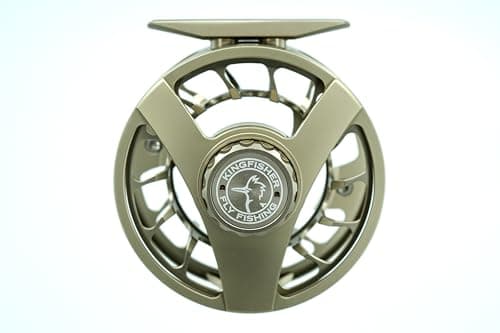
The pick that makes the strongest argument against spending the whole band. A large-arbor 5/6 reel sitting just under the hundred-dollar line, which means it does the two things a trout reel is for — hold line, give it back smoothly — for roughly two thirds of what the Orvis costs. Kingfisher is a smaller name than the two above it, so you get the hardware without the retail network. If you are pairing this with a 5-weight rod and your fishing is creeks rather than steelhead, this is where the curve flattens.
Best for: Best value in the band — large arbor, just under $100 - 4
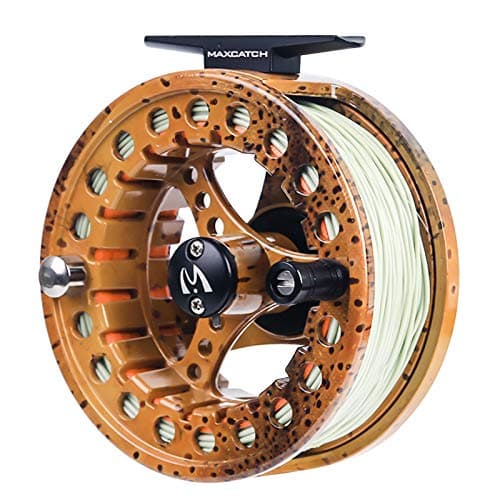
The pick if you do not want to spool a reel. It arrives with fly line and backing already on, which removes a job that is genuinely fiddly the first time and that a lot of beginners pay a shop to do. Large arbor, entry-level build, and the maths is worth noting: a pre-loaded reel at this price is often cheaper than a bare reel plus a line bought separately. What you give up is the ability to choose the line, and line choice matters more to casting than reel choice does — so this is a convenience buy rather than a performance one.
Best for: Best pre-loaded option — arrives with line and backing on it - 5
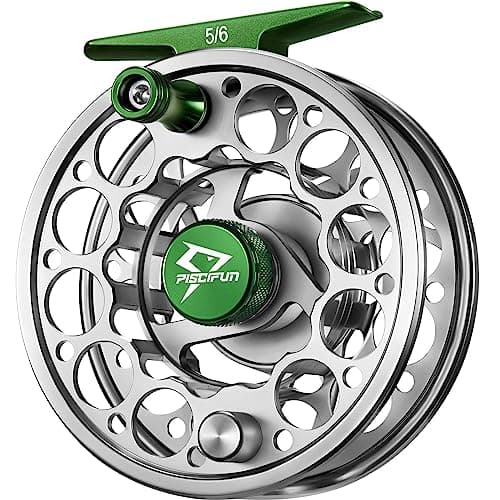
The cheapest pick on the page and the reel that makes the honest case for spending nothing like $200. It is CNC-machined aluminum rather than cast, which is the single spec that separates a reel that lasts from one that develops play, and it comes in sizes from 3/4 through 7/8 so it matches whatever rod you own. Piscifun sells direct, so there is no retail margin and no retail counter. On a creek, where no trout will ever test a drag, this reel does the same job as the one at the top of this page.
Best for: Budget pick — the cheapest machined reel here, in several sizes
| # | Product | Best for | Score | Price |
|---|---|---|---|---|
| 1 | Orvis Clearwater Fly Fishing Reel, Large-Arbor The default answer in this band. A large-arbor frame with a disc drag, from the one brand on this page you can walk into a shop and hand the reel back to. The large arbor matters in a practical way on moving water: it picks up line faster per handle turn, which is what you want when a trout runs downstream into a seam and you need to catch up. Orvis's mid-price position means you are paying some retail margin, and that margin is exactly the thing you are buying. The drag is good rather than sealed, which on a trout creek is a distinction without a difference. | Best overall under $200 — disc drag with retail support behind it | — | $149.00View on Amazon#ad |
| 2 | LAMSON Liquid -3+ S-Series Fly Reel, 2wt-4wt The pick if you fish light tippet and want the drag to be the part you trust. Lamson's sealed conical drag is the engineering story here: sealed means grit and water stay out, which is the actual failure mode for a reel that gets dunked in a gravel-bottomed creek, and conical means the start-up inertia is low, so the drag does not shock 6X on the first pull. The -3+ designation covers 2-weight to 4-weight, which is precisely the small-stream range and a size several makers skip. The trade is that it is the most expensive reel here. | Best drag in the band — sealed, and sized for light line weights | — | $159.99View on Amazon#ad |
| 3 | Kingfisher Big Blackfoot Large Arbor Fly Reel, 5/6 The pick that makes the strongest argument against spending the whole band. A large-arbor 5/6 reel sitting just under the hundred-dollar line, which means it does the two things a trout reel is for — hold line, give it back smoothly — for roughly two thirds of what the Orvis costs. Kingfisher is a smaller name than the two above it, so you get the hardware without the retail network. If you are pairing this with a 5-weight rod and your fishing is creeks rather than steelhead, this is where the curve flattens. | Best value in the band — large arbor, just under $100 | — | $99.95View on Amazon#ad |
| 4 | Maxcatch ECO Large Arbor Fly Reel, Pre-Loaded with Line The pick if you do not want to spool a reel. It arrives with fly line and backing already on, which removes a job that is genuinely fiddly the first time and that a lot of beginners pay a shop to do. Large arbor, entry-level build, and the maths is worth noting: a pre-loaded reel at this price is often cheaper than a bare reel plus a line bought separately. What you give up is the ability to choose the line, and line choice matters more to casting than reel choice does — so this is a convenience buy rather than a performance one. | Best pre-loaded option — arrives with line and backing on it | — | $42.99View on Amazon#ad |
| 5 | Piscifun Sword CNC-Machined Aluminum Fly Reel The cheapest pick on the page and the reel that makes the honest case for spending nothing like $200. It is CNC-machined aluminum rather than cast, which is the single spec that separates a reel that lasts from one that develops play, and it comes in sizes from 3/4 through 7/8 so it matches whatever rod you own. Piscifun sells direct, so there is no retail margin and no retail counter. On a creek, where no trout will ever test a drag, this reel does the same job as the one at the top of this page. | Budget pick — the cheapest machined reel here, in several sizes | — | $35.69View on Amazon#ad |
The best fly reel under $200 is the Orvis Clearwater large-arbor — a disc-drag reel that balances a 9-foot rod, picks line up quickly, and has a shop counter behind it if anything fails. It is for the angler who wants the reel to be the component they never think about again. The budget pick is the Piscifun Sword, the cheapest machined reel here and genuinely enough for creek trout. Prices come from our live retailer feed and are date-stamped under the comparison table — none are typed into this copy.
An unusual thing to say at the top of a page about a price band: three of these five sit nearer the floor than the ceiling, and that is the honest shape of this market for small-stream fishing. The band is worth understanding mostly so you can decide how little of it to use.
What $200 buys that $40 does not
Three things improve between a $40 reel and a $190 one: drag sealing, machining tolerance, and the company behind it. None of the three catches a trout. That is not a reason to buy cheap — it is a reason to know what you are buying.
| What improves | What it means | Who actually needs it |
|---|---|---|
| Sealed drag | Grit and water cannot reach the washers | Anglers who wade sandy or dusty water often |
| Machining tolerance | No play between spool and frame after two seasons | Everyone, eventually |
| Start-up inertia | The drag does not shock fine tippet on the first pull | Anglers fishing 6X to good fish |
| Warranty and support | A failed reel is a claim, not a replacement | Everyone |
| Weight and balance | A light reel balances a short rod properly | Small-stream anglers specifically |
| Drag range | Stopping power for strong fish | Nobody on a trout creek |
The last row is the one worth dwelling on. A creek trout will never run into your backing, which means drag range — the headline spec on most reels — is the spec you can safely ignore. What you cannot ignore is machining, because a cast frame develops play and a spool that wobbles against the frame will eventually trap line. The budget end of the market is covered in the best fly reel for the money, and the premium end in the best high-end fly reels.
What we have not done
Sealed drags, and who needs one
A sealed drag is a genuinely better piece of engineering, and most trout anglers will never notice. It is worth being specific about when it does matter, because "sealed" is the word doing most of the work in reel marketing at this price.
| Situation | Sealed drag matters? | Why |
|---|---|---|
| Small creek trout, 8 to 14 inches | No | You fight them off the reel seat with your hand |
| Good fish on 6X tippet | Yes | Low start-up inertia stops the tippet popping |
| Sandy or silty streambeds | Yes | Grit is what actually kills unsealed drags |
| You dunk the reel regularly | Yes | Water carries grit into the washers |
| Cold weather fishing | Somewhat | Sealed drags stay consistent when greased ones stiffen |
| Saltwater | Yes — but out of scope here | We do not cover saltwater fishing |
If your reel is not sealed, the fix is free: rinse it in clean fresh water after any trip where it touched sand or silt, and let it dry with the drag backed off. That single habit closes most of the real-world gap between a $50 reel and a $160 one. It is also the maintenance step almost nobody does, which is why unsealed reels have the reputation they do.
Arbor size and why it matters on a creek
A large arbor retrieves more line per turn of the handle, and it keeps the line in wider coils so it has less memory when you strip it off. Both of those are worth having, and the first one has a specific creek use that gets overlooked.
On moving water, a hooked trout very often runs downstream — and then you are not fighting a fish, you are trying to catch up with slack line. A large arbor is how you catch up. That is a more frequent event on a creek than any drag-tested run, which is why four of the five reels here are large-arbor and why we would choose arbor size over drag specification if forced to pick one.
The counter-argument is weight and balance. A large-arbor reel is physically bigger, and on a 7-foot-6 3-weight that can tip the balance point forward and make a light rod feel heavy in the hand. If you fish very short light rods, size down and accept the slower pick-up — the light-line options are in the best fly reels for trout and brand-by-brand support is compared in the best fly reel brands.
The five compared
| Reel | Drag | Arbor | Buy it if |
|---|---|---|---|
| Orvis Clearwater | Disc | Large | You want retail support and no decisions |
| Lamson Liquid -3+ | Sealed conical | Standard | You fish light tippet and want the best drag |
| Kingfisher Big Blackfoot | Disc | Large | You want large-arbor performance under $100 |
| Maxcatch ECO large arbor | Entry disc | Large | You do not want to spool a reel |
| Piscifun Sword | Disc | Large | You want machined aluminum for the least money |
The page splits on one question: do you fish fine tippet to fish worth losing? If yes, the Lamson's sealed conical drag and low start-up inertia is a real advantage and worth the top of the band. If no — if your fishing is 10-inch creek trout on 5X — then the Kingfisher or the Piscifun does the same job and the difference goes into your rod or your boots.
When to spend the money elsewhere
The reel is the lowest-leverage purchase in a fly setup, and on small water it is not close. If you have a fixed budget and you are weighing the reel against anything else on this list, the reel loses.
| If you have $150 spare | Spend it on | Because |
|---|---|---|
| and a $40 reel | A better fly line | The rod casts the line, not the reel |
| and a cheap rod | A rod with a warranty | The rod is what breaks |
| and no waders | Waders and boots | Being cold ends trips early |
| and no net | A net | It is the difference between released and dropped |
| and a worn line | A new line | Lines wear out years before people replace them |
| and all of the above | Then buy the reel | This is the correct order |
That is not an argument against this band — it is an argument about sequence. A good reel is a pleasure to own and it will outlast two rods. It just should not be the thing you upgrade first. The line decision is in the best fly line, the rod bands are in under $200 and under $500, and if you would rather buy a matched set than assemble one, the outfits are in the best fly fishing combos under $500.
The picks in detail
Orvis Clearwater Fly Fishing Reel, Large-Arbor
Best for: Best overall under $200 — disc drag with retail support behind it
The default answer in this band. A large-arbor frame with a disc drag, from the one brand on this page you can walk into a shop and hand the reel back to. The large arbor matters in a practical way on moving water: it picks up line faster per handle turn, which is what you want when a trout runs downstream into a seam and you need to catch up. Orvis's mid-price position means you are paying some retail margin, and that margin is exactly the thing you are buying. The drag is good rather than sealed, which on a trout creek is a distinction without a difference.
- Drag
- Disc drag
- Arbor
- Large
- Brand position
- Mid-price, full retail support
- Retail stores and a long warranty behind it
- Large arbor picks line up fast when a fish runs
- Sits comfortably below the band ceiling
- Drag is not sealed — rinse it after dusty or sandy trips
- You pay retail margin you may never use
LAMSON Liquid -3+ S-Series Fly Reel, 2wt-4wt
Best for: Best drag in the band — sealed, and sized for light line weights
The pick if you fish light tippet and want the drag to be the part you trust. Lamson's sealed conical drag is the engineering story here: sealed means grit and water stay out, which is the actual failure mode for a reel that gets dunked in a gravel-bottomed creek, and conical means the start-up inertia is low, so the drag does not shock 6X on the first pull. The -3+ designation covers 2-weight to 4-weight, which is precisely the small-stream range and a size several makers skip. The trade is that it is the most expensive reel here.
- Drag
- Sealed conical
- Sizes
- 2wt to 4wt
- Brand position
- Engineering-led, mid to premium
- Sealed drag — grit and water stay out
- Low start-up inertia protects fine tippet
- Sized for 2wt to 4wt, which most makers skip
- Most expensive pick on the page
- No use for a sealed drag if you only chase 10-inch creek trout
Kingfisher Big Blackfoot Large Arbor Fly Reel, 5/6
Best for: Best value in the band — large arbor, just under $100
The pick that makes the strongest argument against spending the whole band. A large-arbor 5/6 reel sitting just under the hundred-dollar line, which means it does the two things a trout reel is for — hold line, give it back smoothly — for roughly two thirds of what the Orvis costs. Kingfisher is a smaller name than the two above it, so you get the hardware without the retail network. If you are pairing this with a 5-weight rod and your fishing is creeks rather than steelhead, this is where the curve flattens.
- Size
- 5/6
- Arbor
- Large
- Position
- Just under $100
- Large arbor at roughly two thirds the price of the Orvis
- Correct size for a 5-weight trout setup
- Nothing on it you will not use on a creek
- Smaller brand — thinner support and resale
- Only a 5/6 size, so no light-line option
Maxcatch ECO Large Arbor Fly Reel, Pre-Loaded with Line
Best for: Best pre-loaded option — arrives with line and backing on it
The pick if you do not want to spool a reel. It arrives with fly line and backing already on, which removes a job that is genuinely fiddly the first time and that a lot of beginners pay a shop to do. Large arbor, entry-level build, and the maths is worth noting: a pre-loaded reel at this price is often cheaper than a bare reel plus a line bought separately. What you give up is the ability to choose the line, and line choice matters more to casting than reel choice does — so this is a convenience buy rather than a performance one.
- Arbor
- Large
- Included
- Pre-loaded line and backing
- Brand position
- Entry
- Line and backing already on — nothing to spool
- Often cheaper than a bare reel plus a separate line
- Large arbor despite the entry price
- You do not get to choose the line, which matters for casting
- Entry-level drag and build
Piscifun Sword CNC-Machined Aluminum Fly Reel
Best for: Budget pick — the cheapest machined reel here, in several sizes
The cheapest pick on the page and the reel that makes the honest case for spending nothing like $200. It is CNC-machined aluminum rather than cast, which is the single spec that separates a reel that lasts from one that develops play, and it comes in sizes from 3/4 through 7/8 so it matches whatever rod you own. Piscifun sells direct, so there is no retail margin and no retail counter. On a creek, where no trout will ever test a drag, this reel does the same job as the one at the top of this page.
- Build
- CNC-machined aluminum
- Drag
- Disc
- Sizes
- 3/4 through 7/8
- Cheapest pick here — a fraction of the band ceiling
- Machined rather than cast, which is the spec that matters
- Size range covers light creek rods to 8-weights
- Direct-to-consumer brand with no retail support
- Drag is adequate rather than refined
Prices shown are from Amazon as of November 21, 2026 and change often — the button always goes to the current listing. Some links may earn us a commission at no extra cost to you. How this works.
Frequently asked questions
Is a $200 fly reel worth it for trout fishing?
For creek trout, mostly not — and it is worth saying plainly. At this price you gain a sealed drag, tighter machining and a real warranty, but a stream trout will never test a drag and you fight most of them with line held against the rod. A machined reel at a fraction of the price does the same job. Buy up the band if you fish fine tippet to good fish, or if your water is sandy enough to kill unsealed drags.
Do I need a sealed drag on a fly reel?
Only in specific cases: if you fish 6X tippet to fish worth losing, if your streambeds are sandy or silty, or if you dunk the reel regularly. Grit, not use, is what kills an unsealed drag. If you do not have a sealed drag, rinsing the reel in clean fresh water after a dusty trip and drying it with the drag backed off closes most of the real-world gap.
Large arbor or standard arbor for creek fishing?
Large arbor, in most cases. It picks up more line per handle turn, which matters because a hooked creek trout usually runs downstream and leaves you chasing slack line — a far more common event than any drag-tested run. The exception is a very short light rod, where a big reel can tip the balance point forward and make the rod feel heavy.
What size fly reel do I need for a 5 weight rod?
A 5/6 size, which is how most makers label it. For a 3-weight or 4-weight rod you want a 3/4 size instead — lighter, so it balances a shorter rod properly. Matching the reel size to the rod matters more for balance than for capacity, because you will not use the backing on small water.
Should I buy a reel with line already on it?
It is a reasonable convenience buy for a first setup, and a pre-loaded reel is often cheaper than a bare reel plus a line bought separately. What you give up is choosing the line, and line choice affects your casting far more than reel choice does. If you know what line you want, buy the reel bare.
What should I upgrade before the reel?
The fly line, then the rod, then waders and boots, then a net. The rod casts the line, so a worn or mismatched line makes a good rod feel broken, and it costs a fraction of a reel. The reel is the lowest-leverage purchase in a fly setup on small water — it is a pleasure to own and it will outlast two rods, but it should not be first in the queue.
Sources
Keep reading
Not sure where to start?
The beginner gear guide walks you through exactly what a new stream angler needs — the six essentials first, nice-to-haves later, with one safe-default pick per category.