Fly Rods · Roundup
The Best Fly Reels for Trout
On a creek the reel is mostly a line holder — but it has to be the right size for the rod, hold the right line, and not jerk when a surprise sixteen-incher runs. Sizing first, then picks.
Disclosure: Creek Cover is reader-supported. If you buy through our links we may earn a commission, at no extra cost to you. It never changes which pick we tell a new angler to start with. Full disclosure.
Quick picks at a glance
Tap a pick to read the full write-up, or the price button to check it on Amazon.
- 1
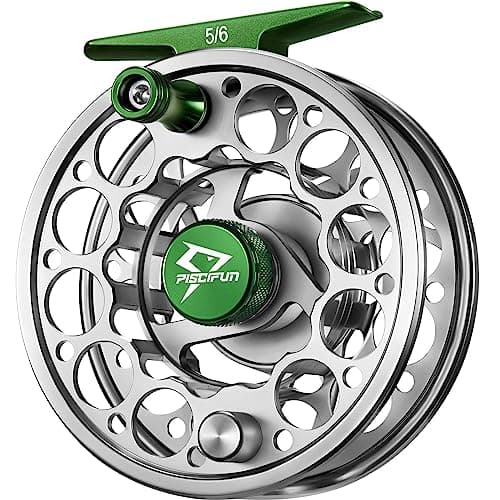
Machined aluminum construction at a die-cast price, with a smooth drag and a large-arbor spool. Pick the 5/6 for a 5-weight rod or the 3/4 for a small-stream 3-weight, and the reel question is settled for years.
Best for: Best fly reel for trout overall9.1 - 2
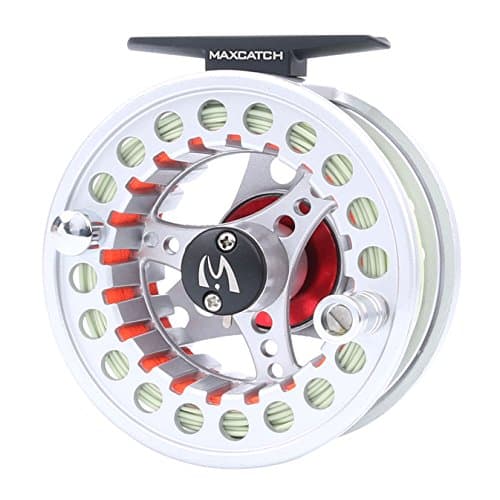
The sensible match for a 3-weight creek rod: an aluminum-bodied reel sized correctly for a light rod and pre-loaded with line, backing and leader, so it arrives ready to fish. Balance matters more on a light rod than anywhere else.
Best for: Best for a 3-weight small-stream rod8.9 - 3
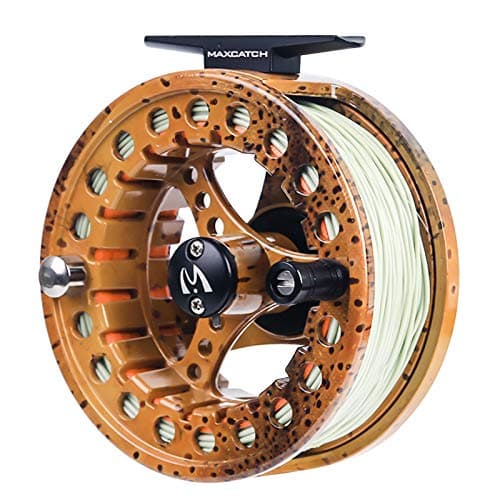
The same idea in the 5/6 size that pairs with a standard 5-weight trout rod. If you bought a bare rod and want to be fishing this weekend without learning to spool backing, this is the shortcut.
Best for: Best ready-to-fish 5/68.7 - 4
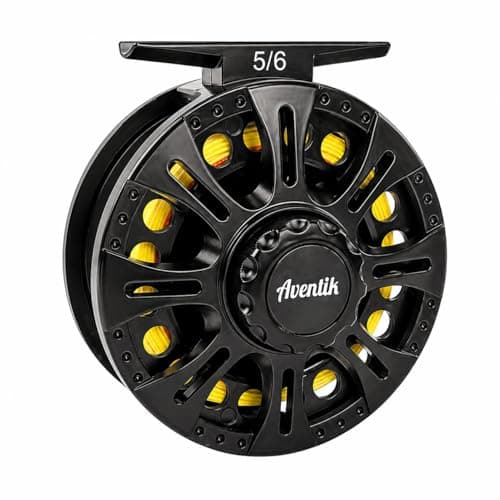
The lowest-cost route to a complete, line-loaded 5/6 reel. On creek trout the drag never gets tested hard, so the saving is real rather than a false economy — just do not expect it to feel like a machined reel.
Best for: Cheapest complete option8.3 - 5
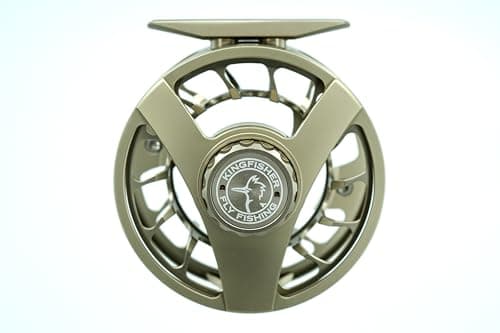
The step up: a better-machined large-arbor 5/6 with a drag you can actually set rather than merely tighten. The reel to buy if you have outgrown a kit reel and want the last one you need for trout.
Best for: Best upgrade reel9.0
| # | Product | Best for | Score | Price |
|---|---|---|---|---|
| 1 | Piscifun Sword CNC-Machined Aluminum Fly Reel Machined aluminum construction at a die-cast price, with a smooth drag and a large-arbor spool. Pick the 5/6 for a 5-weight rod or the 3/4 for a small-stream 3-weight, and the reel question is settled for years. | Best fly reel for trout overall | 9.1 | $41.99View on Amazon#ad |
| 2 | Maxcatch ECO Pre-Loaded Fly Reel 3/4wt, Aluminum Body The sensible match for a 3-weight creek rod: an aluminum-bodied reel sized correctly for a light rod and pre-loaded with line, backing and leader, so it arrives ready to fish. Balance matters more on a light rod than anywhere else. | Best for a 3-weight small-stream rod | 8.9 | $31.99View on Amazon#ad |
| 3 | Maxcatch ECO Large Arbor Fly Reel, Pre-Loaded with Line The same idea in the 5/6 size that pairs with a standard 5-weight trout rod. If you bought a bare rod and want to be fishing this weekend without learning to spool backing, this is the shortcut. | Best ready-to-fish 5/6 | 8.7 | $39.99View on Amazon#ad |
| 4 | Aventik Z Classic III Large Arbor Fly Reel 5/6 with Line The lowest-cost route to a complete, line-loaded 5/6 reel. On creek trout the drag never gets tested hard, so the saving is real rather than a false economy — just do not expect it to feel like a machined reel. | Cheapest complete option | 8.3 | $32.79View on Amazon#ad |
| 5 | Kingfisher Big Blackfoot Large Arbor Fly Reel, 5/6 The step up: a better-machined large-arbor 5/6 with a drag you can actually set rather than merely tighten. The reel to buy if you have outgrown a kit reel and want the last one you need for trout. | Best upgrade reel | 9.0 | $99.95View on Amazon#ad |
Buy the reel size that matches your rod weight: a 3/4 reel for a 3- or 4-weight rod, a 5/6 for a 5- or 6-weight. For most trout anglers that means the Piscifun Sword in 5/6; for a small-stream 3-weight, the Maxcatch ECO 3/4, which arrives with line already on it. Trout in creeks do not test a drag, so the reel's job is to hold the right line and balance the rod — and both of those are decided by size, not by price.
Reel size: match the rod, not the fish
Fly reels are sold in weight ranges — 2/3, 3/4, 5/6, 7/8 — and those numbers refer to the line weight the spool is built to hold, which in turn matches the rod. It is not about the size of fish.
| Rod weight | Reel size | Typical use |
|---|---|---|
| 2wt-3wt | 2/3 or 3/4 | Small brushy creeks, brook trout, fine tippet |
| 4wt | 3/4 or 4/5 | Small streams with a bit of wind or bigger flies |
| 5wt | 5/6 | The all-round trout size; creeks and rivers both |
| 6wt | 5/6 or 6/7 | Streamers, bigger water, wind |
Get this wrong and the rod feels wrong. A 7/8 reel on a 4-weight rod is a dumbbell on a wand — tip-light, awkward to cast, tiring in an hour. A 2/3 reel on a 6-weight cannot hold the line plus backing. If you do not know your rod's weight, it is printed just above the handle.
If you are still choosing the rod, start there instead: our fly rod roundup and 4-weight vs 5-weight comparison settle that decision, and the reel follows from it.
How much drag does a trout need?
Less than any reel on this page provides. A ten-inch creek trout will never pull line against a drag. On small water, the fish is landed by stripping line in by hand with the rod doing the work, and the drag setting is irrelevant for the great majority of fish you catch.
What drag is actually for is the surprise. Once or twice a season something considerably larger than expected takes the fly, turns, and runs. What you want then is not strength but smoothness — a drag that starts moving without a jolt, because the jolt is what breaks 5X tippet. Any of these reels does that adequately; the more expensive ones do it more consistently when wet and cold.
Click-and-pawl vs disc drag, briefly
Large arbor vs standard arbor
The arbor is the center spindle the line winds onto. Large-arbor reels have a fat center and a wide shallow spool. Standard-arbor reels have a thin center and a deeper spool.
Large arbor wins on two counts. You retrieve more line per turn of the handle, which matters when a fish runs toward you and you need to catch up. And line stored on a wide radius keeps less coil memory, so it comes off straight instead of in springs — a real difference on the first cast of the morning.
Standard arbor holds more backing for the same size. That matters for saltwater and salmon, and not at all for trout, where you will never see your backing. Buy large arbor.
Balance, and why it matters on a 3-weight
A fly rod should balance roughly at the top of the cork grip with the reel fitted. Hold the assembled rod lightly with one finger under the grip just above the reel seat — it should sit near level rather than nosing up or down.
Light rods are fussier than heavy ones. A 3-weight rod weighs so little that reel weight dominates the balance, which is why a 3/4 reel on a 3-weight is not just about line capacity — a 5/6 reel on the same rod makes it feel like a different, worse rod. On a 5-weight you have more latitude.
This is the main argument for buying an outfit. A matched combo has the balance already solved. Our complete outfits guide covers those, and the starter kit guide compares buying a kit against assembling pieces.
Pre-loaded or spool it yourself
Pre-loaded reels arrive with backing, fly line and often a leader already fitted. For a first reel that is worth real money — spooling backing under correct tension, tying the backing-to-line connection and getting the line on the right way round are three jobs that are easy to do badly.
Spool it yourself when the line is the point. The line included on a pre-loaded reel is entry-level, and line does more for how a rod casts than the reel ever will. If you are buying a reel to pair with good line, buy the reel bare and read our fly line guide — that is where the upgrade actually lives.
Where the money should go
On small trout water the honest order is rod, then line, then reel. A good line on a cheap rod outcasts a bad line on a good rod, and a $35 machined reel does the reel's entire job on a creek. Spend $40 on the reel, put the difference into line, and the setup casts better than the reverse allocation at the same total price.
The exception is if you will also fish bigger water for bigger fish, where a genuinely good sealed drag starts to earn its keep. Our general fly reel guide covers arbor sizes and when an upgrade is worth it in more depth; this page is the trout-sized subset of that question. And if you are weighing a fly setup against spinning tackle for small streams, fly fishing vs spinning is the honest comparison, with ultralight spinning reels as the other route.
And if the next reel is meant to be the last one, the step up to a sealed drag and a machined frame is laid out in high quality fly reels — including an honest account of what it does not change on small water.
One fishery where the drag genuinely matters. Everything above assumes trout, where a reel is a line holder with a brake. Tributary steelhead run into the backing, which changes the reel requirement completely — the rod and reel pairing for that is in the steelhead rod roundup.
If you would rather choose a brand than a model. The best fly reel brands guide compares Orvis, Redington, Lamson, Sage, Piscifun and Maxcatch on drag type, machining and warranty.
The picks in detail
Piscifun Sword CNC-Machined Aluminum Fly Reel
9.1/10Best for: Best fly reel for trout overall
Machined aluminum construction at a die-cast price, with a smooth drag and a large-arbor spool. Pick the 5/6 for a 5-weight rod or the 3/4 for a small-stream 3-weight, and the reel question is settled for years.
- Construction
- CNC-machined aluminum alloy
- Arbor
- Large
- Sizes
- 3/4, 5/6 and up
- Best for
- Any trout rod 3wt to 6wt
- Machined, not die-cast, at this price
- Sizes that actually match trout rods
- Drag is smooth from the start
- Line and backing bought separately
- Heavier than premium machined reels
Maxcatch ECO Pre-Loaded Fly Reel 3/4wt, Aluminum Body
8.9/10Best for: Best for a 3-weight small-stream rod
The sensible match for a 3-weight creek rod: an aluminum-bodied reel sized correctly for a light rod and pre-loaded with line, backing and leader, so it arrives ready to fish. Balance matters more on a light rod than anywhere else.
- Size
- 3/4 wt
- Body
- Aluminum
- Includes
- Line, backing, leader fitted
- Correct size for a 3wt rod
- Arrives loaded — no spooling
- Keeps a light rod balanced
- Included line is entry level
- Too small for a 6-weight
Maxcatch ECO Large Arbor Fly Reel, Pre-Loaded with Line
8.7/10Best for: Best ready-to-fish 5/6
The same idea in the 5/6 size that pairs with a standard 5-weight trout rod. If you bought a bare rod and want to be fishing this weekend without learning to spool backing, this is the shortcut.
- Size
- 5/6 wt
- Arbor
- Large
- Includes
- Line and backing fitted
- No spooling required
- Right size for a 5wt
- Large arbor picks line up quickly
- Line is the first upgrade
- Finish is plainer than the Sword
Aventik Z Classic III Large Arbor Fly Reel 5/6 with Line
8.3/10Best for: Cheapest complete option
The lowest-cost route to a complete, line-loaded 5/6 reel. On creek trout the drag never gets tested hard, so the saving is real rather than a false economy — just do not expect it to feel like a machined reel.
- Size
- 5/6 wt
- Arbor
- Large
- Includes
- Line fitted
- Lowest price here
- Comes with line on it
- Fine for small trout
- Lightest-duty build on this page
- Drag adjustment is coarse
Kingfisher Big Blackfoot Large Arbor Fly Reel, 5/6
9.0/10Best for: Best upgrade reel
The step up: a better-machined large-arbor 5/6 with a drag you can actually set rather than merely tighten. The reel to buy if you have outgrown a kit reel and want the last one you need for trout.
- Size
- 5/6 wt
- Arbor
- Large
- Best for
- Anglers upgrading from a kit reel
- Noticeably better machining and finish
- Usable drag range
- Holds its value
- Three times the budget pick
- Line bought separately
Prices shown are from Amazon as of October 20, 2026 and change often — the button always goes to the current listing. Some links may earn us a commission at no extra cost to you. How this works.
Frequently asked questions
What size fly reel do I need for trout?
Match the reel to your rod weight: a 3/4 reel for a 3- or 4-weight rod, a 5/6 for a 5- or 6-weight. The numbers refer to the line weight the spool holds, not the size of the fish. A 5/6 covers the all-round 5-weight trout rod most anglers own.
Does a trout fly reel need a good drag?
Not a strong one. Creek and stream trout are landed by hand-stripping line and rarely pull against the drag at all. What matters is smooth start-up so that an unexpectedly large fish does not snap 5X tippet with a jolt, and every reel at these prices does that adequately.
Is a large arbor fly reel better for trout?
Yes. A large arbor retrieves more line per handle turn, which helps when a fish runs toward you, and storing line on a wide radius leaves less coil memory so it casts straighter. The extra backing capacity of a standard arbor is irrelevant for trout.
Should I buy a fly reel already loaded with line?
For a first reel, yes - spooling backing under tension and connecting it to the fly line correctly are easy jobs to get wrong, and a pre-loaded reel arrives fishable. If you are deliberately pairing the reel with better line, buy it bare, because line affects casting far more than the reel does.
Sources
Keep reading
Not sure where to start?
The beginner gear guide walks you through exactly what a new stream angler needs — the six essentials first, nice-to-haves later, with one safe-default pick per category.