Flies & Lures · Roundup
The Best Trout Spoons
A spoon is the lure that flashes without spinning, which means it casts further than a spinner of the same weight and does not twist your line. On a creek it earns its place in two situations: wind, and the deep pool a spinner swims straight over.
Disclosure: Creek Cover is reader-supported. If you buy through our links we may earn a commission, at no extra cost to you. It never changes which pick we tell a new angler to start with. Full disclosure.
Quick picks at a glance
Tap a pick to read the full write-up, or the price button to check it on Amazon.
- 1
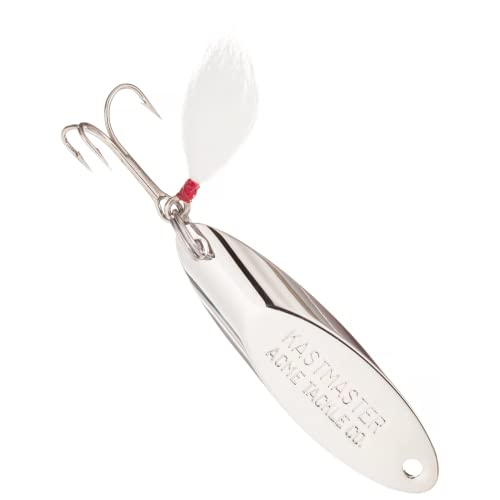
The best trout spoon on this page and the cheapest, which does not happen often enough to pass up. A Kastmaster is a dense machined spoon with a shape that keeps it stable in the air, and the practical consequence is that it casts further and more accurately for its weight than a spinner or a crankbait. That matters in two specific creek situations: a headwind that kills a light spinner, and a long pool where the fish are at the far end. The buck tail teaser dressed on the hook adds a target and some movement on the drop. At 1/8 ounce it is in the right weight class for small water.
Best for: Best overall, and the budget pick — the casting spoon for wind and distance - 2
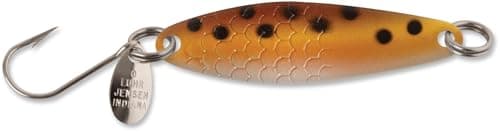
The pick for the opposite problem to the Kastmaster. A Needlefish is thin and light for its length, which means it does not sink like a stone — it flutters down, rolling and flashing on the drop, and that falling action is what triggers a trout that has been following a fast lure without committing. In a deep slow creek pool, where a dense spoon reaches bottom before it has done anything interesting, this is the better tool. The Brown Trout pattern over a brass back is a natural-plus-flash combination that works in clearer water than a bright painted lure.
Best for: Best thin flutter spoon — slow deep pools, and fish that follow without taking - 3
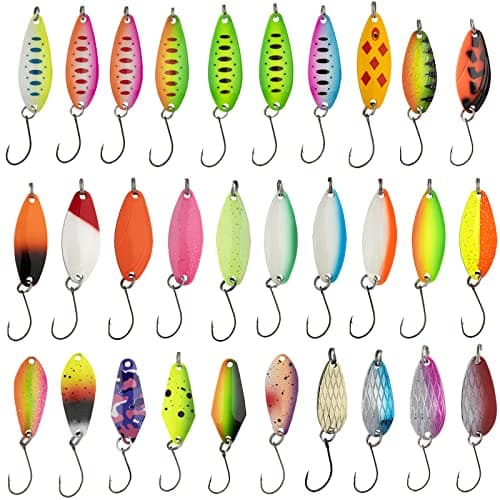
The pick if you do not yet know which spoon your water rewards, which is most people reading this. Thirty casting spoons across a range of sizes and finishes is a cheap way to find out by experiment rather than by reading, and spoons are a lure class where color genuinely changes the result more than it does with, say, a nymph. The honest caveat is the one that applies to every unbranded assortment: the hooks and split rings vary, so check the point against a thumbnail and the ring for a gap before you tie one on. Expect to upgrade a few trebles.
Best for: Best way to learn what your creek wants — thirty spoons across sizes and colors
| # | Product | Best for | Score | Price |
|---|---|---|---|---|
| 1 | Acme Kastmaster Lure with Buck Tail Teaser, 1/8 oz The best trout spoon on this page and the cheapest, which does not happen often enough to pass up. A Kastmaster is a dense machined spoon with a shape that keeps it stable in the air, and the practical consequence is that it casts further and more accurately for its weight than a spinner or a crankbait. That matters in two specific creek situations: a headwind that kills a light spinner, and a long pool where the fish are at the far end. The buck tail teaser dressed on the hook adds a target and some movement on the drop. At 1/8 ounce it is in the right weight class for small water. | Best overall, and the budget pick — the casting spoon for wind and distance | — | $8.99View on Amazon#ad |
| 2 | Luhr Jensen Needlefish Spoon, Size 2, Brown Trout / Brass Back The pick for the opposite problem to the Kastmaster. A Needlefish is thin and light for its length, which means it does not sink like a stone — it flutters down, rolling and flashing on the drop, and that falling action is what triggers a trout that has been following a fast lure without committing. In a deep slow creek pool, where a dense spoon reaches bottom before it has done anything interesting, this is the better tool. The Brown Trout pattern over a brass back is a natural-plus-flash combination that works in clearer water than a bright painted lure. | Best thin flutter spoon — slow deep pools, and fish that follow without taking | — | $9.52View on Amazon#ad |
| 3 | QualyQualy Fishing Spoon Assortment, 30-Piece Trout Lure Set The pick if you do not yet know which spoon your water rewards, which is most people reading this. Thirty casting spoons across a range of sizes and finishes is a cheap way to find out by experiment rather than by reading, and spoons are a lure class where color genuinely changes the result more than it does with, say, a nymph. The honest caveat is the one that applies to every unbranded assortment: the hooks and split rings vary, so check the point against a thumbnail and the ring for a gap before you tie one on. Expect to upgrade a few trebles. | Best way to learn what your creek wants — thirty spoons across sizes and colors | — | $23.74View on Amazon#ad |
The best trout spoon is the Acme Kastmaster with the buck tail teaser in 1/8 ounce — it casts further for its weight than anything else here, which is exactly what you want in wind or across a long pool. It is also the cheapest pick, so it doubles as the budget pick. If your water is deep and slow rather than windy, the Luhr Jensen Needlefish flutters on the drop and converts followers into takes. Prices come from our live retailer feed and are date-stamped under the comparison table — none are typed into this copy.
A spoon is not the first lure a creek angler should buy; a small spinner is. A spoon is the second one, and it earns the slot by doing two things a spinner cannot — cutting through wind and fluttering on a slow fall in deep water.
What a spoon does that a spinner does not
A spinner has a blade that rotates around a shaft. A spoon is a single curved piece of metal that wobbles and flashes without spinning. That one difference produces four practical consequences.
| Spoon | Inline spinner | |
|---|---|---|
| Casting distance for weight | Further — dense and aerodynamic | Shorter — the blade catches air |
| Line twist | Almost none | Real, and it builds up over a session |
| Action at very slow speed | Still wobbling and flashing | Blade stops turning |
| Action on the drop | Flutters and rolls | Falls fairly dead |
| Vibration a fish can feel | Less | More — the blade thumps |
| Shallow water | Sinks fast, snags | Easier to keep high |
The two rows worth buying a spoon for are casting distance and action on the drop. Everything else on that table is a draw or a point to the spinner, which is why spinners remain the default creek lure — the field is in the best trout spinners, and the general lure decision is in the best creek fishing lures. A spoon is the specialist you add when wind or depth beats your spinner.
What we have not done
Thick or thin: the only spec that matters
Spoons divide into thick casting spoons and thin flutter spoons, and the two behave so differently that calling them the same lure is nearly misleading. If you take one thing from this page, take this distinction — it decides which spoon belongs in which pool.
| Thick casting spoon | Thin flutter spoon | |
|---|---|---|
| Example here | Acme Kastmaster | Luhr Jensen Needlefish |
| Casting | Long and accurate, cuts wind | Short, planes in the air |
| Sink rate | Fast — gets down quickly | Slow — hangs in the water column |
| On the drop | Drops with a tight wobble | Rolls, flashes, flutters |
| Best water | Wind, current, long pools | Slow deep pools, clear water |
| Best retrieve | Steady, moderate speed | Slow, with pauses |
Own one of each and the choice makes itself at the water. Wind in your face or a pool you cannot reach: the thick spoon. A deep green pool with fish you can see following and refusing: the thin one, retrieved slowly with pauses so it drops and flashes. That is the entire decision, and it is more useful than any color chart.
Size and weight for creek water
Nearly every spoon sold is too heavy for a small creek, because most spoons are sold to lake and river anglers. Buying the wrong weight is the most common reason a spoon snags all afternoon and catches nothing.
| Weight | Water it suits | What happens if you misapply it |
|---|---|---|
| 1/12 to 1/8 oz | Creeks, small streams, shallow pools | Will not cast into real wind |
| 1/4 oz | Bigger streams, deep pools, wind | Drags bottom and snags in a creek |
| 3/8 oz | Rivers and lakes | Wrong tool for small water entirely |
| 1/2 oz and up | Trolling, big water | Not a stream lure |
If you fish one creek and buy one weight, buy 1/8 ounce. That is the weight that casts far enough to be useful and still fishes above the rocks. The exception is a deep plunge pool below a falls, where a 1/4 ounce spoon gets down to fish that a light one never reaches. On color: start with silver in clear water and brass or gold in stained water, and treat everything beyond that as experiment — which is the argument for the assortment. Size logic for lures generally is in the best trout lures.
The three compared
| Spoon | Type | Best water | Buy it if |
|---|---|---|---|
| Acme Kastmaster, 1/8 oz | Thick casting spoon | Wind, current, long pools | You own one spoon |
| Luhr Jensen Needlefish, size 2 | Thin flutter spoon | Slow deep clear pools | Fish follow and refuse |
| QualyQualy 30-piece assortment | Mixed casting spoons | Anywhere — it is for learning | You do not know what your creek wants |
Two single spoons and one assortment, which maps onto how people actually buy lures. If you know your water, buy the specific spoon for it. If you do not, thirty spoons and a season of experiment teaches you more than any page can — then you buy the two singles to replace the ones that worked.
How to fish a spoon on a creek
Cast across and slightly down, and let the current do half the work. A spoon fished straight upstream has to be retrieved fast to keep its action, and fast is usually wrong. The across-and-down swing keeps steady tension on the spoon so it wobbles at walking pace.
| Water | Cast | Retrieve | Weight |
|---|---|---|---|
| Long pool, wind in your face | Straight down the pool | Steady, moderate | 1/8 oz thick spoon |
| Deep slow pool | Across, let it sink | Slow with pauses so it flutters | Thin flutter spoon |
| Plunge pool under a falls | Into the white water | Let it drop, then lift | 1/4 oz thick spoon |
| Undercut bank | Tight to the bank, downstream | Swing it along the seam | 1/8 oz |
| Riffle above a pool | Across the riffle | Steady — the current adds action | 1/8 oz |
Pinch the barbs and change the trebles.Spoons come with treble hooks, and a treble in a small trout's mouth does real damage if you intend to release it — a single hook on the split ring catches nearly as well and releases cleanly. That change also reduces snags, which on a rocky creek is the difference between fishing and retrieving. The tackle this assumes is an ultralight rod and light line: the rods are in the best ultralight spinning rods and the line in the best line for trout fishing.
Why there are three picks
Three spoons rather than five, because three is how many we can recommend from real listings with a live price right now. Spoons are a smaller category than spinners or soft plastics for trout, and the sizes that suit small water are a minority within that. We would rather publish three real picks than pad a list with lures we cannot price or with a fourth entry in a size no creek angler should buy.
The practical consequence for you: the assortment is doing more work on this page than it would on a bigger one. Thirty spoons across sizes and finishes is genuinely the most efficient way into this lure class, and the two singles are the proven shapes to settle on afterwards. If a spoon is not earning its place in your box, the alternatives for small water are jigs and spinners — in the best trout jigs and the best trout spinners — and the flies-against-lures question is settled in flies vs lures for creek trout.
The picks in detail
Acme Kastmaster Lure with Buck Tail Teaser, 1/8 oz
Best for: Best overall, and the budget pick — the casting spoon for wind and distance
The best trout spoon on this page and the cheapest, which does not happen often enough to pass up. A Kastmaster is a dense machined spoon with a shape that keeps it stable in the air, and the practical consequence is that it casts further and more accurately for its weight than a spinner or a crankbait. That matters in two specific creek situations: a headwind that kills a light spinner, and a long pool where the fish are at the far end. The buck tail teaser dressed on the hook adds a target and some movement on the drop. At 1/8 ounce it is in the right weight class for small water.
- Type
- Casting spoon, 1/8 oz
- Addition
- Buck tail teaser on the hook
- Strength
- Casting distance for its size
- Casts further than anything else here for its weight
- Cheapest pick on the page
- Dressed hook gives trout a target on the drop
- Dense body sinks fast — snags in very shallow water
- Single color and size per pack
Luhr Jensen Needlefish Spoon, Size 2, Brown Trout / Brass Back
Best for: Best thin flutter spoon — slow deep pools, and fish that follow without taking
The pick for the opposite problem to the Kastmaster. A Needlefish is thin and light for its length, which means it does not sink like a stone — it flutters down, rolling and flashing on the drop, and that falling action is what triggers a trout that has been following a fast lure without committing. In a deep slow creek pool, where a dense spoon reaches bottom before it has done anything interesting, this is the better tool. The Brown Trout pattern over a brass back is a natural-plus-flash combination that works in clearer water than a bright painted lure.
- Type
- Thin flutter spoon
- Size
- Size 2
- Fishes
- Slow water, on the drop
- Flutters and rolls on the drop rather than dropping dead
- Converts followers into takes in slow pools
- Natural pattern suits clear creek water
- Light and thin, so it casts poorly into wind
- Needs slower water to show its action
QualyQualy Fishing Spoon Assortment, 30-Piece Trout Lure Set
Best for: Best way to learn what your creek wants — thirty spoons across sizes and colors
The pick if you do not yet know which spoon your water rewards, which is most people reading this. Thirty casting spoons across a range of sizes and finishes is a cheap way to find out by experiment rather than by reading, and spoons are a lure class where color genuinely changes the result more than it does with, say, a nymph. The honest caveat is the one that applies to every unbranded assortment: the hooks and split rings vary, so check the point against a thumbnail and the ring for a gap before you tie one on. Expect to upgrade a few trebles.
- Count
- 30 pieces
- Type
- Casting spoons
- Best for
- Covering sizes and finishes cheaply
- Thirty spoons — enough to experiment and to lose some
- Covers the color range that actually changes results
- Cheapest cost per lure on the page
- Hook and split-ring quality varies piece to piece
- Sizes include some too heavy for a small creek
Prices shown are from Amazon as of November 21, 2026 and change often — the button always goes to the current listing. Some links may earn us a commission at no extra cost to you. How this works.
Frequently asked questions
What is the best trout spoon?
An Acme Kastmaster in 1/8 ounce, for most creek and small-stream fishing. It casts further and more accurately for its weight than any other trout lure in the class, which is what you want in a headwind or across a long pool, and it is inexpensive. For slow deep pools where fish follow without taking, a thin flutter spoon like a Luhr Jensen Needlefish is the better tool.
What size spoon is best for trout in a creek?
1/8 ounce if you buy one weight. It casts far enough to be useful and still fishes above the rocks instead of dragging through them. A 1/4 ounce spoon is worth carrying for deep plunge pools below a falls, and anything 3/8 ounce or heavier is a river and lake lure that will only snag on small water.
Spoon or spinner for trout?
A spinner first — it has more vibration, it is easier to keep high in shallow water, and it is the default creek lure. Add a spoon for the two things a spinner does badly: casting into wind, and fluttering on a slow drop in a deep pool. A spoon also causes almost no line twist, where a spinner builds twist over a session.
What color trout spoon should I use?
Silver in clear water, brass or gold in stained water. That covers most situations and is as far as a confident recommendation goes. Colour matters more with spoons than with most lure classes because the whole lure is a reflective surface, which is the real argument for buying an assortment and letting your own creek tell you the answer.
How do you fish a spoon for trout in a stream?
Cast across and slightly downstream, and let the current keep tension on the lure so it wobbles at walking pace. Fishing a spoon straight upstream forces you to retrieve fast to keep the action, and fast is usually wrong. In deep slow pools, slow the retrieve down and add pauses so a thin spoon flutters and flashes on the drop.
Should I replace the treble hooks on a trout spoon?
Yes, if you release your fish. A treble in a small trout's mouth does real damage, and a single hook on the split ring catches nearly as well while releasing cleanly. It also snags far less on a rocky creek bed, which on small water is the difference between fishing and spending the afternoon freeing your lure.
Sources
Keep reading
Not sure where to start?
The beginner gear guide walks you through exactly what a new stream angler needs — the six essentials first, nice-to-haves later, with one safe-default pick per category.