Waders & Boots · Roundup
The Best Neoprene Waders
Neoprene is the wader fabric that keeps you warm instead of dry-and-cold. On a creek in March, or standing still in a tailwater pool in January, that is the whole argument — and it is why a $120 neoprene wader can outfish a $400 breathable one for half the year.
Disclosure: Creek Cover is reader-supported. If you buy through our links we may earn a commission, at no extra cost to you. It never changes which pick we tell a new angler to start with. Full disclosure.
Quick picks at a glance
Tap a pick to read the full write-up, or the price button to check it on Amazon.
- 1
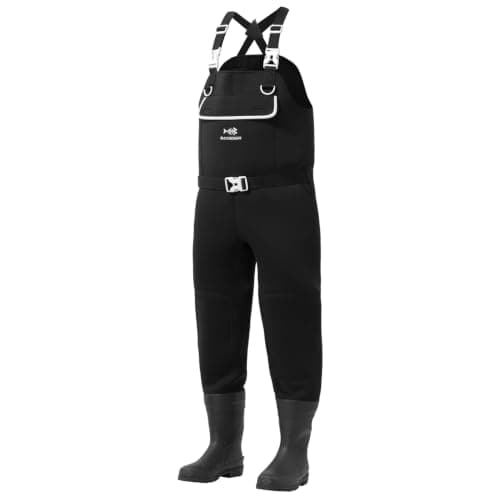
The pair to buy if you only own one set of neoprene. Boots are already attached and already rubber-soled, so there is no second purchase and no stockingfoot-to-boot sizing to get wrong. Neoprene insulates by trapping a thin layer of water against the suit, which means this stays comfortable in water that makes a breathable wader feel like a plastic bag full of cold — exactly the condition a creek is in from November to April.
Best for: Best overall — warmth, attached boots, no sizing puzzle - 2
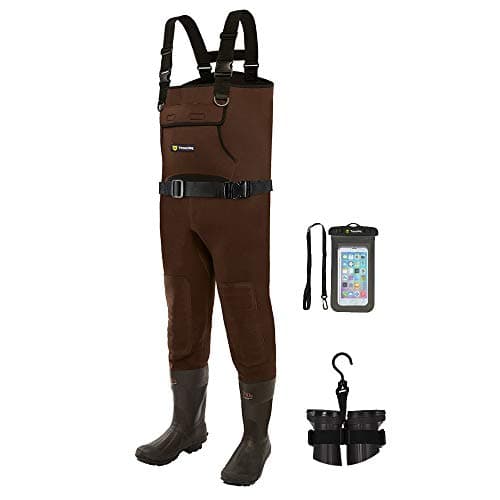
The same cold-water case as the Bassdash, with a cleated outsole instead of a plain rubber one. Cleats dig into soft mud, silt and loose gravel in a way flat rubber does not, which matters more on a low-gradient creek with a soft bottom than on a boulder stream. If you fish farm-country water, beaver ponds or anywhere you sink in past your ankles, this is the better of the two.
Best for: Best grip — cleated boots for mud and loose gravel - 3
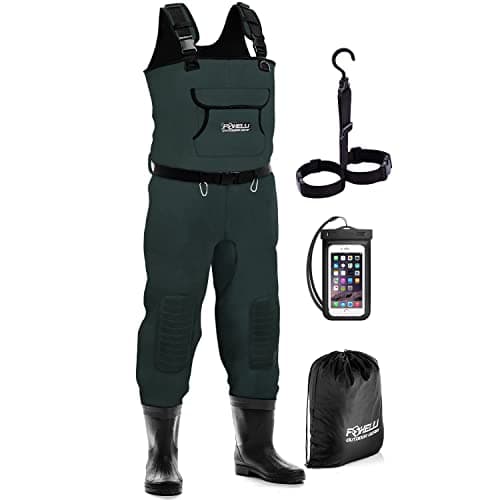
The cheapest pair here and the one that answers the only question most people actually have: what is the least I can spend to stand in cold water without being miserable. The listing states 4mm neoprene, which is the sensible middle thickness — warm enough for genuinely cold water, not so thick that you cannot climb a bank. Nothing about it is clever, and that is fine; a neoprene wader's job is insulation and a seal, and this does both.
Best for: Budget pick — the cheapest neoprene that does the job - 4
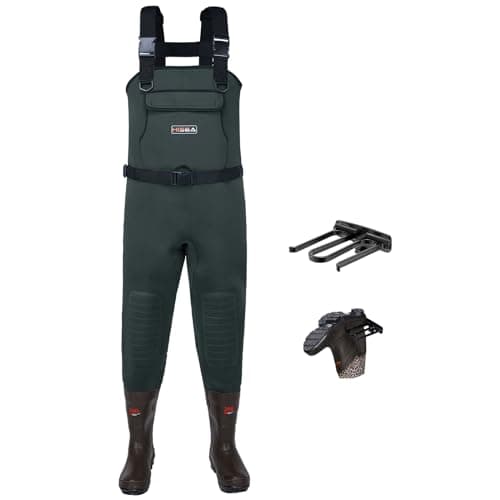
HISEA builds for the cold end of the market, and this is the pair for the angler who stands in one pool working a nymph rig rather than covering two miles of water. Walking generates heat; standing still does not, and that is when neoprene thickness stops being a specification and starts being the difference between an afternoon and an hour. Cleated bootfoot, chest cut, nothing to assemble.
Best for: Best for standing still — the warmest-feeling of the five - 5
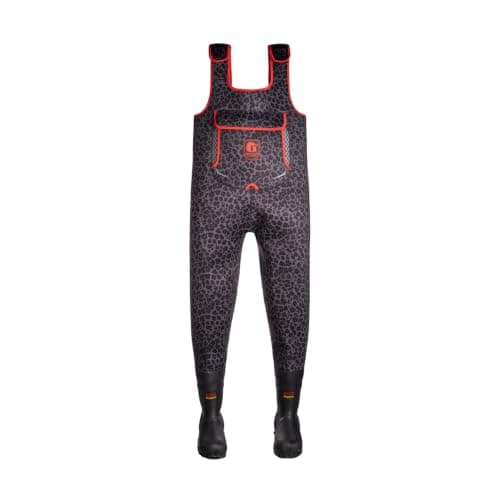
Neoprene is the fabric where a bad fit hurts most, because it has to seal against you to insulate. A wader cut on a women's pattern has the chest, hip and inseam proportions in the right places, which a small men's size does not, and it is the reason this costs more than the unisex pairs above. If you are a woman buying cold-water waders, start here rather than sizing down.
Best for: Best women's fit — cut for a woman, not downsized from a men's pattern
| # | Product | Best for | Score | Price |
|---|---|---|---|---|
| 1 | BASSDASH Men's Neoprene Waders with Waterproof Rubber Boots The pair to buy if you only own one set of neoprene. Boots are already attached and already rubber-soled, so there is no second purchase and no stockingfoot-to-boot sizing to get wrong. Neoprene insulates by trapping a thin layer of water against the suit, which means this stays comfortable in water that makes a breathable wader feel like a plastic bag full of cold — exactly the condition a creek is in from November to April. | Best overall — warmth, attached boots, no sizing puzzle | — | $95.98View on Amazon#ad |
| 2 | TIDEWE Neoprene Waders, Cleated Bootfoot Chest Waders The same cold-water case as the Bassdash, with a cleated outsole instead of a plain rubber one. Cleats dig into soft mud, silt and loose gravel in a way flat rubber does not, which matters more on a low-gradient creek with a soft bottom than on a boulder stream. If you fish farm-country water, beaver ponds or anywhere you sink in past your ankles, this is the better of the two. | Best grip — cleated boots for mud and loose gravel | — | $89.24View on Amazon#ad |
| 3 | Foxelli Chest Waders, 4mm Neoprene with Boots The cheapest pair here and the one that answers the only question most people actually have: what is the least I can spend to stand in cold water without being miserable. The listing states 4mm neoprene, which is the sensible middle thickness — warm enough for genuinely cold water, not so thick that you cannot climb a bank. Nothing about it is clever, and that is fine; a neoprene wader's job is insulation and a seal, and this does both. | Budget pick — the cheapest neoprene that does the job | — | $84.97View on Amazon#ad |
| 4 | HISEA Neoprene Fishing Chest Waders for Men with Cleated Bootfoot HISEA builds for the cold end of the market, and this is the pair for the angler who stands in one pool working a nymph rig rather than covering two miles of water. Walking generates heat; standing still does not, and that is when neoprene thickness stops being a specification and starts being the difference between an afternoon and an hour. Cleated bootfoot, chest cut, nothing to assemble. | Best for standing still — the warmest-feeling of the five | — | $102.99View on Amazon#ad |
| 5 | Gator Waders Women's Retro Neoprene Chest Waders with Boots Neoprene is the fabric where a bad fit hurts most, because it has to seal against you to insulate. A wader cut on a women's pattern has the chest, hip and inseam proportions in the right places, which a small men's size does not, and it is the reason this costs more than the unisex pairs above. If you are a woman buying cold-water waders, start here rather than sizing down. | Best women's fit — cut for a woman, not downsized from a men's pattern | — | Check price on Amazon#ad |
The best neoprene waders for creek and stream fishing are the Bassdash neoprene waders with attached rubber boots — insulation, boots and a single size decision in one purchase, for the angler who wants to fish from November to April and stop thinking about it. If your creek has a soft, silty bottom, take the cleated TIDEWE pair instead. If you want the smallest sensible amount of money spent on cold-water waders, the budget pick is the 4mm Foxelli, which is the cheapest pair here that still does the whole job. Every price on this page comes from our live price feed, with the as-of date shown under the comparison table.
Neoprene is the odd one out in the wader world. Almost every wader review you will read is about breathable fabric, because breathable is what a guide wears for eight hours in July. Neoprene is the opposite tool: it is for water cold enough that staying dry is not the problem — staying warm is. On a small stream that is most of the fishing year.
What neoprene actually does
It insulates. Breathable fabric does not. A breathable wader is a waterproof shell: it keeps stream water out, and whatever warmth you have comes entirely from what you wear underneath. Neoprene is closed-cell foam rubber — the same material as a wetsuit — and the gas trapped in the foam is the insulation. Put the two in 40-degree water and the difference is immediate and large.
Which is why the layering advice changes. Under a breathable wader you build a system: a wicking base layer, a fleece mid-layer, and the shell on top — the full case is in base layers to wear under waders. Under neoprene you often need nothing but long johns, because the wader itself is the warm layer. That is a real saving on gear and a real saving on bulk.
And why neoprene does not breathe at all. No perspiration escapes. Walk half a mile upstream in a neoprene wader on a mild day and you will arrive wet from the inside. This is the single genuine drawback and it is not fixable — it is what the material is. The full trade-off, with the case for each, is in breathable vs neoprene waders.
The honest short version
3mm, 4mm, 5mm: what to pick
Neoprene is sold by thickness in millimetres, and thicker means warmer and stiffer. That is the entire specification. There is no hidden technology; a 5mm wader has more foam between you and the water than a 3mm one, insulates better and bends less.
| Thickness | Water it suits | The trade-off |
|---|---|---|
| 3mm | Cool spring and autumn water, mild winter days | Easiest to walk and climb in; not enough for ice-edge fishing |
| 3.5 to 4mm | Most cold creek fishing, most of the winter | The sensible default — warm where it matters, still mobile |
| 5mm and up | Ice-water, long static sessions, big tailwaters in January | Genuinely warm, genuinely clumsy on a steep bank |
For a creek, 4mm is the answer nine times out of ten. Small-stream fishing involves walking: up the bank, over deadfall, around a brush tangle, into the next pocket. A 5mm wader punishes all of that, and the extra warmth only pays off if you stand still. The Foxelli pick states 4mm on the listing, which is why it is the budget recommendation rather than merely the cheap one.
Where a listing does not publish a thickness, treat it as unknown.Several good neoprene waders — including two on this page — simply say “neoprene” without a number. That is not a red flag, but it does mean nobody should quote you a figure for them. We have not invented thicknesses for products that do not publish one.
Why they all have boots attached
Neoprene waders are almost always bootfoot, and that is a feature here. A stockingfoot wader ends in a neoprene sock and needs a separate wading boot pulled over it, which means a second purchase, a second size to get right, and cold water circulating through the laces. A bootfoot wader ends in a boot. For cold-water fishing, the boot keeps your feet warmer because there is no soaked lace-up boot drawing heat away.
The cost is ankle support and fit precision. An attached boot comes in whole sizes, is roomier than a laced boot, and gives you less support on a rocky bank. If you are hiking a mile in and scrambling, a stockingfoot wader with a real boot is the better system — the comparison is laid out in stockingfoot vs bootfoot waders, and the boots themselves are ranked in the best wading boots.
Check the sole before you buy, because it decides where you can fish. Rubber soles are legal everywhere. Felt is banned in several states as an invasive-species vector. Cleats bite mud and lose on smooth rock. All five picks here are rubber or cleated rubber, so none of them will strand you at a boat ramp sign — the longer argument is in felt wading boots vs rubber. Your state wildlife agency publishes the current rule; that is the authority to check, not us.
The five compared
| Waders | Sole | Buy it if |
|---|---|---|
| BASSDASH Neoprene | Rubber | You want the straightforward cold-water default |
| TIDEWE Neoprene | Cleated | Your creek has a soft, silty or muddy bottom |
| Foxelli 4mm Neoprene | Attached boot | You want the cheapest pair that genuinely works |
| HISEA Neoprene | Cleated | You stand still in cold water for hours |
| Gator Waders Women's Retro | Attached boot | You want a wader cut on a women's pattern |
Prices for all five come from the live feed under the table, not from this copy — we do not type numbers into articles, because a number in an article is wrong within a month. Use the Check price button on each row.
When neoprene is the wrong choice
Above about 60 degrees of air temperature, it is the wrong wader. You will overheat walking to the water and stay damp all day. This is not a durability question or a quality question; it is physics, and a $400 neoprene wader fails the same test as a $90 one.
If you walk more than you fish, it is the wrong wader. Small-stream anglers who cover a mile of water in an afternoon are generating heat the entire time. For that style, a breathable stockingfoot with a fleece layer under it is both warmer when you stop and far more comfortable when you move.
If you only want to own one pair, buy breathable. A breathable wader works in every month of the year once you layer under it; a neoprene wader works in four or five. The one-pair answer is in the best waders roundup, and the sub-$100 end of that field is in the best cheap waders. Neoprene earns its place as a second pair, or as a first pair for someone whose season is genuinely cold.
Making a pair last
Hang them, do not fold them. Neoprene creases, and a crease is where the foam cells collapse and eventually split. Hang a pair upside down by the boots in a cool dry place, with the inside turned out until it is dry. Folding a neoprene wader into a stuff sack for a winter is the most common way people kill one.
Rinse the outside and dry the inside. Silt and grit abrade the surface; sweat and condensation rot the lining. Cold fresh water on the outside, then let the inside air out completely before storing. No machine wash, no dryer, no direct sun for days on end.
Patch leaks early, because they spread. A pinhole in neoprene is a small job with a wetsuit cement and a scrap patch, and a large job once the seam around it has started to go. The method, including how to find a leak you cannot see, is in how to repair waders. Sizing is the other thing worth getting right first time — how to size waders covers the measurements that matter, and they matter more in neoprene than in anything else because the fabric has to sit against you to insulate.
The picks in detail
BASSDASH Men's Neoprene Waders with Waterproof Rubber Boots
Best for: Best overall — warmth, attached boots, no sizing puzzle
The pair to buy if you only own one set of neoprene. Boots are already attached and already rubber-soled, so there is no second purchase and no stockingfoot-to-boot sizing to get wrong. Neoprene insulates by trapping a thin layer of water against the suit, which means this stays comfortable in water that makes a breathable wader feel like a plastic bag full of cold — exactly the condition a creek is in from November to April.
- Fabric
- Neoprene
- Boot
- Attached, rubber sole
- Cut
- Chest wader
- Insulating rather than merely waterproof
- Boots attached — one purchase, one size decision
- Rubber outsole, so it is legal on felt-restricted water
- Too warm for summer wading, as every neoprene wader is
- Heavier to walk in than a breathable stockingfoot
TIDEWE Neoprene Waders, Cleated Bootfoot Chest Waders
Best for: Best grip — cleated boots for mud and loose gravel
The same cold-water case as the Bassdash, with a cleated outsole instead of a plain rubber one. Cleats dig into soft mud, silt and loose gravel in a way flat rubber does not, which matters more on a low-gradient creek with a soft bottom than on a boulder stream. If you fish farm-country water, beaver ponds or anywhere you sink in past your ankles, this is the better of the two.
- Fabric
- Neoprene
- Boot
- Attached, cleated
- Cut
- Chest wader
- Cleated sole bites into mud and loose bottom
- Insulation and boots in one purchase
- TIDEWE's sizing runs predictably across its wader range
- Cleats are noisier and less sure-footed on smooth bedrock
- No felt or studded option in this model
Foxelli Chest Waders, 4mm Neoprene with Boots
Best for: Budget pick — the cheapest neoprene that does the job
The cheapest pair here and the one that answers the only question most people actually have: what is the least I can spend to stand in cold water without being miserable. The listing states 4mm neoprene, which is the sensible middle thickness — warm enough for genuinely cold water, not so thick that you cannot climb a bank. Nothing about it is clever, and that is fine; a neoprene wader's job is insulation and a seal, and this does both.
- Fabric
- 4mm neoprene
- Boot
- Attached
- Cut
- Chest wader
- Lowest outlay in this category
- 4mm is the right thickness for most cold creek fishing
- Boots included, so the whole cost is on the page
- Fewest features of the five
- Thinner than a dedicated ice-water 5mm suit
HISEA Neoprene Fishing Chest Waders for Men with Cleated Bootfoot
Best for: Best for standing still — the warmest-feeling of the five
HISEA builds for the cold end of the market, and this is the pair for the angler who stands in one pool working a nymph rig rather than covering two miles of water. Walking generates heat; standing still does not, and that is when neoprene thickness stops being a specification and starts being the difference between an afternoon and an hour. Cleated bootfoot, chest cut, nothing to assemble.
- Fabric
- Neoprene
- Boot
- Attached, cleated
- Cut
- Chest wader
- Built for genuinely cold, static fishing
- Cleated outsole included
- Chest-high coverage
- The least walkable pair here
- Overkill from May onward
Gator Waders Women's Retro Neoprene Chest Waders with Boots
Best for: Best women's fit — cut for a woman, not downsized from a men's pattern
Neoprene is the fabric where a bad fit hurts most, because it has to seal against you to insulate. A wader cut on a women's pattern has the chest, hip and inseam proportions in the right places, which a small men's size does not, and it is the reason this costs more than the unisex pairs above. If you are a woman buying cold-water waders, start here rather than sizing down.
- Fabric
- Neoprene
- Boot
- Attached
- Fit
- Women's pattern
- Proportioned on a women's pattern
- Boots attached, like every pick here
- The most finished-looking pair of the five
- Most expensive pick on the page
- Women's-only, so it is not an option for everyone
Prices shown are from Amazon as of November 20, 2026 and change often — the button always goes to the current listing. Some links may earn us a commission at no extra cost to you. How this works.
Frequently asked questions
Are neoprene waders warmer than breathable waders?
Yes, substantially, and that is the only reason to buy them. Neoprene is closed-cell foam that insulates on its own; a breathable wader is a waterproof shell that provides no warmth at all, so everything depends on what you layer under it. In cold water the difference is immediate.
What thickness of neoprene wader should I buy?
About 4mm for most cold creek and stream fishing. 3mm is easier to walk and climb in but is not enough for ice-edge conditions; 5mm and above is genuinely warm for standing still in winter water but clumsy on a steep bank. Small-stream fishing involves a lot of walking, which is why the middle thickness usually wins.
Can you wear neoprene waders in summer?
You can, but you will not enjoy it. Neoprene does not breathe at all, so above roughly 60 degrees you overheat on the walk in and stay damp from perspiration. For warm-weather wading, a breathable stockingfoot wader is the right tool.
Do neoprene waders come with boots?
Almost always, and all five picks here do. Neoprene waders are typically bootfoot, meaning the boot is attached, which keeps feet warmer than a laced boot with cold water circulating through it. The trade-off is less ankle support and a less precise fit than a stockingfoot wader paired with a real wading boot.
How long do neoprene waders last?
Longer than most people expect if they are hung rather than folded. Neoprene fails at creases where the foam cells collapse, and at seams that have been stressed. Rinse the outside, dry the inside fully, hang them upside down by the boots, and patch pinholes with wetsuit cement before they spread into the seam.
Sources
Keep reading
Not sure where to start?
The beginner gear guide walks you through exactly what a new stream angler needs — the six essentials first, nice-to-haves later, with one safe-default pick per category.