Packs, Vests & Nets · Roundup
The Best Fly Fishing Nippers and Tool Kits
Three tools do almost everything on a trout stream: something that cuts tippet square, something that holds a hook, and something that keeps both attached to you. Everything past that is gadget creep. These are the kits that get the three right.
Disclosure: Creek Cover is reader-supported. If you buy through our links we may earn a commission, at no extra cost to you. It never changes which pick we tell a new angler to start with. Full disclosure.
Quick picks at a glance
Tap a pick to read the full write-up, or the price button to check it on Amazon.
- 1
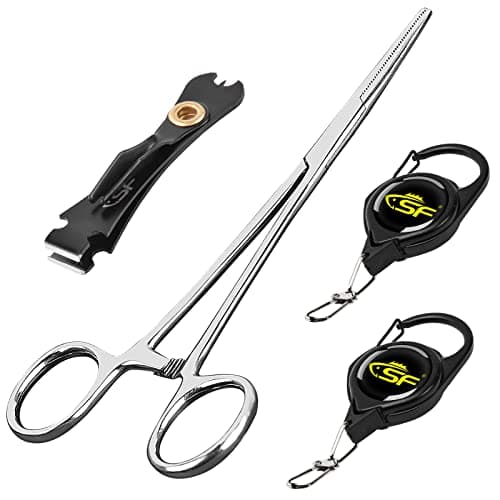
The default answer, and the one most anglers should buy. You get the cutter, the hook tool and the retractor that keeps them with you, all stainless, all serviceable, for roughly what two shop flies cost. The nipper cuts nylon tippet cleanly and includes a hook-eye pin for picking dried head cement out of an eye, and the 6.3-inch forceps lock closed so they hold a size 18 hook without you pinching it. Nothing here is premium hardware — the jaw tolerances are ordinary and the blades will dull in a season or two of hard use — but at this price replacing it is cheaper than upgrading it.
Best for: Best overall — the three tools that matter, for pocket money - 2
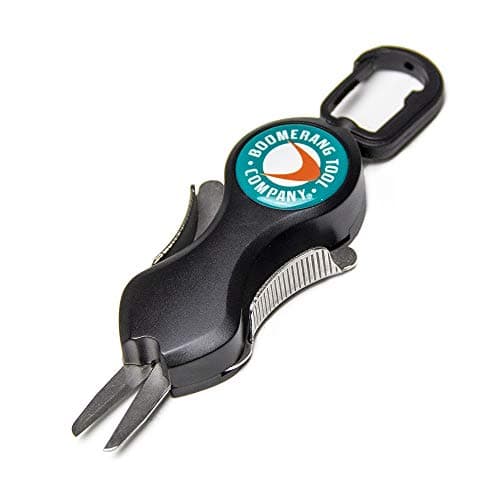
If you want one tool to be genuinely good rather than three to be adequate, this is it. The blades are hardened stainless and they shear braided line as cleanly as nylon, which matters if you also fish spinning tackle, and the built-in retractable tether means the cutter is both the nipper and the zinger in one object. The long nose reaches into a fly box or a knot without your hand blocking the view. The trade is that it does no hook work at all, so it is half a kit rather than a whole one.
Best for: Best dedicated nipper — the one that also cuts braid - 3
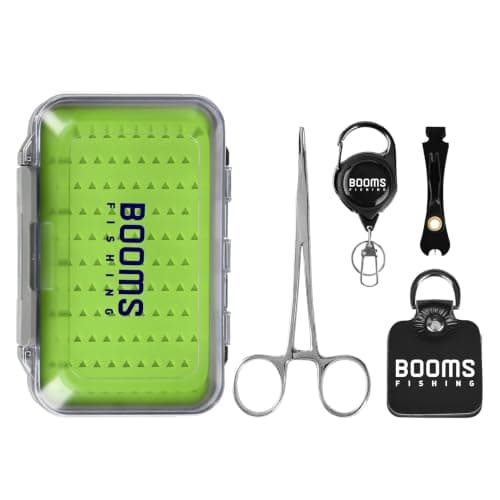
The kit to buy if you own a rod and nothing else. Forceps, nipper, leader straightener, zinger and a two-sided fly box covers the tool half and the storage half of a first setup in a single purchase, which for a beginner removes two decisions at once. The leader straightener is the one piece nobody really needs — pulling a coiled leader through your fingers does the same job — so judge the kit on the other four. The fly box is small, which is right for a creek and wrong for a collection.
Best for: Best complete starter kit — tools plus a fly box in one buy - 4
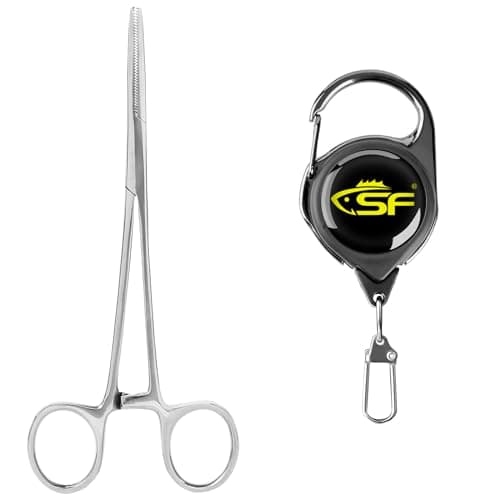
The single tool that does the most for the fish you release. Locking serrated jaws grip a small hook firmly enough to back it out along the line of entry in one movement, instead of three attempts with wet fingertips while the trout thrashes. Straight jaws are the right choice for trout work: curved forceps suit deeper mouths and are harder to aim in a four-inch jaw. Buy these if you already own a nipper, or as the second pair that lives in your other pack.
Best for: Best standalone forceps — the fish-welfare tool - 5
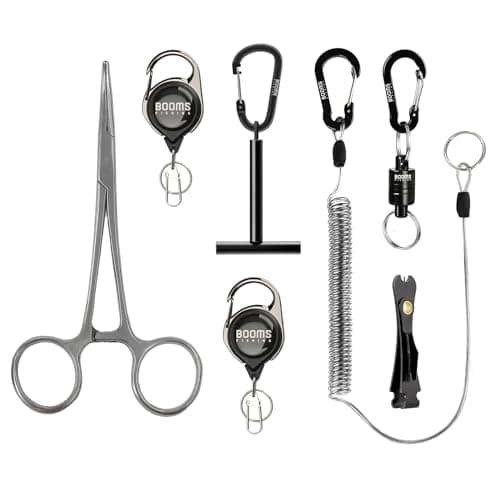
The kit for someone who already fishes and is now organizing. Beyond the nipper, forceps and retractor it adds a magnetic net release and a tippet spool holder, which are the two accessories anglers tend to buy separately six months in. The net release is the genuinely useful one: a magnet on your pack strap holds the landing net out of the way and lets go when you reach for it. Seven pieces also means seven things to lose, and a first-timer does not need this much hardware.
Best for: Best for a loaded vest — net release and tippet holder included
| # | Product | Best for | Score | Price |
|---|---|---|---|---|
| 1 | SF Fly Fishing Tools Kit: Nipper, Zinger & Forceps The default answer, and the one most anglers should buy. You get the cutter, the hook tool and the retractor that keeps them with you, all stainless, all serviceable, for roughly what two shop flies cost. The nipper cuts nylon tippet cleanly and includes a hook-eye pin for picking dried head cement out of an eye, and the 6.3-inch forceps lock closed so they hold a size 18 hook without you pinching it. Nothing here is premium hardware — the jaw tolerances are ordinary and the blades will dull in a season or two of hard use — but at this price replacing it is cheaper than upgrading it. | Best overall — the three tools that matter, for pocket money | — | $9.99View on Amazon#ad |
| 2 | Boomerang Tool Company Long Snip Line Cutter with Retractable Tether If you want one tool to be genuinely good rather than three to be adequate, this is it. The blades are hardened stainless and they shear braided line as cleanly as nylon, which matters if you also fish spinning tackle, and the built-in retractable tether means the cutter is both the nipper and the zinger in one object. The long nose reaches into a fly box or a knot without your hand blocking the view. The trade is that it does no hook work at all, so it is half a kit rather than a whole one. | Best dedicated nipper — the one that also cuts braid | — | $15.97View on Amazon#ad |
| 3 | Booms Fishing FF2 5-in-1 Fly Fishing Tool Kit with Fly Box The kit to buy if you own a rod and nothing else. Forceps, nipper, leader straightener, zinger and a two-sided fly box covers the tool half and the storage half of a first setup in a single purchase, which for a beginner removes two decisions at once. The leader straightener is the one piece nobody really needs — pulling a coiled leader through your fingers does the same job — so judge the kit on the other four. The fly box is small, which is right for a creek and wrong for a collection. | Best complete starter kit — tools plus a fly box in one buy | — | $17.47View on Amazon#ad |
| 4 | SF Fishing Forceps and Hemostats, 6.3 in Straight Stainless Steel The single tool that does the most for the fish you release. Locking serrated jaws grip a small hook firmly enough to back it out along the line of entry in one movement, instead of three attempts with wet fingertips while the trout thrashes. Straight jaws are the right choice for trout work: curved forceps suit deeper mouths and are harder to aim in a four-inch jaw. Buy these if you already own a nipper, or as the second pair that lives in your other pack. | Best standalone forceps — the fish-welfare tool | — | $7.99View on Amazon#ad |
| 5 | Booms Fishing FF3 7-Piece Fly Fishing Tool Kit with Magnetic Net Release The kit for someone who already fishes and is now organizing. Beyond the nipper, forceps and retractor it adds a magnetic net release and a tippet spool holder, which are the two accessories anglers tend to buy separately six months in. The net release is the genuinely useful one: a magnet on your pack strap holds the landing net out of the way and lets go when you reach for it. Seven pieces also means seven things to lose, and a first-timer does not need this much hardware. | Best for a loaded vest — net release and tippet holder included | — | $15.99View on Amazon#ad |
For most anglers the answer is the three-piece nipper, forceps and zinger kit — it covers every tool job on a trout stream for pocket money. If you want one properly good tool instead, the tethered line cutter shears braid as well as nylon and needs no separate retractor. If you own a rod and nothing else, the five-piece kit with a fly box gets the tools and the storage in one purchase.
Fly fishing tools are a category where the marketing and the reality have drifted a long way apart. Catalogs sell twenty-piece kits and $60 machined nippers; what you actually do on the water is cut tippet, crush a barb, get a hook out of a fish, and avoid dropping any of that in the river. Three objects cover it. The useful question is not which kit has the most pieces, it is which one gets those three right.
The three tools that matter
| Tool | What it does | How often | What happens without it |
|---|---|---|---|
| Nippers | Cuts tippet square and close to the knot | Every fly change | You bite line, which chips teeth and leaves long tags |
| Forceps | Backs a hook out; crushes barbs | Every fish | Slow unhooking, more handling, worse release survival |
| Zinger / retractor | Keeps tools clipped to you and retracts them | Constantly, invisibly | Tools end up on the streambed |
| Net release (optional) | Holds a landing net out of the way magnetically | Every fish, if you carry a net | A net that swings into your casting arm |
| Leader straightener (optional) | Heats and straightens leader coil by friction | Rarely | You pull the leader through your fingers instead |
The first three are not optional in any real sense. You can fish without them, in the way you can drive without mirrors. Everything below the line in that table is a convenience, and the leader straightener in particular is a solution to a problem your hands already solve.
What makes a nipper good
It has to cut 6X tippet square, not crush it. A crushed end will not thread through a size 18 hook eye, which turns a ten-second fly change into a two-minute fight in fading light. Scissors and worn nail clippers deform fine nylon; a sharp flush-cutting blade shears it. That is the entire functional difference, and it is worth caring about because fly changes are the most frequent thing you do.
Braid is the dividing line between cheap and good. Braided line is many fine fibers and it defeats soft blades completely — it frays rather than parts. If you only ever fish fly tackle and nylon tippet, a budget nipper is genuinely fine. If you also fish braid on a spinning reel, buy hardened blades once instead of three soft ones.
Size matters more than people expect. A tiny nipper is unusable with cold wet fingers in October, and your hands will be cold and wet. Something with a body you can actually grip, or a long nose you can aim without blocking your own view of the knot, is a real improvement over the smallest object that technically cuts line.
A hook-eye pin is a small, genuine upgrade. Flies arrive with head cement in the eye, and a thin pin clears it in a second. It is a one-cent feature that removes a recurring annoyance, which is a better definition of a good tool than any amount of machined aluminum.
Do not bite your tippet
Forceps: the welfare tool
Forceps exist to get the hook out fast. Time out of water is the thing that kills released trout, and the slowest part of handling a fish is usually the unhooking. A locking pair of forceps grips the hook shank firmly enough to reverse the hook along the line it went in, in one motion, with the fish still in the net and in the water. Fingers cannot do that on a size 16 hook in a four-inch mouth.
Straight jaws for trout, curved for bigger mouths. On a creek everything you catch has a small mouth and the hook is usually in the front of it, where straight jaws aim naturally. Curved forceps are built for reaching around a tongue in a bass or pike and are harder to place accurately in a trout. If you buy one pair, buy straight.
They are also your barb crusher. Clamping the barb flat with the jaws takes two seconds per hook and makes every subsequent unhooking faster and gentler. A barbless hook costs you very few fish if you keep steady pressure, and on small wild trout water it is simply the right thing to do — the same argument runs through flies vs lures for creek trout, where hook type is one of the deciding factors.
And they pair with a rubber-mesh net, not a replacement for one. Netting a fish means you can unhook it in the water instead of lifting it out. Which net matters more than most tackle decisions — the landing net roundup covers why soft rubber mesh beats knotted nylon for survival.
Zingers and why you need one
A zinger is a retractable cord that clips tools to your pack. You use a nipper fifty times a day and set it down fifty times, and about once a season you set it down on moving water. A two-dollar retractor removes that failure mode entirely, which is a strange amount of value for the least interesting item in your kit.
Pin-on versus clip-on. A clip attaches to a D-ring, a loop or a zipper pull and is the practical choice on a modern pack or vest; a pin suits a woven garment. Most kits ship with a clip, and most packs ship with somewhere to clip it, so this rarely requires thought.
Two short cords beat one long one. A single retractor shared between nipper and forceps means unclipping one to use the other. Tools that each have their own cord, on opposite sides of your chest, are faster and tangle less — which is exactly how the multi-piece kits are meant to be set up. Retractors bought on their own, plus the magnets that carry a landing net, are compared in net magnets and retractors.
The five compared
| Kit | Pieces | Cuts braid | Buy it if |
|---|---|---|---|
| SF 3-in-1 tools kit | 3 | No | You want the whole job covered at the lowest cost |
| Boomerang Long Snip | 1 (with tether) | Yes | You want one excellent cutter and own forceps |
| Booms FF2 5-in-1 with box | 5 | No | You own a rod and need tools plus storage |
| SF straight forceps | 1 | n/a | You have a nipper and need the hook tool |
| Booms FF3 7-piece | 7 | No | You are kitting out a vest and want a net release |
The honest ranking is about completeness, not quality. None of these is machined trout jewelry, and all of them cut tippet and hold hooks. Buy the three-piece kit if you want to stop thinking about it, the tethered snip if you fish braid too, and the bigger Booms kits if the extra pieces are things you were going to buy anyway.
What to skip
Twenty-piece kits. Past about seven pieces you are buying hook sharpeners, knot tools for knots you do not tie and spare lanyards. Fly fishing has a long tradition of selling beginners objects instead of skills, and a crowded chest pack slows you down.
Premium machined nippers, at first. A $60 nipper with replaceable tungsten blades is a real tool and worth it to someone who fishes a hundred days a year. For a first season it is $50 that would buy a complete fly assortment, and the cheap one cuts the same tippet. Buy the expensive one when the cheap one annoys you, not before.
Hook sharpeners, for creek fishing. They matter for saltwater hooks and big single hooks that hit rock constantly. On a trout stream a dulled size 16 fly costs fifty cents to replace, and checking the point with a thumbnail tells you when to retire it — which is also the two-minute inspection in the cheap flies roundup.
And skip the second fly box until the first one is full. Tools fail by being absent, not by being basic; storage fails by being disorganized. If you want to spend the money somewhere useful, a slit-foam box with a clear lid does more for a fishing day than any upgrade in this category.
Where to put them
Nipper on your left, forceps on your right, or whatever is opposite your rod hand. You will be holding a rod in one hand through most of this, so every tool should be reachable and usable with the other. Set them up that way once at home and the muscle memory does the rest.
High on the chest, not down at the hip. Anything hanging at waist level is underwater when you wade deep, and a submerged zinger cord drags. Chest height keeps tools dry and visible, which is one of the better arguments for a chest pack or vest on small water — fly fishing vest vs pack compares the formats, and the chest pack roundup covers the front-mounted option specifically.
Keep the net on the opposite shoulder. A magnetic release on your back shoulder strap holds a landing net out of the casting arc and hands it to you when you reach back, which is the one place the seven-piece kit earns its extra pieces. If you fish from a sling pack, the net goes on the strap that does not swing forward.
Then write the kit down. Nipper, forceps, zinger, tippet, leaders, floatant, flies, net. Eight things, checked at the door, is the difference between a fishing trip and a drive. The wider version of that list is in the fly fishing accessories guide, in the order a beginner should buy them.
The picks in detail
SF Fly Fishing Tools Kit: Nipper, Zinger & Forceps
Best for: Best overall — the three tools that matter, for pocket money
The default answer, and the one most anglers should buy. You get the cutter, the hook tool and the retractor that keeps them with you, all stainless, all serviceable, for roughly what two shop flies cost. The nipper cuts nylon tippet cleanly and includes a hook-eye pin for picking dried head cement out of an eye, and the 6.3-inch forceps lock closed so they hold a size 18 hook without you pinching it. Nothing here is premium hardware — the jaw tolerances are ordinary and the blades will dull in a season or two of hard use — but at this price replacing it is cheaper than upgrading it.
- Includes
- Nipper, forceps, zinger retractor
- Forceps
- 6.3 in, serrated, locking
- Material
- Stainless steel
- Covers all three essential tools in one purchase
- Zinger included, so nothing gets dropped in the river
- Cheap enough to own two and keep one in the car
- Blades dull faster than a hardened dedicated nipper
- Will not reliably cut braided line
Boomerang Tool Company Long Snip Line Cutter with Retractable Tether
Best for: Best dedicated nipper — the one that also cuts braid
If you want one tool to be genuinely good rather than three to be adequate, this is it. The blades are hardened stainless and they shear braided line as cleanly as nylon, which matters if you also fish spinning tackle, and the built-in retractable tether means the cutter is both the nipper and the zinger in one object. The long nose reaches into a fly box or a knot without your hand blocking the view. The trade is that it does no hook work at all, so it is half a kit rather than a whole one.
- Type
- Line cutter with built-in tether
- Blades
- Stainless steel, cut braid
- Tether
- Retractable
- Cuts braid and fluorocarbon, not just nylon tippet
- Tether built in — no separate zinger to buy
- Long nose makes precise trims easy
- No forceps, so you still need a hook tool
- Costs more than the complete three-piece budget kit
Booms Fishing FF2 5-in-1 Fly Fishing Tool Kit with Fly Box
Best for: Best complete starter kit — tools plus a fly box in one buy
The kit to buy if you own a rod and nothing else. Forceps, nipper, leader straightener, zinger and a two-sided fly box covers the tool half and the storage half of a first setup in a single purchase, which for a beginner removes two decisions at once. The leader straightener is the one piece nobody really needs — pulling a coiled leader through your fingers does the same job — so judge the kit on the other four. The fly box is small, which is right for a creek and wrong for a collection.
- Includes
- Forceps, nipper, leader straightener, zinger, fly box
- Fly box
- Two-sided
- Use
- Complete first tool set
- Tools and storage in one purchase
- Two-sided box suits a small working fly selection
- Everything is zinger-ready out of the pack
- Leader straightener is close to redundant
- Fly box is too small to be your only one for long
SF Fishing Forceps and Hemostats, 6.3 in Straight Stainless Steel
Best for: Best standalone forceps — the fish-welfare tool
The single tool that does the most for the fish you release. Locking serrated jaws grip a small hook firmly enough to back it out along the line of entry in one movement, instead of three attempts with wet fingertips while the trout thrashes. Straight jaws are the right choice for trout work: curved forceps suit deeper mouths and are harder to aim in a four-inch jaw. Buy these if you already own a nipper, or as the second pair that lives in your other pack.
- Length
- 6.3 in
- Jaws
- Straight, serrated, locking
- Also for
- Crushing barbs
- Fastest, least damaging way to unhook a trout
- Locking jaws double as a barb crusher
- Cheap enough to own a spare
- One job only — no cutting function
- Lightweight jaws can flex on a deeply set hook
Booms Fishing FF3 7-Piece Fly Fishing Tool Kit with Magnetic Net Release
Best for: Best for a loaded vest — net release and tippet holder included
The kit for someone who already fishes and is now organizing. Beyond the nipper, forceps and retractor it adds a magnetic net release and a tippet spool holder, which are the two accessories anglers tend to buy separately six months in. The net release is the genuinely useful one: a magnet on your pack strap holds the landing net out of the way and lets go when you reach for it. Seven pieces also means seven things to lose, and a first-timer does not need this much hardware.
- Pieces
- 7
- Includes
- Nipper, forceps, retractor, magnetic net release, tippet holder
- Use
- Vest or chest-pack setup
- Magnetic net release saves buying one later
- Tippet spool holder keeps three spools in order
- Best value per piece on the page
- More hardware than a beginner needs
- Magnetic release is only as strong as where you clip it
Prices shown are from Amazon as of November 20, 2026 and change often — the button always goes to the current listing. Some links may earn us a commission at no extra cost to you. How this works.
Frequently asked questions
What are the best fly fishing nippers?
For most anglers, a budget stainless nipper bought as part of a three-piece kit with forceps and a zinger. It cuts nylon tippet cleanly, which is the whole job on fly tackle. Pay more only if you also fish braided line on spinning gear, because braid frays soft blades and needs hardened ones.
What tools do I actually need for fly fishing?
Three: nippers to cut tippet, forceps to unhook fish and crush barbs, and a zinger to keep both attached to you. A magnetic net release is a worthwhile fourth if you carry a landing net. Everything beyond that - hook sharpeners, leader straighteners, twenty-piece kits - is convenience rather than need.
Can I just use nail clippers instead of nippers?
They work on nylon tippet when new and get worse quickly, because the blades are soft and meet with a crushing rather than a shearing action. A crushed tippet end will not thread through a small hook eye. They will not cut braided line at all.
Are straight or curved fly fishing forceps better?
Straight, for trout. Creek fish have small mouths and take the hook near the front, where straight jaws aim naturally and let you reverse the hook along its line of entry. Curved forceps are designed for reaching into deeper mouths on species like bass and pike.
Do I need a leader straightener?
No. A fresh leader comes off the packet in coils, and drawing it firmly through your fingers two or three times generates enough friction heat to straighten it. The tool does the same job slightly faster and is the one piece in most multi-tool kits you could leave at home.
Sources
Keep reading
Not sure where to start?
The beginner gear guide walks you through exactly what a new stream angler needs — the six essentials first, nice-to-haves later, with one safe-default pick per category.