Gear · Roundup
The Best Deer Drags, Sleds and Game Carts
Every beginner plans the shot. Almost nobody plans the part that comes after it - moving a hundred and fifty pounds of dead weight, in the dark, usually uphill, usually alone.
Disclosure: Creek Cover is reader-supported. If you buy through our links we may earn a commission, at no extra cost to you. It never changes which pick we tell a beginner to start with. Full disclosure.
Quick picks at a glance
Tap a pick to read the full write-up, or the price button to check it on Amazon.
- 1
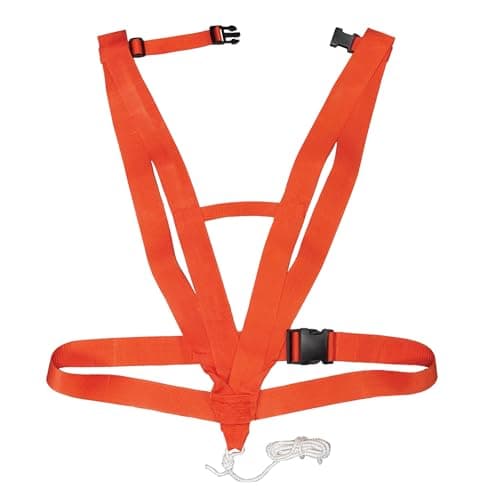
The whole point of this page in one cheap piece of webbing. A safety-orange harness that straps across your shoulders, chest and waist with a drag rope already attached, so you walk upright and pull with your legs instead of bending double and hauling with your hands. It lives in a pack pocket and weighs nothing.
Best for: The best deer drag for most beginners9.1 - 2
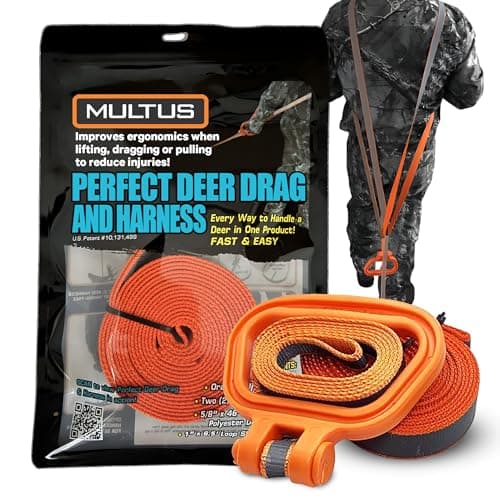
A 2-in-1 system: a 46-inch dual-loop strap with a removable handle you can drag by hand, plus a 6.5-foot loop you throw over your shoulder when you want to stand up and pull. Reflective webbing throughout and hardware the listing rates at a 400 lb working load. Buy this instead of the basic harness if you expect to swap between hands and shoulder, or if two of you will be pulling.
Best for: Best hand-or-shoulder drag with a real handle8.8 - 3
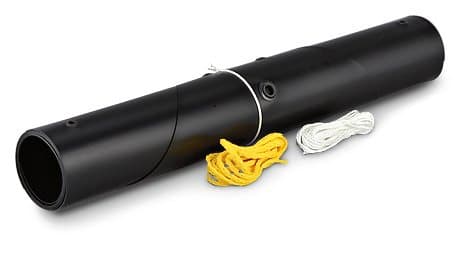
A slick polymer sheet, roughly three feet by six, that rolls up small and weighs about five pounds. You roll the deer onto it, thread the included rope through the grommets, and now the animal slides on plastic instead of grinding through leaves, gravel and mud. It is the biggest friction reduction available for under thirty dollars, and it keeps hair and dirt off the hide.
Best for: Best sled for keeping meat clean8.9 - 4
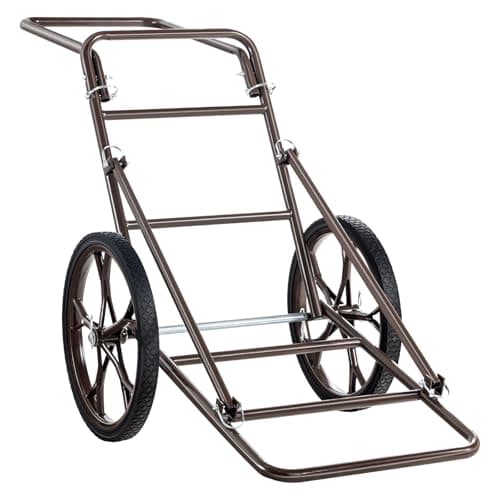
The cheapest cart here that still has big solid tires and a folding steel frame. Seventeen-inch puncture-proof wheels are the spec that decides whether a cart is useful or a nuisance, because small wheels stop at every root. If you hunt ground with two-tracks, field edges or a logging road between you and the truck, a cart turns an ordeal into a walk.
Best for: Best value game cart8.6 - 5
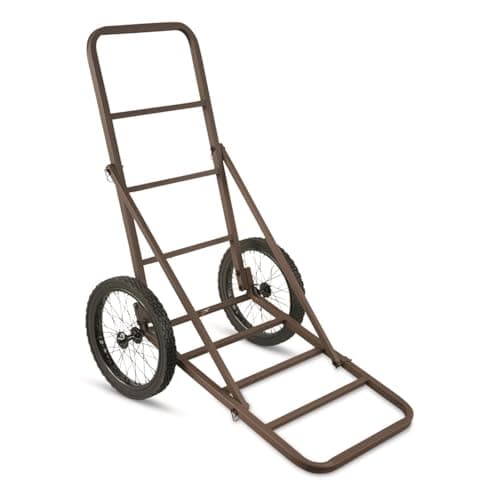
The cart a lot of deer camps already own. Sixteen-inch solid-rubber spoked wheels, a frame the listing describes as stainless steel, three lashing straps in the box, and a design that centers the load over the axle so you are balancing weight rather than lifting it. It costs more than the budget cart and carries less on paper, which is the trade you are making for a known quantity.
Best for: Best cart from a long-running hunting brand8.5 - 6
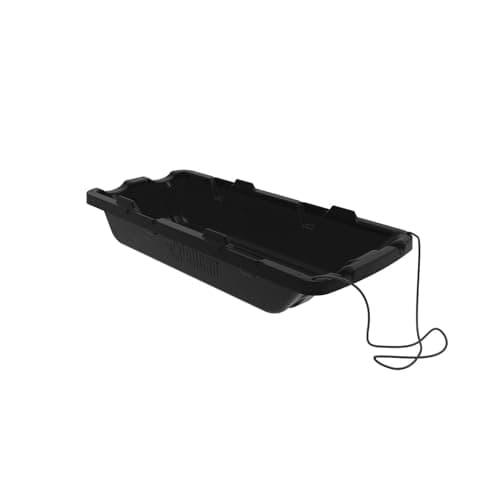
A rigid four-season sled with molded-in HDPE runners, a pull rope and 71 liters of space, rated by the listing to 130 pounds. It is not a deer-specific product and that is the appeal: late-season hunters, ice fishermen and waterfowlers all end up owning one, and it will haul your decoys in October and quartered venison in December.
Best for: Best hard sled for snow and marsh8.4 - 7
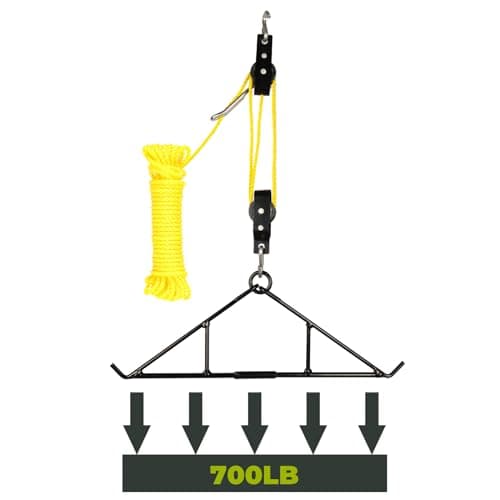
Getting the deer to the truck is only three quarters of the job. A gambrel and pulley kit with a 4:1 lift ratio and 44 feet of rope lets one person raise an animal into a truck bed, onto a hitch carrier, or up a tree limb to skin it - which is the moment most solo hunters discover they are stuck.
Best for: The step everyone forgets: lifting it8.6
| # | Product | Best for | Score | Price |
|---|---|---|---|---|
| 1 | Hunter's Specialties Deluxe Deer Drag The whole point of this page in one cheap piece of webbing. A safety-orange harness that straps across your shoulders, chest and waist with a drag rope already attached, so you walk upright and pull with your legs instead of bending double and hauling with your hands. It lives in a pack pocket and weighs nothing. | The best deer drag for most beginners | 9.1 | $8.29View on Amazon#ad |
| 2 | MULTUS Deer Drag Harness A 2-in-1 system: a 46-inch dual-loop strap with a removable handle you can drag by hand, plus a 6.5-foot loop you throw over your shoulder when you want to stand up and pull. Reflective webbing throughout and hardware the listing rates at a 400 lb working load. Buy this instead of the basic harness if you expect to swap between hands and shoulder, or if two of you will be pulling. | Best hand-or-shoulder drag with a real handle | 8.8 | $24.55View on Amazon#ad |
| 3 | Deer Sleigh'R Magnum Game Sled A slick polymer sheet, roughly three feet by six, that rolls up small and weighs about five pounds. You roll the deer onto it, thread the included rope through the grommets, and now the animal slides on plastic instead of grinding through leaves, gravel and mud. It is the biggest friction reduction available for under thirty dollars, and it keeps hair and dirt off the hide. | Best sled for keeping meat clean | 8.9 | $27.89View on Amazon#ad |
| 4 | VEVOR 500 lb Folding Game Cart The cheapest cart here that still has big solid tires and a folding steel frame. Seventeen-inch puncture-proof wheels are the spec that decides whether a cart is useful or a nuisance, because small wheels stop at every root. If you hunt ground with two-tracks, field edges or a logging road between you and the truck, a cart turns an ordeal into a walk. | Best value game cart | 8.6 | $72.90View on Amazon#ad |
| 5 | Guide Gear Deluxe Deer Cart The cart a lot of deer camps already own. Sixteen-inch solid-rubber spoked wheels, a frame the listing describes as stainless steel, three lashing straps in the box, and a design that centers the load over the axle so you are balancing weight rather than lifting it. It costs more than the budget cart and carries less on paper, which is the trade you are making for a known quantity. | Best cart from a long-running hunting brand | 8.5 | $89.99View on Amazon#ad |
| 6 | Pelican Trek 45 Utility Sled A rigid four-season sled with molded-in HDPE runners, a pull rope and 71 liters of space, rated by the listing to 130 pounds. It is not a deer-specific product and that is the appeal: late-season hunters, ice fishermen and waterfowlers all end up owning one, and it will haul your decoys in October and quartered venison in December. | Best hard sled for snow and marsh | 8.4 | $82.99View on Amazon#ad |
| 7 | Highwild Game Hoist Gambrel & Deer Hanger Kit Getting the deer to the truck is only three quarters of the job. A gambrel and pulley kit with a 4:1 lift ratio and 44 feet of rope lets one person raise an animal into a truck bed, onto a hitch carrier, or up a tree limb to skin it - which is the moment most solo hunters discover they are stuck. | The step everyone forgets: lifting it | 8.6 | $25.99View on Amazon#ad |
There is a moment, maybe twenty minutes after the shot, when a first-season deer hunter stands over an animal in fading light and does the arithmetic for the first time. The deer is on the ground. The truck is nine hundred yards away, through a creek bottom, uphill at the end. It is getting dark. There is nobody else here. And the animal, which looked manageable through a scope, now weighs more than a bag of concrete and has no handles.
Every piece of gear on this page exists to solve that moment, and it is the part of deer hunting that gets the least honest coverage. Hunting content is full of what to shoot and where to sit; the recovery is treated as a footnote, or worse, as something real hunters just do. It is not a footnote. It is the hardest physical work in the sport, it is where people get hurt, and for about ten dollars you can make it meaningfully less bad. If you have not read the after-the-shot sequence yet, how to field dress a deer covers what happens before you start pulling. This page covers the pulling.
How we picked these
Our criteria, in order. Does it take the load off your body? That came first, because it is the only criterion in this category with actual published research behind it, and the next section explains what that research found. Does it match your ground? Second, because the most expensive cart on earth is worthless in timber full of blowdowns and a fifteen-dollar strap is perfect there. Can you use it alone? Third, because beginners hunt alone more than anyone admits, and half the recovery gear sold assumes a second person who never appears in the photographs. Does it protect the meat? Fourth - a carcass ground through gravel and leaves for half a mile is dirtier and harder to butcher than one that slid on plastic. Does it pack? Last, because gear that lives in the truck instead of your pack is gear you do not have when the deer falls.
Every product here was confirmed as a live, in-stock listing before it went on the page, and every figure quoted comes from the manufacturer’s or the retailer’s own published specs - the numbers marked “listing” are theirs, not ours, and we label them rather than dressing a marketing figure up as a test result. We do not drag test carcasses for sport and we do not pretend to; the method is on the how we research and pick page. Prices on this page are live and dated, and the brackets in the writing are deliberately qualitative, because a number typed into an article is wrong by the following week.
Why the drag is the dangerous part
This is the section nobody writes, and it is the reason the cheap harness is ranked first. In 2015, researchers at the University of Minnesota Duluth published a study in Wilderness & Environmental Medicine comparing two ways of moving a deer. Twelve participants first towed and then hand-dragged a 45-kilogram simulated carcass over 457 meters at their own pace, with heart rate and oxygen consumption measured throughout. The tow condition used a shoulder harness on a two-meter strap, so the participant walked upright. The drag condition was the traditional one: bend at the trunk, grab the legs, pull with your hands.
Towing came out significantly lower on peak oxygen consumption, peak heart rate, average heart rate and rating of perceived exertion. Time to complete the course was not significantly different - so the harness was not slower, it was simply easier. The authors’ conclusion was blunt: hunters who are deconditioned or who have cardiovascular risk factors are strongly encouraged to use a shoulder harness and tow rope rather than traditional dragging.
That advice exists because of what a second body of research found about deer hunting in general. A 2007 study in the American Journal of Cardiology put ambulatory ECG monitors on 25 middle-aged men, 17 of whom had known coronary artery disease, and recorded them through seven different hunting activities. Twenty-two of the 25 hit heart rates above 85 percent of their treadmill-tested maximum for stretches lasting from one minute to sixty-five. Ten of them exceeded the maximum heart rate they had reached on a treadmill at all. Three showed ischemic ECG changes in the field that had not appeared in the lab, and three showed complex arrhythmias - including runs of ventricular tachycardia - that treadmill testing had missed entirely.
What that means for you
A ten-dollar harness is not a comfort accessory. Published measurements say towing a deer upright in a shoulder harness produces significantly lower cardiovascular demand than hand-dragging the same load the same distance, in the same time. If you are new, out of shape, over forty, or hunting alone in the cold - which describes most of the people reading this - buy the harness before you buy anything else on this page, and plan to rest more often than your pride suggests.
None of that means you should not drag a deer. Millions of people do it every fall without incident. It means the drag deserves the same planning you give the shot: know your route before you sit down, know where you can get a vehicle, and own the one piece of gear that the evidence says lowers the strain.
Harness, sled or cart?
The honest answer for a first season is that you need a harness, you will probably want a sled, and you should not buy a cart until you have hunted the ground once. Access decides everything. A cart needs a route a wheel can follow - a two-track, a field edge, a logging road, a mowed power line. If your access is a deer trail through greenbrier, a cart is a hundred dollars of garage decoration and a strap is the correct answer.
| Your situation | What to buy | Why |
|---|---|---|
| Timber, blowdowns, no vehicle access | Harness (plus a sled if you get snow) | Nothing with wheels will follow you in there. Reduce the load on your body instead. |
| Short drag, bare dry ground | Harness only | Under a couple of hundred yards on flat ground, a harness is all the help that exists. |
| Snow, mud or frozen marsh | Sled | Friction collapses on snow. A sled is the biggest single improvement you can buy for the money. |
| Two-track, field edge or logging road to the truck | Game cart | Wheels beat everything when the ground allows wheels. Big tires matter more than capacity. |
| Long pack-out on public land, a mile plus | Knife, game bags and a frame pack | You are not dragging that animal whole. Quarter it and carry it out in two trips. |
| Solo hunter with a tall truck bed | Harness plus a hoist and gambrel | The lift at the tailgate defeats more solo hunters than the drag does. |
The one combination worth calling out: a harness and a roll-up sled together cost less than forty dollars, weigh a couple of pounds, both fit in a day pack, and cover almost every situation a beginner will face on private ground or close-access public. That is the package. If you are heading somewhere with a long walk in, read the public land day pack list instead - the answer there is a sharp knife and game bags, not a bigger drag strap.
Before you move the animal
Tag it first.In a lot of states it is illegal to move a deer from the point of kill until it is tagged, and “moving” can include dragging it ten feet to better ground. South Carolina requires the deer to be tagged in the field where you harvest it and to stay tagged through transport. West Virginia requires a completed field tag before the animal is moved from where it was killed, with the option of carrying the completed tag on your person while you drag. Other states are written differently again. This is one of the easiest citations to earn in deer hunting and the one first-timers walk into most often, because the adrenaline says go and the regulation says stop. Read your own state’s current rules before the season - our hunting license basics guide covers where to find them.
Field dress before you drag, in nearly all cases. A field-dressed whitetail is meaningfully lighter than a whole one, and it cools faster - and cooling is what decides whether the meat is good. The exception is a short drag straight into a truck headed to a processor within the hour, and even then you are usually better off doing the job at the animal.
Decide between dragging and quartering before you start. If the animal is far enough out that the drag looks like an hour of work, breaking it down and carrying it in game bags is often the faster and safer choice, and on a warm early-season day it is the better one for the meat. Some states require evidence of sex or species to stay attached during transport, which changes how you quarter - another regulation to have read in advance rather than in the dark with a knife in your hand.
Keep your blaze orange on.The walk out is when you are lowest to the ground, moving through brush, often at last light, dragging something roughly the shape and color of a deer. Hunter-ed’s guidance is the usual one: most states require a minimum area of solid blaze orange worn above the waist, deer see it as gray rather than orange because of their dichromatic vision, and the more you wear the more visible you are. Do not take the vest off because you are done hunting. If you are dragging after dark, a headlamp turned on yourself occasionally is worth more than one pointed at the ground.
How to actually drag a deer
Drag it head first. The hair lies back toward the tail, so pulling from the head means sliding with the grain instead of against it, and the head and antlers give you an attachment point that will not tear loose. Cinch the strap around the base of the antlers, or around the neck on an antlerless deer, and keep the head slightly elevated so the nose does not plow.
Use the terrain. The shortest route to the truck is almost never the easiest one. Downhill, along a creek bottom, around the hill rather than over it, through open hardwoods instead of the straight line through the thicket - a longer route on better ground is faster and far less punishing. Walk the route in your head before you start, because once you are pulling you will stop thinking clearly about anything.
Work in intervals. Pull fifty yards, stop, breathe until your heart rate comes down, pull another fifty. That is not weakness, it is exactly what the cardiology research above argues for, and you will move the deer faster overall than you will by trying to do it in one heroic effort and then sitting down for ten minutes.
Two people, two straps, side by side. If you have help, do not take turns - pull together with a strap each, walking abreast. Two people dragging in sequence is barely better than one; two people pulling at once roughly halves the work for both.
The thing nobody tells beginners
Loading is harder than dragging. A field-dressed deer on the ground behind a pickup is a genuine problem for one person, and it is where a lot of solo hunters end up phoning someone for help at ten at night. Solve it before you need to: a hoist and gambrel off a limb, a ramp of two planks, a hitch-mounted carrier, or simply parking where you can back down to lower ground.
Getting it into the truck
The pulley kit on this page exists for exactly that. A 4:1 hoist means you are pulling roughly a quarter of the animal’s weight at the rope, with a self-locking device so you can stop partway and rest without losing what you have gained. The same kit hangs the deer at home for skinning, which you need anyway - a gambrel is not optional equipment once the animal is in the garage, and hanging it is how you get a clean, cool carcass to work on.
From there the chain is the one the rest of this hub covers. Game bags keep dirt and flies off, a cooler holds quarters on ice while the meat ages, and a vacuum sealer gets it into the freezer without burn. If you plan to make your own burger, the grinder guide is the last link. The recovery gear on this page is simply the first link, and it is the one beginners skip.
What to skip for now
Skip the cart until you have hunted the ground. This is the most common hundred-dollar mistake in this category. Carts are excellent where wheels work and useless where they do not, and you genuinely cannot tell which you have until you have walked the property with a full pack. Hunt your first season with a harness, note the places you would have wanted a cart, and buy one in the spring when it is cheaper.
Skip the hard sled if you do not get snow. A rigid four-season sled is outstanding over snow and frozen marsh and unremarkable over dry leaves. If your season ends before the ground freezes, the roll-up sheet sled does the same job for a third of the money and rides in your pack.
Skip anything sold as a complete “deer hauling system” that bundles a strap, a rope and a pair of gloves at four times the price of the strap. The harness is the functional part. Everything else in those kits is something you already own.
And skip the idea that you have to drag it at all. Quartering an animal in the field and carrying it out in game bags on a frame pack is normal, legal in most places as long as you follow the evidence-of-sex rules, easier on your body, and better for the meat on a warm day. It is what western hunters do by default and what eastern hunters increasingly do on long public-land walks. Dragging is a tool, not an obligation.
The through-line of this page: buy the harness now, before the season, because it costs almost nothing and the research says it matters. Add a sled if you hunt snow or care about clean meat. Add a cart only once you know your access rewards one. And plan the route out before you climb in - the best recovery gear in the world is a good decision made while you are still fresh. If you are still assembling the rest of the kit, the first deer hunt checklist puts this in order with everything else you need.
The picks in detail
Hunter's Specialties Deluxe Deer Drag
9.1/10Best for: The best deer drag for most beginners
The whole point of this page in one cheap piece of webbing. A safety-orange harness that straps across your shoulders, chest and waist with a drag rope already attached, so you walk upright and pull with your legs instead of bending double and hauling with your hands. It lives in a pack pocket and weighs nothing.
- Type
- Full body harness with drag rope
- Adjustment
- Shoulder straps, sternum strap, waist belt
- Color
- Safety orange
- Weight
- Around 7 oz (retailer listings)
- Shoulder-harness towing measurably lowered peak heart rate and perceived exertion versus hand-dragging in a 2015 Wilderness & Environmental Medicine study
- Leaves both hands free for a rifle, a flashlight, brush or a fence
- Safety orange, which matters more on the walk out than it does in the stand
- Packs to the size of a sandwich and costs less than a tank of gas
- Hunter's Specialties does not publish a load rating on its own product page - retailer listings quote 500 lb, which is a retailer number, not a manufacturer one
- Thin nylon webbing digs in over a long haul if you are in light clothing
- Does nothing to keep the animal out of the dirt - pair it with a sled if the meat matters to you
- A harness makes dragging easier, not easy. It is still the hardest work of the season
MULTUS Deer Drag Harness
8.8/10Best for: Best hand-or-shoulder drag with a real handle
A 2-in-1 system: a 46-inch dual-loop strap with a removable handle you can drag by hand, plus a 6.5-foot loop you throw over your shoulder when you want to stand up and pull. Reflective webbing throughout and hardware the listing rates at a 400 lb working load. Buy this instead of the basic harness if you expect to swap between hands and shoulder, or if two of you will be pulling.
- Type
- Dual-loop strap plus shoulder harness loop
- Webbing
- Reflective polyester, 48 in x 5/8 in plus 13 ft x 1 in (listing)
- Working load
- 400 lb (listing)
- Handle
- Removable HDPE handle with locking peg
- Works as a hand drag, a shoulder tow, or a two-person tandem pull without changing gear
- Reflective webbing is genuinely useful when you are dragging at last light
- The O-ring buckle-slide cinches onto antlers, a neck or a leg without tying knots in the dark
- Folds into a pocket, and doubles as a strap for firewood, decoy bags or a feed sack
- Three times the price of the plain harness for a convenience upgrade, not a capability one
- The listing explicitly says it is not rated for overhead lifting or supporting body weight - it is a drag strap, not a safety line
- A single shoulder loop loads one side of your body; the full harness spreads it better
- The load rating is a listing figure with no published test standard behind it
Deer Sleigh'R Magnum Game Sled
8.9/10Best for: Best sled for keeping meat clean
A slick polymer sheet, roughly three feet by six, that rolls up small and weighs about five pounds. You roll the deer onto it, thread the included rope through the grommets, and now the animal slides on plastic instead of grinding through leaves, gravel and mud. It is the biggest friction reduction available for under thirty dollars, and it keeps hair and dirt off the hide.
- Size
- About 3 ft x 6 ft (retailer listing)
- Weight
- About 5 lb (retailer listing)
- Material
- Slick, tough-tested polymer
- Rope
- 6 ft rope through the grommets, included
- Cuts drag resistance dramatically over snow, gravel, leaves and light brush
- Keeps the carcass out of the dirt, which matters if you are butchering it yourself
- Rolls up and straps to a pack, so it can live in the truck or ride in with you
- Also hauls gear - a ground blind, decoys, firewood - the other eleven months of the year
- It does not roll. Over bare dry ground with no snow it helps far less than it does on snow
- Flexible sheet sleds snag on stumps and blowdowns where a rigid sled would ride over
- You still have to roll a dead deer onto it, which is its own job alone
- Published specs vary between retailers; treat the dimensions as approximate
VEVOR 500 lb Folding Game Cart
8.6/10Best for: Best value game cart
The cheapest cart here that still has big solid tires and a folding steel frame. Seventeen-inch puncture-proof wheels are the spec that decides whether a cart is useful or a nuisance, because small wheels stop at every root. If you hunt ground with two-tracks, field edges or a logging road between you and the truck, a cart turns an ordeal into a walk.
- Capacity
- 500 lb (listing)
- Wheels
- 17 in solid rubber, puncture-proof
- Frame
- Alloy steel, folding
- Size
- About 49.6 x 24.8 x 40.8 in set up (listing)
- Solid tires cannot go flat in a truck bed full of broadheads and brush
- Folds down to fit a trunk or a truck bed alongside everything else
- Big wheels roll over roots and ruts that stop a small-wheeled garden cart
- Doubles as a gear hauler for blinds, feed and treestands in the preseason
- A cart is useless in thick timber, steep ground or anywhere with blowdowns - know your access first
- Assembly quality on budget carts is inconsistent; check every bolt before you trust it with a deer
- Loading a deer onto a cart alone is genuinely hard, and nobody's marketing photo shows it
- Capacity is a listing number with no published test standard behind it
Guide Gear Deluxe Deer Cart
8.5/10Best for: Best cart from a long-running hunting brand
The cart a lot of deer camps already own. Sixteen-inch solid-rubber spoked wheels, a frame the listing describes as stainless steel, three lashing straps in the box, and a design that centers the load over the axle so you are balancing weight rather than lifting it. It costs more than the budget cart and carries less on paper, which is the trade you are making for a known quantity.
- Capacity
- 300 lb (listing)
- Wheels
- 16 in solid-rubber spoked, puncture-proof
- Frame
- Stainless steel, folds flat (listing)
- Included
- 3 lashing straps
- Weight centered over the axle is the difference between pushing a cart and fighting one
- Lashing straps included, so the deer is actually secured rather than balanced
- Folds flat for the truck and for the garage the other fifty weeks of the year
- An established hunting-catalog product with a long history behind the part number
- 300 lb rated capacity is lower than budget carts that cost less
- Same fundamental limitation as any cart: it needs a route a wheel can follow
- A steel frame is heavier to walk in to the animal than an aluminum cart
- Costs roughly what a harness, a sled and a hoist cost together
Pelican Trek 45 Utility Sled
8.4/10Best for: Best hard sled for snow and marsh
A rigid four-season sled with molded-in HDPE runners, a pull rope and 71 liters of space, rated by the listing to 130 pounds. It is not a deer-specific product and that is the appeal: late-season hunters, ice fishermen and waterfowlers all end up owning one, and it will haul your decoys in October and quartered venison in December.
- Size
- About 45.5 x 20 x 8 in (listing)
- Weight
- About 6 lb (listing)
- Capacity
- 130 lb / 71 L (listing)
- Build
- RAM-X hull with pre-molded HDPE runners
- Rigid runners track straight behind you instead of wandering like a flexible sheet
- Rated capacity covers a quartered deer or a small field-dressed one, plus gear
- Genuinely excellent over snow and frozen marsh, where a cart is hopeless
- Crosses over to duck gear, ice fishing and winter camping, so it earns storage space
- The 130 lb listed capacity is below the field-dressed weight of a big whitetail - plan to quarter
- Bulky. It does not roll up and it does not ride in with you
- Costs more than the roll-up sled and more than the budget cart
- On bare dry ground a hard sled scuffs and drags; this is a snow and mud tool
Highwild Game Hoist Gambrel & Deer Hanger Kit
8.6/10Best for: The step everyone forgets: lifting it
Getting the deer to the truck is only three quarters of the job. A gambrel and pulley kit with a 4:1 lift ratio and 44 feet of rope lets one person raise an animal into a truck bed, onto a hitch carrier, or up a tree limb to skin it - which is the moment most solo hunters discover they are stuck.
- Capacity
- 700 lb (listing)
- Lift ratio
- 4:1 pulley system with self-locking device
- Rope
- 44 ft poly hoist rope included
- Parts
- Gambrel and hoist usable separately; folds for storage
- A 4:1 pulley turns a two-person lift into a one-person job
- The self-locking device means you can stop mid-lift without losing the animal
- The gambrel alone is what you need to hang and skin at home anyway
- Folds down small enough to leave in the truck all season
- Rated for game only - never use a game hoist to support a person
- You need a solid limb, a rafter or a hitch mount; it does not solve the problem by itself
- Hardware quality varies on budget hoist kits - inspect the hooks and rope before every season
- One more thing to buy before you have proven you need it
Prices shown are from Amazon as of Sep 26, 2026 and change often — the button always goes to the current listing. Some links may earn us a commission at no extra cost to you. How this works.
Frequently asked questions
How do you get a deer out of the woods by yourself?
Field dress it, tag it if your state requires tagging before movement, then tow it with a shoulder harness rather than hand-dragging - a 2015 study in Wilderness & Environmental Medicine measured significantly lower peak heart rate, oxygen consumption and perceived exertion for harness towing versus hand-dragging over the same course in the same time. Drag head first so the hair lies with you, take the easiest route rather than the shortest, and rest in intervals. If the walk is long, quarter it and carry it out in game bags instead.
Is a deer cart worth it?
Only if your access lets a wheel follow you. On two-tracks, field edges, logging roads and mowed lanes a cart is transformative. In thick timber, steep ground or anywhere with blowdowns it is worse than a ten-dollar strap, because you end up carrying it. Hunt the ground once before you buy, and if you do buy, prioritize big solid tires over rated capacity - small wheels stop at every root.
Do you have to tag a deer before dragging it?
In many states, yes. South Carolina requires the deer to be tagged in the field where it is harvested and to remain tagged during transport. West Virginia requires a completed field tag before the animal is moved from where it was killed, with the option to keep the completed tag on your person while dragging. Rules differ state to state and change between seasons, so read your own current regulations before opening day rather than in the dark with a deer on the ground.
Should you drag a deer head first or feet first?
Head first. Deer hair lies back toward the tail, so pulling from the head slides with the grain instead of against it, and the antlers or neck give you an attachment point that will not tear. Keep the head slightly raised so the nose does not plow into the dirt, and cinch your strap at the base of the antlers on a buck or around the neck on an antlerless deer.
What is the cheapest thing that actually helps?
A body-harness drag strap, which typically costs less than a box of ammunition. It moves the load from your hands and lower back onto your hips and legs and leaves both hands free, and the published research on deer retrieval methods supports exactly that change. A roll-up sled is the second purchase if you hunt snow or want to keep the carcass out of the dirt.
How heavy is a deer to drag?
Heavier than beginners expect, and highly variable by region, age and sex - the peer-reviewed deer retrieval study used a 45-kilogram (about 99-pound) simulated carcass as its test load, and plenty of mature bucks exceed that field dressed. Treat any deer as a load you cannot lift alone, and plan the route and the loading method before you shoot rather than after.
Sources
- Fountaine CJ, Evenson MJ - Cardiovascular demands of deer retrieval methods, Wilderness & Environmental Medicine 2015;26(2):216-20
- Haapaniemi S, Franklin BA, et al. - Electrocardiographic responses to deer hunting activities in men with and without coronary artery disease, American Journal of Cardiology 2007;100(2):175-9
- South Carolina DNR - Deer tagging FAQs (tag in the field, remain tagged during transport)
- West Virginia DNR - Regulations and licenses FAQ (field tag before moving the animal)
- Hunter-ed - Why hunters wear blaze orange and how much states require
- Hunter's Specialties - Deluxe Deer Drag (HS-02019) product page
- Exit15 - Deer Sleigh'R Magnum Game Sled listed specifications
Keep reading
Not sure where to start?
The beginner gear checklist walks you through exactly what a first-season hunter needs — essentials first, nice-to-haves later, with one safe-default pick per category.