Flies & Lures · Roundup
The Best Flies for Brown Trout
Brown trout are the most predatory and the most cautious trout in a creek at the same time. They eat bigger food than brook trout and rainbows will, they feed hardest in low light, and they hold under cover — which changes what belongs in your box.
Disclosure: Creek Cover is reader-supported. If you buy through our links we may earn a commission, at no extra cost to you. It never changes which pick we tell a new angler to start with. Full disclosure.
Quick picks at a glance
Tap a pick to read the full write-up, or the price button to check it on Amazon.
- 1
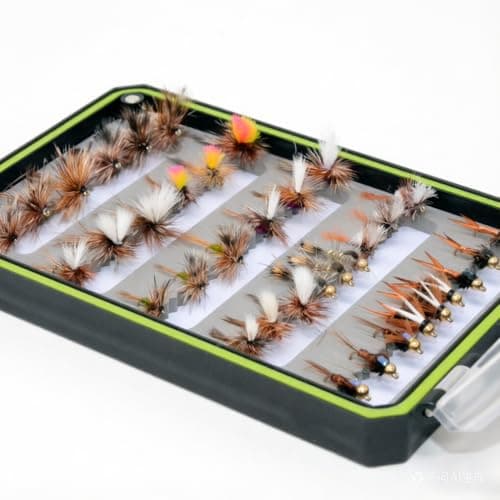
The most useful single purchase on this page, because it covers both halves of how a brown trout feeds. Adams dries and parachute variants for the hour either side of dark when browns come up, bead head nymphs for the long middle of the day when they do not, and — the part that matters most — a size spread from 10 down to 18. That spread is the difference between matching a hatch and guessing at it, and browns are the trout least forgiving of a fly that is twice the size of what they are eating. The magnetic box is a genuine convenience when your hands are cold and wet.
Best for: Best overall — one box that covers a whole brown trout day - 2
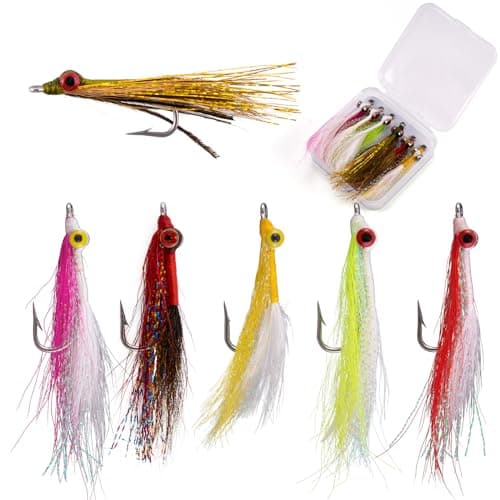
The cheapest pick on this page and the one most likely to hook the fish you have been trying to catch all season. Brown trout become fish-eaters as they grow, which is why the largest brown in a creek is usually caught on something that looks like a minnow rather than on a size 18 mayfly. A Clouser is a weighted baitfish streamer that rides hook-point-up, so it is less likely to foul on the bottom when you are fishing it right along the gravel where a big brown ambushes from. Six flies is enough to lose a few to snags, which you will.
Best for: Budget pick — and the fly that catches the biggest brown in the creek - 3
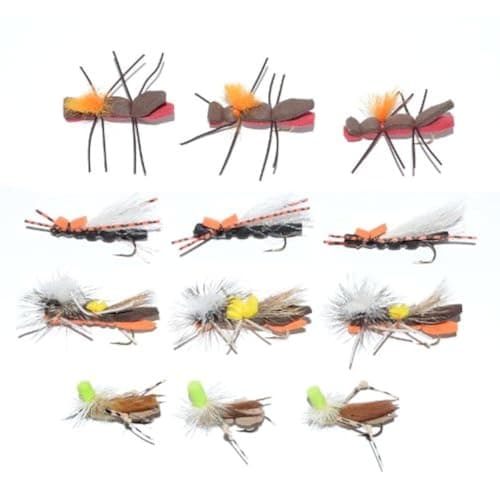
The pick for high summer, when the creek is low and clear and the mayflies have stopped. Browns in that water eat what falls in — hoppers, beetles, ants — and a big foam fly on the surface is the one presentation that will move a cautious fish out from under a bank in daylight. These are also the best indicator flies on this page: a Chernobyl Ant floats a beadhead nymph on eighteen inches of tippet, which means you fish the surface and the bottom at once. Twelve flies, and foam lasts far longer than hackle.
Best for: Best terrestrials — and the best hopper-dropper platform for a brown - 4
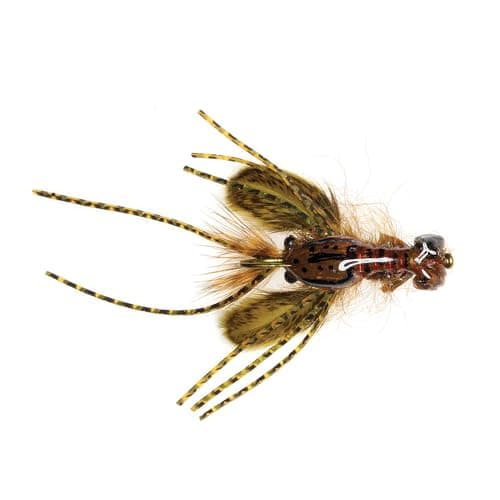
The pick that fills the gap in most anglers' boxes. Crayfish are a major part of a large brown trout's diet in rocky creeks and almost nobody carries one, which means the fish have not seen a good imitation recently. This is fished slowly along the bottom in rocky runs and pool tails rather than stripped like a minnow streamer, which also makes it the pattern to reach for when the water is slightly high and colored and a dry fly is pointless. It is a specialist, and if your creek has no crayfish it is the wrong purchase.
Best for: Best crayfish pattern — the food source most brown trout boxes ignore - 5
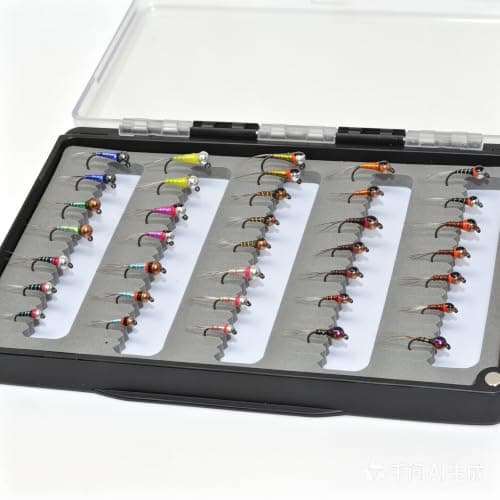
The pick for the problem that defeats most anglers on brown trout water: the fish is deeper than your fly. Perdigons are slim, hard-bodied, tungsten-beaded nymphs built to sink fast and cut through current rather than to look pretty, and that is precisely what you need to reach a brown lying in the deepest part of a pool or under a fast chute. Thirty-six flies across sizes 14 to 18 on barbless hooks, which releases fish cleanly and is required water in some places. They are not a substitute for a general nymph box — they are the sinking end of one.
Best for: Best deep nymphs — tungsten, to reach the slot a brown is actually holding in
| # | Product | Best for | Score | Price |
|---|---|---|---|---|
| 1 | 36-Piece Hand-Tied Adams Dry Fly and Bead Head Nymph Assortment, Sizes 10-18, with Magnetic Fly Box The most useful single purchase on this page, because it covers both halves of how a brown trout feeds. Adams dries and parachute variants for the hour either side of dark when browns come up, bead head nymphs for the long middle of the day when they do not, and — the part that matters most — a size spread from 10 down to 18. That spread is the difference between matching a hatch and guessing at it, and browns are the trout least forgiving of a fly that is twice the size of what they are eating. The magnetic box is a genuine convenience when your hands are cold and wet. | Best overall — one box that covers a whole brown trout day | — | $23.99View on Amazon#ad |
| 2 | Dr.Fish Clouser Minnow Streamer Flies, 6 Pack The cheapest pick on this page and the one most likely to hook the fish you have been trying to catch all season. Brown trout become fish-eaters as they grow, which is why the largest brown in a creek is usually caught on something that looks like a minnow rather than on a size 18 mayfly. A Clouser is a weighted baitfish streamer that rides hook-point-up, so it is less likely to foul on the bottom when you are fishing it right along the gravel where a big brown ambushes from. Six flies is enough to lose a few to snags, which you will. | Budget pick — and the fly that catches the biggest brown in the creek | — | $14.99View on Amazon#ad |
| 3 | The Fly Fishing Place Chernobyl Ant and Foam Grasshopper Collection, 12 Flies The pick for high summer, when the creek is low and clear and the mayflies have stopped. Browns in that water eat what falls in — hoppers, beetles, ants — and a big foam fly on the surface is the one presentation that will move a cautious fish out from under a bank in daylight. These are also the best indicator flies on this page: a Chernobyl Ant floats a beadhead nymph on eighteen inches of tippet, which means you fish the surface and the bottom at once. Twelve flies, and foam lasts far longer than hackle. | Best terrestrials — and the best hopper-dropper platform for a brown | — | $26.95View on Amazon#ad |
| 4 | Colorado Fly Supply Creek Crawler Crayfish Fly The pick that fills the gap in most anglers' boxes. Crayfish are a major part of a large brown trout's diet in rocky creeks and almost nobody carries one, which means the fish have not seen a good imitation recently. This is fished slowly along the bottom in rocky runs and pool tails rather than stripped like a minnow streamer, which also makes it the pattern to reach for when the water is slightly high and colored and a dry fly is pointless. It is a specialist, and if your creek has no crayfish it is the wrong purchase. | Best crayfish pattern — the food source most brown trout boxes ignore | — | $15.95View on Amazon#ad |
| 5 | Outdoor Planet 36-Piece Perdigon Nymph Assortment, Tungsten Barbless The pick for the problem that defeats most anglers on brown trout water: the fish is deeper than your fly. Perdigons are slim, hard-bodied, tungsten-beaded nymphs built to sink fast and cut through current rather than to look pretty, and that is precisely what you need to reach a brown lying in the deepest part of a pool or under a fast chute. Thirty-six flies across sizes 14 to 18 on barbless hooks, which releases fish cleanly and is required water in some places. They are not a substitute for a general nymph box — they are the sinking end of one. | Best deep nymphs — tungsten, to reach the slot a brown is actually holding in | — | $24.99View on Amazon#ad |
The best fly selection for brown trout is the 36-piece Adams dry and bead head nymph box in sizes 10 to 18 — it covers both halves of a brown trout day, and the size spread is what stops you guessing at a hatch. It is for the angler who wants one purchase that works from morning to dusk. The budget pick is the Dr.Fish Clouser minnow streamer, the cheapest thing here and the fly most likely to hook the largest brown in your creek. Prices come from our live retailer feed and are date-stamped under the comparison table.
This site covers brook trout and rainbows separately, and this page exists because browns genuinely want different flies rather than because the species makes a nice heading. The reasons are in the next section, and they change what you buy.
How brown trout differ from brookies and rainbows
Three differences matter for fly selection: browns eat bigger food, they feed hardest in low light, and they are the most cover-bound and the most easily spooked of the three. Every pick on this page follows from one of those.
| Brook trout | Rainbow trout | Brown trout | |
|---|---|---|---|
| Willingness to take a fly | Highest — often reckless | High | Lowest — most cautious |
| Food size preference | Small to medium | Small to medium | Largest, as the fish grows |
| Eats other fish | Occasionally | Sometimes | Routinely once over 12 inches |
| Best feeding light | All day | Morning and evening | Dusk, dawn and after dark |
| Where it holds | Open pockets and pools | Faster water and riffles | Under cover, deepest slot |
| Response to a bad cast | Often ignores it | Spooks and returns | Spooks and is gone |
The practical headline is that browns reward a bigger fly and punish a careless approach more than the other two. That is why a streamer and a foam hopper are on this page where they would not top a brook trout list, and why the single most useful thing you can change is not your fly but where you stand. The species-specific lists for the other two are in the best flies for brook trout and the best flies for rainbow trout.
What we have not done
The four fly types a brown trout box needs
A brown trout box is not a bigger version of a general trout box. It needs four categories, and most anglers carry two of them.
| Category | What it is for | When you need it | On this page |
|---|---|---|---|
| General dries and nymphs | Rising fish, and the quiet middle of the day | Always | Adams and nymph box |
| Baitfish streamers | The biggest brown in the creek | Low light, high water, autumn | Clouser minnows |
| Big terrestrials | Moving a cautious fish in daylight | Summer, low clear water | Chernobyl ants and hoppers |
| Fast-sinking nymphs | Reaching a deep holding slot | Bright days, deep pools | Tungsten perdigons |
| Crayfish | The food source nobody imitates | Rocky creeks, colored water | Creek Crawler |
The two most people are missing are the streamers and the fast-sinking nymphs, and they are missing them for the same reason: both are answers to depth. A box full of dries and standard beadhead nymphs fishes the top two feet of the water column, and a big brown spends its day below that. If you already own a general fly selection and want one addition, make it the Clouser minnows. The general trout fly field is in the best trout flies for beginners and the streamer field specifically is in the best streamers for trout.
The five compared
| Selection | Type | Count | Buy it if |
|---|---|---|---|
| 36-piece Adams and nymph box | Dries and nymphs, sizes 10-18 | 36 | You are buying one thing |
| Dr.Fish Clouser minnows | Weighted baitfish streamer | 6 | You want the biggest brown in the creek |
| Chernobyl ant and hopper collection | Foam terrestrials | 12 | You fish low clear summer water |
| Creek Crawler crayfish | Crayfish pattern | Single pattern | Your creek is rocky and has crayfish |
| Outdoor Planet perdigon nymphs | Tungsten barbless nymphs | 36 | Your fly is not reaching the fish |
The buying order, if you are starting from nothing: the Adams box, then the Clouser minnows, then the hoppers. Those three cover a season. The perdigons and the crayfish are both answers to specific problems — a fish too deep, and a food source your creek has — and they are worth buying once you have identified the problem rather than before.
Light and time of day decide more than pattern
A brown trout is substantially easier to catch in the last forty minutes of daylight than in the middle of the day, and no fly compensates for fishing at the wrong hour. This is the single most useful thing on this page and it costs nothing.
| Time | What browns are doing | What to fish |
|---|---|---|
| First light | Actively hunting in the open | Streamer, swung or stripped |
| Mid-morning | Dropping back under cover | Nymph, deep and slow |
| Bright midday | Holding in the deepest shade | Tungsten nymph, or a hopper tight to cover |
| Late afternoon | Beginning to look up | Dry fly to visible fish |
| Last hour of light | Feeding hardest of the day | Dry fly, then a streamer as it darkens |
| After dark | Hunting, often in shallow water | Large streamer, fished slowly |
If you can only fish one hour, fish the last one. Browns feed at dusk in a way that is not true of brook trout. And when you do, move slowly and stay low — a brown that has been spooked by movement on the bank does not come back the way a rainbow often will. How to read the water you are approaching is in the creek fishing gear guide.
Size: bigger, except when it is smaller
The general rule for browns is to fish a size larger than you would for brook trout. The exception is a fish that is actively feeding on something specific, where you must match it exactly. Those two statements look contradictory and they are not.
A brown that is not feeding has to be provoked, and a bigger fly provokes better. That is why streamers, hoppers and size 10 attractors work on fish that will not look at a size 18 mayfly. But a brown that is visibly rising to a hatch has selected a food item, and a brown is the trout least likely to accept a near miss — this is where the size spread down to 18 in the main box earns its place. The size logic in detail is in what size flies for trout, and the nymph field generally is in the best nymphs for trout.
The gear this assumes
The streamer and the hopper on this page will not cast on a 3-weight, and that is the one gear decision that follows from targeting browns. A weighted Clouser and a big air-resistant foam fly both need line weight behind them: a 4-weight at minimum and a 5-weight comfortably.
That is a real trade against the delicate small-stream setup a creek otherwise rewards. If you fish dries to visible fish most of the time and only occasionally throw a streamer, keep the light rod and accept the awkwardness — the 4-weight options are in the best 4 weight fly rods, and the general small-stream field is in the best fly rods for small streams.
Tippet is the other decision, and browns push it both ways. Fine tippet for a rising fish in low clear water, heavier for a streamer that a good brown will hit hard in fast water. Carry both — the sizing is in the best tippet for trout. A net matters more than usual too, because a large brown on fine tippet is lost at the bank more often than anywhere else: options in the best fly fishing nets.
The picks in detail
36-Piece Hand-Tied Adams Dry Fly and Bead Head Nymph Assortment, Sizes 10-18, with Magnetic Fly Box
Best for: Best overall — one box that covers a whole brown trout day
The most useful single purchase on this page, because it covers both halves of how a brown trout feeds. Adams dries and parachute variants for the hour either side of dark when browns come up, bead head nymphs for the long middle of the day when they do not, and — the part that matters most — a size spread from 10 down to 18. That spread is the difference between matching a hatch and guessing at it, and browns are the trout least forgiving of a fly that is twice the size of what they are eating. The magnetic box is a genuine convenience when your hands are cold and wet.
- Count
- 36 flies
- Sizes
- 10 to 18
- Mix
- Adams dries, parachutes, bead head nymphs
- Covers dries and nymphs in one purchase
- Sizes 10 to 18 — a real spread, not three sizes
- Magnetic box is easy to use with cold hands
- No streamers, which is where big browns are caught
- Unbranded hooks — check the points before tying on
Dr.Fish Clouser Minnow Streamer Flies, 6 Pack
Best for: Budget pick — and the fly that catches the biggest brown in the creek
The cheapest pick on this page and the one most likely to hook the fish you have been trying to catch all season. Brown trout become fish-eaters as they grow, which is why the largest brown in a creek is usually caught on something that looks like a minnow rather than on a size 18 mayfly. A Clouser is a weighted baitfish streamer that rides hook-point-up, so it is less likely to foul on the bottom when you are fishing it right along the gravel where a big brown ambushes from. Six flies is enough to lose a few to snags, which you will.
- Type
- Weighted baitfish streamer
- Count
- 6
- Rides
- Hook point up
- Cheapest pick here by a clear margin
- The fly class that catches the largest browns
- Hook-point-up ride means fewer bottom snags
- Needs a 5-weight or heavier rod to cast comfortably
- Wrong fly entirely for a rising fish
The Fly Fishing Place Chernobyl Ant and Foam Grasshopper Collection, 12 Flies
Best for: Best terrestrials — and the best hopper-dropper platform for a brown
The pick for high summer, when the creek is low and clear and the mayflies have stopped. Browns in that water eat what falls in — hoppers, beetles, ants — and a big foam fly on the surface is the one presentation that will move a cautious fish out from under a bank in daylight. These are also the best indicator flies on this page: a Chernobyl Ant floats a beadhead nymph on eighteen inches of tippet, which means you fish the surface and the bottom at once. Twelve flies, and foam lasts far longer than hackle.
- Count
- 12 flies
- Patterns
- Chernobyl Ant, foam grasshopper
- Use
- Dry, or as a dropper indicator
- Moves cautious browns out from under cover in daylight
- Doubles as the indicator in a hopper-dropper rig
- Foam bodies survive many fish
- Summer and early autumn only, in most creeks
- Big air-resistant flies are awkward to cast in brush
Colorado Fly Supply Creek Crawler Crayfish Fly
Best for: Best crayfish pattern — the food source most brown trout boxes ignore
The pick that fills the gap in most anglers' boxes. Crayfish are a major part of a large brown trout's diet in rocky creeks and almost nobody carries one, which means the fish have not seen a good imitation recently. This is fished slowly along the bottom in rocky runs and pool tails rather than stripped like a minnow streamer, which also makes it the pattern to reach for when the water is slightly high and colored and a dry fly is pointless. It is a specialist, and if your creek has no crayfish it is the wrong purchase.
- Type
- Crayfish pattern
- Presentation
- Slow, along the bottom
- Water
- Rocky runs and pool tails
- Imitates a major large-brown food source almost nobody carries
- Works in slightly high, colored water
- Fished slowly, so it is easy to present well
- Useless if your creek has no crayfish
- Bottom-bouncing means lost flies on rocky beds
Outdoor Planet 36-Piece Perdigon Nymph Assortment, Tungsten Barbless
Best for: Best deep nymphs — tungsten, to reach the slot a brown is actually holding in
The pick for the problem that defeats most anglers on brown trout water: the fish is deeper than your fly. Perdigons are slim, hard-bodied, tungsten-beaded nymphs built to sink fast and cut through current rather than to look pretty, and that is precisely what you need to reach a brown lying in the deepest part of a pool or under a fast chute. Thirty-six flies across sizes 14 to 18 on barbless hooks, which releases fish cleanly and is required water in some places. They are not a substitute for a general nymph box — they are the sinking end of one.
- Count
- 36 flies
- Sizes
- 14, 16, 18
- Bead
- Tungsten, barbless hooks
- Tungsten beads reach depth without added weight on the leader
- Barbless, so clean releases and legal on regulated water
- Thirty-six flies across three sizes
- Slim modern patterns, not a general-purpose nymph selection
- Sizes 14 to 18 only — nothing bigger for high water
Prices shown are from Amazon as of November 21, 2026 and change often — the button always goes to the current listing. Some links may earn us a commission at no extra cost to you. How this works.
Frequently asked questions
What is the best fly for brown trout?
There is no single answer, but the most productive fly class for large browns is a baitfish streamer like a Clouser minnow, because browns become fish-eaters once they pass about twelve inches. For a whole day's fishing, a box of Adams dries and bead head nymphs in sizes 10 to 18 covers more situations than any one pattern. In low clear summer water, a big foam hopper or Chernobyl ant is the fly that moves a cautious fish out from under cover.
Do brown trout take bigger flies than rainbows?
As a rule, yes. Browns become predatory on other fish as they grow and will eat larger food than brook trout or rainbows of the same size, which is why streamers, crayfish and big terrestrials belong in a brown trout box. The exception is a brown actively feeding on a hatch — then it is the most selective of the three and you have to match the size exactly.
What time of day is best for brown trout?
The last hour of daylight, and after dark. Browns feed hardest in low light in a way that is not true of brook trout, which feed throughout the day. If you can only fish one hour, fish dusk — and move slowly, because a brown spooked by movement on the bank does not come back the way a rainbow often will.
Are streamers necessary for brown trout?
Not necessary, but they are the fly class most likely to catch the biggest fish in the creek. A box of dries and standard beadhead nymphs fishes the top two feet of the water column, and a large brown spends most of its day below that. If you already own a general fly selection and want one addition for browns, make it weighted baitfish streamers.
Do brown trout eat crayfish?
Large ones do, routinely, in rocky creeks — and almost nobody carries a crayfish pattern, which means the fish have not seen a good imitation recently. Fish it slowly along the bottom in rocky runs and pool tails rather than stripping it like a minnow. If your creek has no crayfish, it is the wrong fly to buy.
What rod do I need to fish streamers for brown trout?
A 4-weight at minimum and a 5-weight comfortably. A weighted Clouser and a big foam hopper both need line weight behind them, and neither will cast properly on a 3-weight. If most of your fishing is dry flies to visible fish on small water, keep the lighter rod and accept the awkwardness on the occasional streamer rather than buying up for a minority of your casts.
Sources
Keep reading
Not sure where to start?
The beginner gear guide walks you through exactly what a new stream angler needs — the six essentials first, nice-to-haves later, with one safe-default pick per category.