Flies & Lures · Roundup
The Best Summer Trout Flies
Summer is the one season where the hatch chart stops helping. Mayflies thin out, the water drops and warms, and the food that matters starts falling off the bank instead of rising out of the riverbed. These are the flies that match that, and the boxes that carry them.
Disclosure: Creek Cover is reader-supported. If you buy through our links we may earn a commission, at no extra cost to you. It never changes which pick we tell a new angler to start with. Full disclosure.
Quick picks at a glance
Tap a pick to read the full write-up, or the price button to check it on Amazon.
- 1
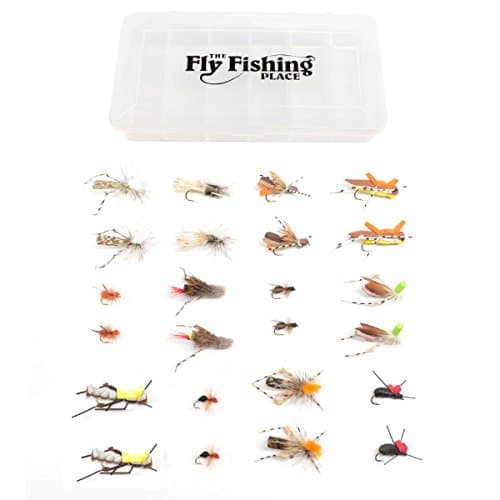
Twenty-four flies spread across foam hoppers, ants, beetles and cicadas, with a box included. That is the summer menu on a small stream, because every one of those insects lives in the grass and brush on the bank rather than in the water, and gravity does the rest. A dedicated terrestrial box is the clearest upgrade a creek angler can make between June and September, and this is the sensible quantity: enough to lose a few in the willows without rationing.
Best for: Best overall — the summer food group, in one box - 2
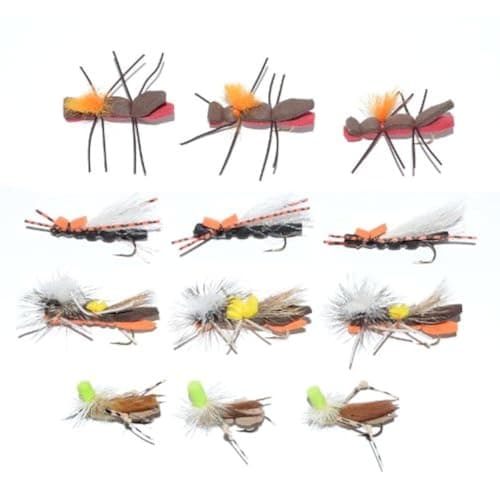
A dozen large foam flies, and the reason to buy them is as much structural as it is about imitation. A Chernobyl Ant is a slab of foam with rubber legs: it floats a bead head nymph eighteen inches below it without sinking, which turns one fly into a two-depth rig. Trout in thin summer water eat it as a hopper, or a beetle, or as something they cannot classify, and that ambiguity is the point. Twelve is a small count, but these are flies that survive fish rather than ones you lose constantly.
Best for: Best hopper-dropper platform — big foam that floats a nymph - 3
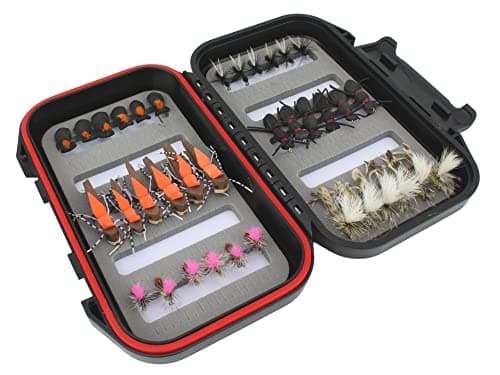
Thirty-six terrestrials with a box, and the widest variety on this page. If your creek runs through meadow in one stretch and hardwood shade in the next, those two stretches ask for different insects, and a bigger spread means you have both. It also covers panfish water, which matters more than it sounds: plenty of small creeks hold bluegill and sunfish in the slow pools, and they eat beetles and ants with more enthusiasm than trout do.
Best for: Best wide spread — most terrestrial variety per purchase - 4
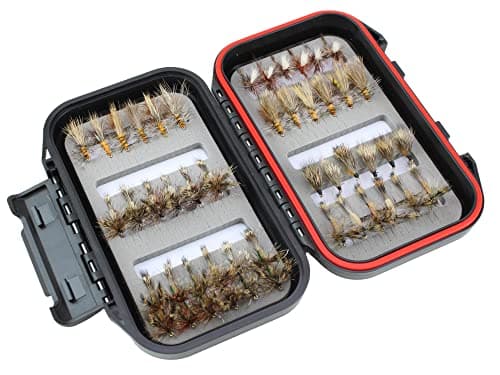
Forty-two attractor dries, which is the other half of the summer answer. Terrestrials work along banks; attractors work in the fast, bubbly pocket water that stays cool and oxygenated when the rest of the creek goes slack. A Stimulator-style fly rides high in a chute, stays visible in foam, and gets eaten by fish that have perhaps two seconds to decide. The honest limit is that an attractor imitates nothing in particular, so in flat clear water a trout gets time to notice.
Best for: Best for pocket water — attractors for fast, broken summer flow - 5
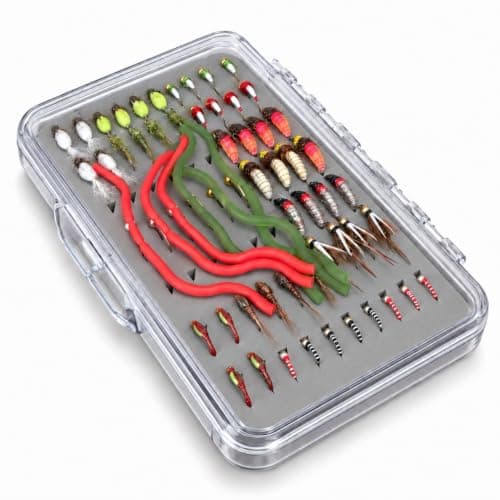
Summer fishing is a morning and evening sport, and the hours in between are nymph hours. Fish hold deep in the coldest water they can find and will not climb three feet through warm surface water for a hopper at two in the afternoon. A zebra midge, a Hare's Ear and a squirmy worm in sizes 10 to 18 cover that window honestly, and the small end of the range is the half that matters once the water drops and clears.
Best for: Best for the heat of the day — when nothing will look up
| # | Product | Best for | Score | Price |
|---|---|---|---|---|
| 1 | The Fly Fishing Place Essential Terrestrials Collection, 2 Dozen with Fly Box Twenty-four flies spread across foam hoppers, ants, beetles and cicadas, with a box included. That is the summer menu on a small stream, because every one of those insects lives in the grass and brush on the bank rather than in the water, and gravity does the rest. A dedicated terrestrial box is the clearest upgrade a creek angler can make between June and September, and this is the sensible quantity: enough to lose a few in the willows without rationing. | Best overall — the summer food group, in one box | — | $39.95View on Amazon#ad |
| 2 | The Fly Fishing Place Chernobyl Ant and Foam Grasshopper Collection, 12 Flies A dozen large foam flies, and the reason to buy them is as much structural as it is about imitation. A Chernobyl Ant is a slab of foam with rubber legs: it floats a bead head nymph eighteen inches below it without sinking, which turns one fly into a two-depth rig. Trout in thin summer water eat it as a hopper, or a beetle, or as something they cannot classify, and that ambiguity is the point. Twelve is a small count, but these are flies that survive fish rather than ones you lose constantly. | Best hopper-dropper platform — big foam that floats a nymph | — | $26.95View on Amazon#ad |
| 3 | Wild Water Fly Fishing 36-Piece Terrestrial Fly Assortment with Fly Box Thirty-six terrestrials with a box, and the widest variety on this page. If your creek runs through meadow in one stretch and hardwood shade in the next, those two stretches ask for different insects, and a bigger spread means you have both. It also covers panfish water, which matters more than it sounds: plenty of small creeks hold bluegill and sunfish in the slow pools, and they eat beetles and ants with more enthusiasm than trout do. | Best wide spread — most terrestrial variety per purchase | — | $39.00View on Amazon#ad |
| 4 | Wild Water Fly Fishing 42-Piece Attractor and Stimulator Fly Assortment with Fly Box Forty-two attractor dries, which is the other half of the summer answer. Terrestrials work along banks; attractors work in the fast, bubbly pocket water that stays cool and oxygenated when the rest of the creek goes slack. A Stimulator-style fly rides high in a chute, stays visible in foam, and gets eaten by fish that have perhaps two seconds to decide. The honest limit is that an attractor imitates nothing in particular, so in flat clear water a trout gets time to notice. | Best for pocket water — attractors for fast, broken summer flow | — | $45.00View on Amazon#ad |
| 5 | Trout Nymph Assortment: Squirmy Worm, Zebra Midge and Hare's Ear, Sizes 10-18 Summer fishing is a morning and evening sport, and the hours in between are nymph hours. Fish hold deep in the coldest water they can find and will not climb three feet through warm surface water for a hopper at two in the afternoon. A zebra midge, a Hare's Ear and a squirmy worm in sizes 10 to 18 cover that window honestly, and the small end of the range is the half that matters once the water drops and clears. | Best for the heat of the day — when nothing will look up | — | $23.99View on Amazon#ad |
The best summer trout flies are terrestrials — hoppers, ants, beetles and cicadas — and the 24-piece essential terrestrials box is the cleanest way to own them. Add a dozen big foam flies if you want to fish a hopper-dropper rig, an attractor box if your creek is steep and broken rather than slow and meadowy, and a small nymph selection for the hours when nothing will look up.
Summer is the season that breaks the standard fly selection. Spring and autumn are hatch seasons: insects emerge from the streambed on a schedule, trout feed on them, and matching the hatch is a reasonable plan. By July on a small stream the water is low, warm and clear, the big hatches are over, and the most reliable protein in the system is falling in from the bank. The flies that work in August are not smaller versions of the flies that worked in May. They are different insects entirely.
Why summer changes the box
The water drops, so the fish move. A creek at summer flow is a different river from the same creek in April. Riffles that held fish in spring are now ankle-deep and empty, and trout concentrate in three places: the deepest pools, the fast oxygenated chutes, and anywhere shade and cover meet moving water. That last category — an undercut bank beneath overhanging brush — is where terrestrials get eaten, because that is where they fall in.
The water clears, so the fish get careful. Low summer flow is usually clear flow, and a trout in clear water sees your leader, your line and your silhouette. This is the season where a long fine tippet and an upstream approach matter more than pattern choice. The X sizing that decides how fine you can go is covered in fly line, leader and tippet explained.
The water warms, so the feeding windows shrink. Trout are cold-water fish. As stream temperature climbs through the 60s Fahrenheit their metabolism rises while the amount of dissolved oxygen the water can hold falls, which is an unpleasant combination: hungrier fish with less capacity to chase. The practical result is that summer fishing happens early and late, and the middle of the day is for sitting under a tree. That is not a limitation to fight. It is the schedule.
The one rig to know for summer creeks
Terrestrials: the summer food group
A terrestrial is a land insect that ended up in the water by accident. Grasshoppers jump wrong. Ants get blown off leaves. Beetles lose their grip. Cicadas, in the years they appear, fall in by the thousand. None of this is a hatch — there is no emergence to match and no schedule to learn. It is a steady accident rate that peaks in high summer, when insect populations on the bank are at their largest.
Small, brushy creeks are the best terrestrial water there is. The ratio that matters is bank length to water volume. A narrow stream with trees and tall grass leaning over it collects far more fallen insects per gallon than a wide river does, and the trout living there know it. On a creek you can fish a beetle tight to the bank all afternoon in August and catch fish that would ignore a mayfly imitation entirely.
Ants are the most underrated fly in the box. Hoppers get the attention because they are big and dramatic, but a size 16 black ant catches trout on days when nothing else does, including days when fish are refusing everything else you own. Ants are abundant all summer, they look identical in silhouette to the real thing, and trout appear to eat them with very little inspection. If one fly from a terrestrial box earns its place, it is the ant.
Beetles are the clear-water answer. A foam beetle is a dark, compact, low-floating shape that does not spook a fish in glassy water the way a size 8 hopper can. On the flat pools where summer trout stack up, a beetle dropped two feet above a holding fish is a quieter presentation than anything with rubber legs.
Hoppers are a meadow fly, and worth being honest about. If your creek runs through grassland, a hopper is deadly from mid-July onward. If it runs through closed-canopy forest, grasshoppers are scarce and a big hopper pattern mostly serves as a dropper float. Buy the box for the ants and beetles; use the hoppers where the habitat justifies them.
Attractors and pocket water
Pocket water is where summer trout go to breathe. Fast water tumbling over rock holds more dissolved oxygen and runs cooler than the slack pool below it. In a hot August week the fish in a creek will often be sitting in flow you would have walked straight past in spring, in pockets the size of a bathtub behind boulders.
That water wants a high-floating attractor, not a delicate match. A fish in a chute has a fraction of a second to decide, the surface is broken, and a sparse size 18 mayfly imitation drowns on the second cast. A Stimulator-style attractor with heavy hackle and a bright body stays up, stays visible to you, and gets taken on impulse. The dry fly roundup covers the five patterns that carry a whole season, and the Stimulator is on that list for exactly this reason.
Fish pocket water close and short. Twenty feet of line on broken current drags instantly. Get within rod-length of the pocket, keep the line off the water, and drop the fly at the head of the seam. A short rod helps more than a long one here — the case is made in the small-stream rod guide.
The middle of the day
Between roughly eleven and four, summer trout stop looking up. The surface layer is the warmest water in the creek and the fish are in the coldest part of the pool, usually where a spring seeps in or where the current has dug under a rock ledge. Asking them to rise through four feet of bathwater for a dry fly is asking a lot.
Go small and go down. A size 16 to 18 zebra midge or a small Hare's Ear drifted along the bottom of the deepest available slot is the midday tactic. This is also the window where a worm pattern earns its keep after a summer thunderstorm, when a creek rises and colors up for a few hours — the only time all season that stained water comes into it. The full subsurface argument is in the nymph roundup.
Or fish the shade instead of the depth. On small water there is a second option: find the stretch with the heaviest canopy, stay low, and fish a beetle tight to the bank. Shaded water stays cooler and the fish under it are more willing. It is slower fishing than dawn, but it is fishing.
The five boxes compared
| Box | Flies | What it covers | Buy it if |
|---|---|---|---|
| Essential Terrestrials, 2 dozen | 24 | Hoppers, ants, beetles, cicadas | You want one summer box and no decisions |
| Chernobyl Ant & foam hopper | 12 | Large foam dries | You intend to fish hopper-dropper all summer |
| Wild Water 36 terrestrials | 36 | Widest terrestrial variety | Your creek changes character stretch to stretch |
| Wild Water 42 attractors | 42 | Stimulators and attractor dries | Your water is steep, fast and broken |
| Squirmy / midge / Hare's Ear nymphs | Assortment, sizes 10-18 | Subsurface, small | You fish midday or after summer rain |
Two boxes is the complete answer. A terrestrial box and a small nymph selection will cover a small stream from June to September. The attractor box is the third purchase, and it is a genuine upgrade only if your creek has real gradient. If you are starting from nothing at all, the mixed assortments in the beginner fly roundup are a better first buy than any single-season box.
Sizes and colors to buy
| Fly | Summer size | Color | Where to fish it |
|---|---|---|---|
| Foam beetle | 14 to 16 | Black, peacock | Flat clear pools, tight to the bank |
| Flying and black ant | 14 to 18 | Black, cinnamon | Anywhere, any summer day — the quiet default |
| Foam hopper | 8 to 12 | Tan, yellow | Meadow stretches, grassy banks, afternoon wind |
| Chernobyl-style foam | 8 to 10 | Tan, black | As the dry in a hopper-dropper rig |
| Stimulator / attractor | 10 to 14 | Yellow, orange | Chutes, riffles and pocket water |
| Zebra midge | 16 to 18 | Black with silver | Deep slots in the middle of the day |
Go one size smaller than you think in clear water. Low summer flow is the most transparent water of the year and fish get a long look at the fly. If a terrestrial is inspected and refused twice, the first change is a smaller version of the same insect, not a different pattern. The general case for sizing is in what size flies to use for trout.
Buy floatant with the flies. Foam does not need much help, but a hackled attractor fishing in broken water will waterlog within an hour, and a gel or powder floatant roughly doubles the time a dry fly spends actually floating. It is a few dollars and it belongs in the same pocket — see the accessories guide for the short list of small items that genuinely change a day. A slit-foam fly box is the other thing to sort out before the flies arrive loose in a bag.
Water temperature and when to stop
Warm water is the real summer limit, and it is a fish-welfare question. Cold water holds more dissolved oxygen than warm water, so as a stream heats up a trout gets less oxygen exactly when a fight demands more of it. Widely published guidance across trout fisheries puts the caution line around 68 degrees Fahrenheit: above it, a released fish is far less likely to recover, however carefully you handle it.
Carry a thermometer, and check before you fish. A stream thermometer costs very little and turns the question from a guess into a number. The US Geological Survey publishes real-time water temperature at thousands of stream gauges, which is a useful way to see what the creeks in your area are doing before you drive to one. If the water is at or over the caution line, fish a different stream, move higher up where it is colder, or go in the morning — the coldest water of the day is around dawn.
Practical summer handling. Land fish quickly rather than playing them out, keep them in the water while you unhook, use a net with soft mesh instead of your hands, and pinch the barb so the hook comes out in one movement. A rubber-mesh landing net does more for a released summer trout than any other piece of gear you own.
And know when the season turns. The first cool nights in late August drop water temperatures, fish spread back out of the deep pools, and terrestrials stay good right through September while the autumn hatches build. Brook and brown trout spawn in autumn, so from October onward pale gravel beds in shallow water should be walked around rather than fished over — flies for brook trout covers that water in more detail.
The picks in detail
The Fly Fishing Place Essential Terrestrials Collection, 2 Dozen with Fly Box
Best for: Best overall — the summer food group, in one box
Twenty-four flies spread across foam hoppers, ants, beetles and cicadas, with a box included. That is the summer menu on a small stream, because every one of those insects lives in the grass and brush on the bank rather than in the water, and gravity does the rest. A dedicated terrestrial box is the clearest upgrade a creek angler can make between June and September, and this is the sensible quantity: enough to lose a few in the willows without rationing.
- Count
- 24 flies
- Patterns
- Hoppers, ants, beetles, cicadas
- Box
- Included
- Covers all four terrestrial families rather than just hoppers
- Foam construction floats hard, which is what a dropper needs
- Box included, so it is one purchase rather than two
- Terrestrial-only — you still need nymphs for the middle of the day
- Costs more per fly than a bulk mixed assortment
The Fly Fishing Place Chernobyl Ant and Foam Grasshopper Collection, 12 Flies
Best for: Best hopper-dropper platform — big foam that floats a nymph
A dozen large foam flies, and the reason to buy them is as much structural as it is about imitation. A Chernobyl Ant is a slab of foam with rubber legs: it floats a bead head nymph eighteen inches below it without sinking, which turns one fly into a two-depth rig. Trout in thin summer water eat it as a hopper, or a beetle, or as something they cannot classify, and that ambiguity is the point. Twelve is a small count, but these are flies that survive fish rather than ones you lose constantly.
- Count
- 12 flies
- Patterns
- Chernobyl Ant, foam grasshopper
- Use
- Dry, or as a dropper indicator
- Floats a weighted nymph — the most effective summer creek rig there is
- Highly visible on broken water, so you see refusals and takes
- Foam bodies do not waterlog the way hackled dries do
- Only 12 flies, and no box included
- Too big for very small, very clear spring creeks
Wild Water Fly Fishing 36-Piece Terrestrial Fly Assortment with Fly Box
Best for: Best wide spread — most terrestrial variety per purchase
Thirty-six terrestrials with a box, and the widest variety on this page. If your creek runs through meadow in one stretch and hardwood shade in the next, those two stretches ask for different insects, and a bigger spread means you have both. It also covers panfish water, which matters more than it sounds: plenty of small creeks hold bluegill and sunfish in the slow pools, and they eat beetles and ants with more enthusiasm than trout do.
- Count
- 36 flies
- Patterns
- Terrestrial assortment
- Also for
- Panfish, crappie, sunfish
- Most patterns and sizes of any terrestrial box here
- Doubles as a panfish box on slow creek pools
- Box included
- Assortment-grade tying — expect to cull a few on inspection
- A wide spread means fewer backups of the pattern that works
Wild Water Fly Fishing 42-Piece Attractor and Stimulator Fly Assortment with Fly Box
Best for: Best for pocket water — attractors for fast, broken summer flow
Forty-two attractor dries, which is the other half of the summer answer. Terrestrials work along banks; attractors work in the fast, bubbly pocket water that stays cool and oxygenated when the rest of the creek goes slack. A Stimulator-style fly rides high in a chute, stays visible in foam, and gets eaten by fish that have perhaps two seconds to decide. The honest limit is that an attractor imitates nothing in particular, so in flat clear water a trout gets time to notice.
- Count
- 42 flies
- Style
- Attractor and Stimulator dries
- Water
- Riffles, chutes, pocket water
- Floats high in broken water where a standard mayfly dry drowns
- Highest fly count on this page
- Carries a dropper nymph well
- Largest total outlay of the boxes here
- Attractors get refused in slow, glassy pools
Trout Nymph Assortment: Squirmy Worm, Zebra Midge and Hare's Ear, Sizes 10-18
Best for: Best for the heat of the day — when nothing will look up
Summer fishing is a morning and evening sport, and the hours in between are nymph hours. Fish hold deep in the coldest water they can find and will not climb three feet through warm surface water for a hopper at two in the afternoon. A zebra midge, a Hare's Ear and a squirmy worm in sizes 10 to 18 cover that window honestly, and the small end of the range is the half that matters once the water drops and clears.
- Patterns
- Squirmy worm, zebra midge, Hare's Ear
- Sizes
- 10 to 18
- Use
- Dropper or standalone nymph
- Covers the midday hours the dry boxes cannot
- Small sizes suited to low, clear summer water
- Works hung off any of the foam flies above
- Not a dry fly box — buy it alongside one, not instead
- Bead heads make it a sinking rig, so you need tippet to fish it properly
Prices shown are from Amazon as of October 20, 2026 and change often — the button always goes to the current listing. Some links may earn us a commission at no extra cost to you. How this works.
Frequently asked questions
What flies should I use for trout in summer?
Terrestrials first: ants, beetles, foam hoppers and, in cicada years, cicadas. They are the most abundant food in a small stream in July and August because they fall in from the bank rather than hatching out of the water. Add a small zebra midge or Hare's Ear nymph for the middle of the day, and an attractor dry such as a Stimulator if your creek has fast pocket water.
What is the best time of day to fly fish in summer?
The first two hours after first light and the last two before dark. Water is coolest around dawn, dissolved oxygen is highest, and trout feed in both windows. Midday in high summer is the worst fishing of the day and also the hardest on released fish, so it is the time to go subsurface and small, or to stop.
Do dry flies work in summer?
Yes, and summer is arguably the best dry fly season on small water. Creek trout have short feeding windows and limited food, so they will come up for a plausible terrestrial whether or not anything is hatching. The difference from spring is what you tie on: a foam beetle or ant rather than a mayfly imitation.
What size terrestrial flies for small streams?
Size 14 to 16 beetles, 14 to 18 ants, and 8 to 12 hoppers. On genuinely small, clear creeks the smaller end wins because the fish get a long look at the fly in low summer flow. Large foam patterns are most useful as the floating half of a hopper-dropper rig rather than as the fly you expect to be eaten.
Is it bad to fish for trout in hot weather?
It can be. Warm water holds less dissolved oxygen, so a trout caught and released above roughly 68 degrees Fahrenheit is much less likely to survive. Carry a thermometer, check the temperature before you start, and if the water is too warm, fish early, move to a colder headwater stretch, or leave it for another day.
Sources
Keep reading
Not sure where to start?
The beginner gear guide walks you through exactly what a new stream angler needs — the six essentials first, nice-to-haves later, with one safe-default pick per category.