Fly Rods & Reels · Roundup
The Best Leader for Trout
The leader is the only part of your fly setup the trout can see clearly, and it is the part most beginners buy last and understand least. Get the length and the X-rating right for small water and your fly lands where you aimed it. Get them wrong and a perfectly good cast piles up in a heap three feet short.
Disclosure: Creek Cover is reader-supported. If you buy through our links we may earn a commission, at no extra cost to you. It never changes which pick we tell a new angler to start with. Full disclosure.
Quick picks at a glance
Tap a pick to read the full write-up, or the price button to check it on Amazon.
- 1
The best all-round trout leader, and the one a shop would hand you without asking a follow-up question. Nine feet and 5X is the standard trout combination for a reason: it is long enough to put some distance between a bright fly line and a wary fish, and 5X is fine enough for a size 16 dry fly while still being strong enough to pull a size 10 nymph out of a snag. RIO describes it as nylon copolymer with a hand-tied perfection loop, and the loop is the detail that matters to a beginner — it joins to the loop on your fly line in about four seconds with no knot to learn. The three-pack reflects how leaders are actually consumed: every fly change shortens the tip, and after enough changes you tie on fresh rather than extending it forever.
Best for: Best overall — the 9-foot 5X that covers most of a trout season - 2
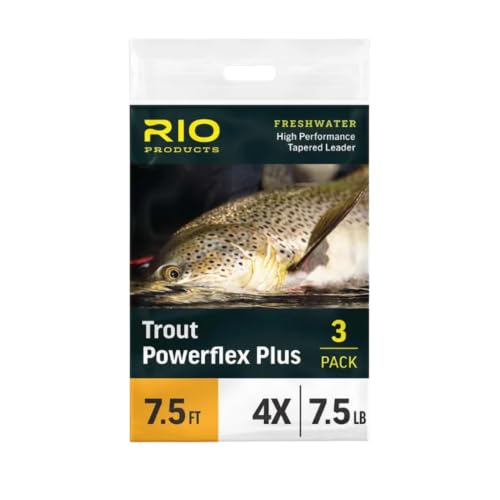
The pick that most small-stream anglers should probably own instead of the 9-footer, and almost nobody is told about. A nine-foot leader needs room and line speed to straighten; on a creek you are making a twenty-foot cast from a crouch under a branch, and a long leader simply does not have time to turn over before the fly lands. Seven and a half feet of the same copolymer taper straightens on a short stroke, lands the fly where you were looking, and is dramatically less likely to tangle when you flick a bow-and-arrow cast into a pocket. You trade a little stealth on flat, clear water — and on a brushy brook trout creek you rarely needed that stealth anyway, because the fish are looking up through broken surface.
Best for: Best for brushy creeks — the short leader that turns over in tight cover - 3
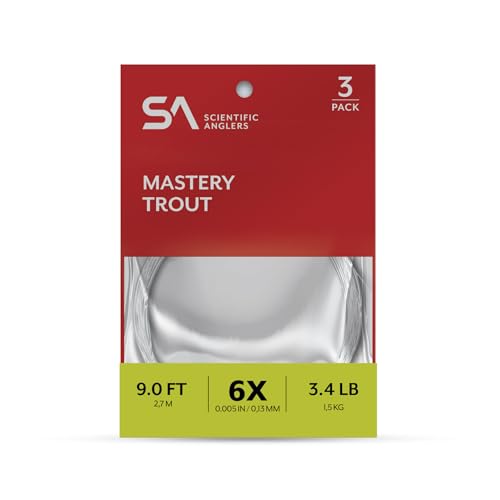
The alternative to the RIO at the same length and tip, and the reason to pick it is presentation. Scientific Anglers describes the Mastery Trout leader as supple and versatile, built to support clean, controlled presentations, and a more supple butt section behaves differently in a practical way: it drops the fly with less energy left in the leader, which means fewer spooked fish in a flat pool and a dry fly that sits rather than slaps. The flip side is the same coin — a softer leader turns over a heavy or wind-resistant fly less decisively, so it is the better dry-fly leader and the worse weighted-nymph leader. At this length and X-rating it is a straight preference call against the RIO rather than a better-or-worse one.
Best for: Best for dry flies — a supple taper that lands softly - 4
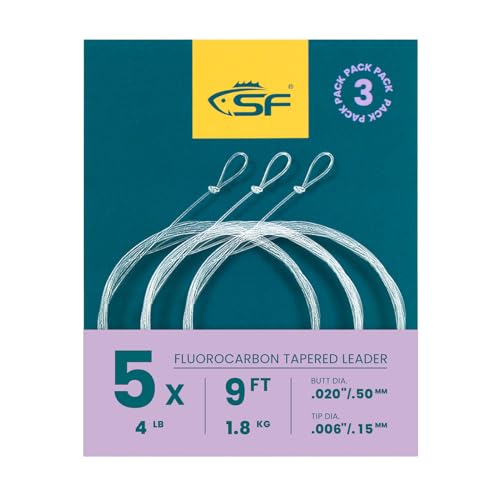
The pick for subsurface fishing, and the one place where fluorocarbon genuinely earns its price over nylon. SF lists this as 100 percent fluorocarbon with abrasion and UV resistance, a pre-tied perfection loop, and a material that sinks fast — and sinking is the point. A nylon leader floats in the surface film, which pulls a nymph up and puts a hinge in your drift; fluorocarbon cuts through and gets the fly down where the fish are. It is also harder than nylon, which matters on a creek where every drift ends somewhere near a rock. Where it does not help is dry-fly fishing, because a sinking leader drags the back of a dry fly under. One rig, one material.
Best for: Best fluorocarbon leader — nymphing, and water you can see the bottom of - 5
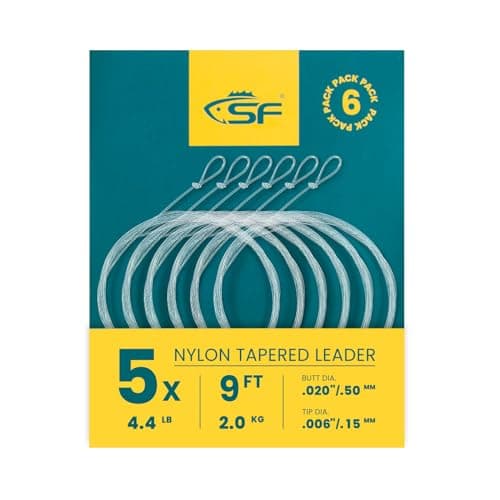
The pick for the first season, when you are going to lose leaders in trees rather than wear them out on fish. Six nylon tapered leaders with hand-tied loops for a few dollars means you can tie on a fresh one without doing arithmetic, and that matters more than it sounds: beginners fish a mangled, knotted, shortened leader for far too long because replacing it feels expensive. The compromise against a RIO or Scientific Anglers leader is consistency of the taper from leader to leader, which shows up as turnover that is good rather than excellent. For creek fishing with a size 14 dry or a bead-head nymph, that difference is smaller than the difference between a fresh leader and a tired one.
Best for: Best value multipack — six leaders for learning on - 6
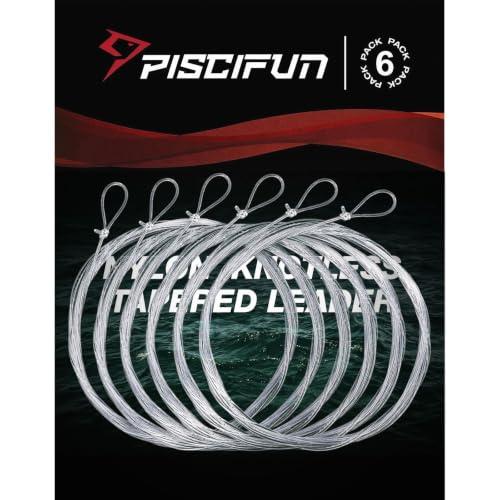
The budget pick, and the answer to the genuinely bad option, which is fishing a leader you have knotted back together four times because a new one felt like a waste. Piscifun lists these as nylon tapered leaders at 9 feet and 5X with a pre-tied loop, six to a pack, and they are the cheapest leaders here by a clear margin. Buy them to learn on. You will notice that turnover is less crisp than a RIO in a headwind, and the clear nylon is a little stiffer than a premium copolymer, which makes a fine tippet knot slightly fussier to seat. Neither of those things will cost you a creek trout that a fresh leader would have caught.
Best for: Best budget pick — the cheapest leader on this page
| # | Product | Best for | Score | Price |
|---|---|---|---|---|
| 1 | RIO Products Trout Powerflex Plus Leader, 9 ft, 5X, 3 Pack The best all-round trout leader, and the one a shop would hand you without asking a follow-up question. Nine feet and 5X is the standard trout combination for a reason: it is long enough to put some distance between a bright fly line and a wary fish, and 5X is fine enough for a size 16 dry fly while still being strong enough to pull a size 10 nymph out of a snag. RIO describes it as nylon copolymer with a hand-tied perfection loop, and the loop is the detail that matters to a beginner — it joins to the loop on your fly line in about four seconds with no knot to learn. The three-pack reflects how leaders are actually consumed: every fly change shortens the tip, and after enough changes you tie on fresh rather than extending it forever. | Best overall — the 9-foot 5X that covers most of a trout season | — | $14.99View on Amazon#ad |
| 2 | RIO Products Trout Powerflex Plus Leader, 7.5 ft, 5X, 3 Pack The pick that most small-stream anglers should probably own instead of the 9-footer, and almost nobody is told about. A nine-foot leader needs room and line speed to straighten; on a creek you are making a twenty-foot cast from a crouch under a branch, and a long leader simply does not have time to turn over before the fly lands. Seven and a half feet of the same copolymer taper straightens on a short stroke, lands the fly where you were looking, and is dramatically less likely to tangle when you flick a bow-and-arrow cast into a pocket. You trade a little stealth on flat, clear water — and on a brushy brook trout creek you rarely needed that stealth anyway, because the fish are looking up through broken surface. | Best for brushy creeks — the short leader that turns over in tight cover | — | $14.99View on Amazon#ad |
| 3 | Scientific Anglers Mastery Trout Leader, 9 ft, 5X, 3 Pack The alternative to the RIO at the same length and tip, and the reason to pick it is presentation. Scientific Anglers describes the Mastery Trout leader as supple and versatile, built to support clean, controlled presentations, and a more supple butt section behaves differently in a practical way: it drops the fly with less energy left in the leader, which means fewer spooked fish in a flat pool and a dry fly that sits rather than slaps. The flip side is the same coin — a softer leader turns over a heavy or wind-resistant fly less decisively, so it is the better dry-fly leader and the worse weighted-nymph leader. At this length and X-rating it is a straight preference call against the RIO rather than a better-or-worse one. | Best for dry flies — a supple taper that lands softly | — | $12.95View on Amazon#ad |
| 4 | SF Fly Fishing Fluorocarbon Tapered Leader, 9 ft, 5X, Pre-Tied Loop The pick for subsurface fishing, and the one place where fluorocarbon genuinely earns its price over nylon. SF lists this as 100 percent fluorocarbon with abrasion and UV resistance, a pre-tied perfection loop, and a material that sinks fast — and sinking is the point. A nylon leader floats in the surface film, which pulls a nymph up and puts a hinge in your drift; fluorocarbon cuts through and gets the fly down where the fish are. It is also harder than nylon, which matters on a creek where every drift ends somewhere near a rock. Where it does not help is dry-fly fishing, because a sinking leader drags the back of a dry fly under. One rig, one material. | Best fluorocarbon leader — nymphing, and water you can see the bottom of | — | $9.99View on Amazon#ad |
| 5 | SF Fly Fishing Tapered Leader, 9 ft, 5X, 6 Pack The pick for the first season, when you are going to lose leaders in trees rather than wear them out on fish. Six nylon tapered leaders with hand-tied loops for a few dollars means you can tie on a fresh one without doing arithmetic, and that matters more than it sounds: beginners fish a mangled, knotted, shortened leader for far too long because replacing it feels expensive. The compromise against a RIO or Scientific Anglers leader is consistency of the taper from leader to leader, which shows up as turnover that is good rather than excellent. For creek fishing with a size 14 dry or a bead-head nymph, that difference is smaller than the difference between a fresh leader and a tired one. | Best value multipack — six leaders for learning on | — | $6.99View on Amazon#ad |
| 6 | Piscifun Fly Fishing Leader with Pre-Tied Loop, 9 ft, 5X, 6 Pack The budget pick, and the answer to the genuinely bad option, which is fishing a leader you have knotted back together four times because a new one felt like a waste. Piscifun lists these as nylon tapered leaders at 9 feet and 5X with a pre-tied loop, six to a pack, and they are the cheapest leaders here by a clear margin. Buy them to learn on. You will notice that turnover is less crisp than a RIO in a headwind, and the clear nylon is a little stiffer than a premium copolymer, which makes a fine tippet knot slightly fussier to seat. Neither of those things will cost you a creek trout that a fresh leader would have caught. | Best budget pick — the cheapest leader on this page | — | $5.09View on Amazon#ad |
The best leader for trout, for most people most of the time, is a 9-foot 5X RIO Powerflex Plus — the standard length and tip, with a pre-tied loop so there is no knot to learn before you fish. But if your water is a brushy creek rather than an open river, the 7.5-foot version is the better buy and almost nobody tells beginners that. For nymphing, the SF fluorocarbon leader sinks instead of hanging in the surface film, and the Piscifun six-pack is the budget pick. Prices come from our live retailer feed and are date-stamped under the comparison table — none are typed into this copy.
Leaders are cheap, they are consumable, and they have more effect on whether your fly lands properly than the last two hundred dollars of rod price does. This page is about picking the right one for small water, which is not the same as picking the one every river-focused review recommends.
What a leader is, and what it is for
A tapered leader is a single length of clear monofilament that is thick where it joins your fly line and thin where it joins your fly. It does two jobs: it hides the fly line from the fish, and it transfers the energy of your cast smoothly down to the fly so the fly lands last and straight.
The second job is the one beginners underestimate. A fly weighs almost nothing, so it cannot pull line out the way a lure does — all the energy comes from the fly line, and the leader has to pass that energy along a shrinking diameter until it runs out exactly as the fly touches down. That is what the taper is. Tie three feet of level fishing line onto your fly line instead and the cast collapses in a pile, which is why a tapered leader is not an optional refinement.
| Part of the leader | What it does | What happens if it is wrong |
|---|---|---|
| Butt (thick end) | Accepts energy from the fly line | Too limp: the cast never straightens |
| Taper (middle) | Steps the diameter down smoothly | Too abrupt: a hinge, and the fly kicks sideways |
| Tippet (thin end) | The invisible bit tied to the fly | Too thick: fish refuse; too thin: breakages |
| Loop at the butt | Joins to the fly line loop | No loop: you have to tie a nail knot |
Buy tapered leaders rather than trying to build your own at the start. Hand-tied leaders are a legitimate craft and a few dollars cheaper per unit, but they are a project rather than a purchase, and getting the taper wrong produces exactly the pile-up a leader exists to prevent. The full relationship between line, leader and tippet is explained in fly line, leader and tippet explained.
What we have not done
The X system, decoded
The X number describes the diameter of the thin end, and it runs backwards: the bigger the number, the thinner the leader. 5X is thinner than 4X. That one inversion is responsible for most of the confusion around leaders, and once you have it, the rest of the system is simple.
| X rating | Roughly suits fly sizes | Where it belongs on small water |
|---|---|---|
| 3X | Size 6 to 10 | Streamers, weighted nymphs, bass flies |
| 4X | Size 10 to 14 | Bead-head nymphs, bigger dries, windy days |
| 5X | Size 14 to 18 | The default — dries and nymphs for creek trout |
| 6X | Size 16 to 22 | Flat clear pools and spooky fish |
| 7X | Size 20 and smaller | Tiny midges, technical water, rarely needed on a creek |
If you buy one X rating, buy 5X. If you buy two, add 4X rather than 6X. The instinct is to go finer for stealth, but on a creek the fish are usually looking up through broken water and the real constraint is turning over a fly and pulling it out of cover. A 4X leader handles a bead-head nymph and a wind-resistant hopper, and those are commoner creek problems than a trout refusing 5X. There is a matching logic for fly size itself in what size flies to use for trout.
Length: why 7.5 feet beats 9 on a creek
Nine feet is the standard trout leader length and it is the standard because most trout fishing writing is about rivers. On a brushy creek, 7.5 feet is usually the better choice. This is the single most useful thing on this page for a small-water angler.
A leader straightens because the fly line passes energy into it. The shorter the cast, the less energy there is in the system, and a long leader needs more of it to turn over. At twenty feet, from a crouch, under a branch — which is what creek casting actually looks like — a nine-foot leader frequently lands in a loose S rather than straight. That costs you the thing a leader was for.
| Your water | Leader length | Why |
|---|---|---|
| Brushy creek, casts under 25 ft | 7 to 7.5 ft | Turns over on short strokes; fewer tangles |
| Small stream, mixed cover | 7.5 to 9 ft | The compromise, and a fine default |
| Open stream or river | 9 ft | Room to turn over, and separation from the line |
| Flat clear pool, spooky fish | 9 to 12 ft | Distance between fly line and fly is the point |
| Streamers in tight cover | 6 to 7.5 ft | Short and stout turns over weight |
You can also shorten a 9-foot leader by cutting the butt end, but you cannot lengthen a short one without adding tippet and a knot. So if you buy one length to cover everything, nine feet is the flexible choice — cut eighteen inches off the thick end for creek work and you have a 7.5-foot leader with a slightly stouter butt, which turns over short casts well. If you fish nothing but tight cover, buy the 7.5-foot version and skip the step. The rod side of this equation is in the best fly rods for small streams.
Nylon or fluorocarbon
Nylon floats in the surface film and is supple. Fluorocarbon sinks and is harder. That is the decision, and it is decided by whether your fly is meant to float.
| Nylon / copolymer | Fluorocarbon | |
|---|---|---|
| In the water | Hangs in the surface film | Sinks |
| Dry flies | Correct — keeps the fly up | Wrong — pulls the fly under |
| Nymphs | Hinges at the surface | Correct — gets the fly down |
| Abrasion on rock | Lower resistance | Higher resistance |
| Stretch on a strike | More, which protects fine tippet | Less, so set more gently |
| Knots | Easy to seat | Need lubricating and seating carefully |
| Price | Lower | Higher |
| Left in the water | Breaks down over years | Effectively does not — pack it out |
Start with nylon. Add a fluorocarbon leader when you start nymphing seriously, not before. The invisibility claim for fluorocarbon is real but marginal at trout-leader diameters; the sink rate and the abrasion resistance are what you actually feel. And one genuine responsibility: fluorocarbon does not meaningfully break down in the environment, so every scrap you cut off belongs in a pocket, not the creek. Nymphing technique and the flies it uses are covered in the best nymphs for trout.
The six compared
| Leader | Length | Material | Pack | Buy it if |
|---|---|---|---|---|
| RIO Powerflex Plus 9 ft 5X | 9 ft | Nylon copolymer | 3 | You want one leader for the season |
| RIO Powerflex Plus 7.5 ft 5X | 7.5 ft | Nylon copolymer | 3 | Your creek is brushy and tight |
| SA Mastery Trout 9 ft 5X | 9 ft | Supple nylon | 3 | You mostly fish dry flies |
| SF Fluorocarbon 9 ft 5X | 9 ft | Fluorocarbon | 1 | You are nymphing |
| SF Nylon 9 ft 5X | 9 ft | Nylon | 6 | You want spares at a low price |
| Piscifun 9 ft 5X | 9 ft | Nylon | 6 | You want the cheapest workable leader |
Five nylon leaders and one fluorocarbon, which reflects what a creek angler actually uses rather than an attempt to balance the list. A sensible first purchase is one three-pack of 9-foot 5X and one six-pack of cheap spares. Add the 7.5-foot leaders once you have noticed your casts piling up in tight cover, and the fluorocarbon once you are fishing weighted nymphs under an indicator.
How long a leader lasts, and tippet
A leader is consumed from the thin end. Every fly you tie on costs you two or three inches of tippet, and after a dozen changes the leader is both shorter and thicker at the tip than it was — which means it is no longer 5X. That is the real reason a tired leader fishes badly, and it is invisible unless you know to look for it.
The fix is a spool of tippet, not a new leader every time. Tie two feet of 5X tippet to the end of the leader and you have restored both the length and the diameter for a few cents. You can keep doing that until the knots crowd each other or the taper no longer turns over, and then you replace the leader.
| Situation | Replace the leader, or add tippet? |
|---|---|
| Tip has shortened after several fly changes | Add tippet |
| Wind knot in the tippet section | Cut it out and add tippet |
| Wind knot in the thick taper | Replace — a knot there kills turnover |
| Leader is visibly curled from the packet | Stretch it straight between your hands first |
| Leader has been in a hot car all summer | Replace — nylon degrades |
| Cast has started piling up for no reason | Replace, and check the loop knot |
A spool of tippet costs about the same as one leader and extends three or four of them. If you are buying leaders for the first time, buy tippet in the same order — the field is in the best tippet for trout, and the knot that joins them is in how to tie tippet to leader. If you are new to all of the knots involved, fly fishing knots for beginners covers the four that matter.
If you are fishing a spinning rod
Everything above is about fly fishing, because a tapered leader is a fly-fishing item. If you are fishing an ultralight spinning rod for creek trout, the word "leader" means something different and simpler: a short length of clear line between your main line and your lure.
On a spinning setup you are not transferring casting energy — the lure does that — so there is no taper and no X rating. What you want is two or three feet of clear fluorocarbon tied to the end of a braided or high-visibility main line, which gives you an invisible last section and some abrasion resistance against rock. If your main line is already clear monofilament, you may not need a leader at all on a small creek.
Do not buy tapered fly leaders for a spinning rod. They are built to do a job your spinning setup does not need, and a straight spool of fluorocarbon is cheaper and better for it. The line choices for that setup are in the best line for trout fishing, and if you are still choosing between the two approaches, fly rod vs spinning rod for trout makes the case for each.
The picks in detail
RIO Products Trout Powerflex Plus Leader, 9 ft, 5X, 3 Pack
Best for: Best overall — the 9-foot 5X that covers most of a trout season
The best all-round trout leader, and the one a shop would hand you without asking a follow-up question. Nine feet and 5X is the standard trout combination for a reason: it is long enough to put some distance between a bright fly line and a wary fish, and 5X is fine enough for a size 16 dry fly while still being strong enough to pull a size 10 nymph out of a snag. RIO describes it as nylon copolymer with a hand-tied perfection loop, and the loop is the detail that matters to a beginner — it joins to the loop on your fly line in about four seconds with no knot to learn. The three-pack reflects how leaders are actually consumed: every fly change shortens the tip, and after enough changes you tie on fresh rather than extending it forever.
- Length
- 9 ft
- Tip
- 5X
- Material
- Nylon copolymer
- Pack
- 3 leaders
- The standard trout length and tip, correct for most of a season
- Hand-tied perfection loop needs no knot to attach
- Copolymer has a little stretch, which protects fine tippet on a strike
- Nine feet is longer than a tight brushy creek wants
- Costs more per leader than the budget multipacks
- Nylon absorbs water and weakens slightly over a long day
RIO Products Trout Powerflex Plus Leader, 7.5 ft, 5X, 3 Pack
Best for: Best for brushy creeks — the short leader that turns over in tight cover
The pick that most small-stream anglers should probably own instead of the 9-footer, and almost nobody is told about. A nine-foot leader needs room and line speed to straighten; on a creek you are making a twenty-foot cast from a crouch under a branch, and a long leader simply does not have time to turn over before the fly lands. Seven and a half feet of the same copolymer taper straightens on a short stroke, lands the fly where you were looking, and is dramatically less likely to tangle when you flick a bow-and-arrow cast into a pocket. You trade a little stealth on flat, clear water — and on a brushy brook trout creek you rarely needed that stealth anyway, because the fish are looking up through broken surface.
- Length
- 7.5 ft
- Tip
- 5X
- Material
- Nylon copolymer
- Pack
- 3 leaders
- Turns over properly on the short casts a creek demands
- Far fewer tangles in tight cover and on bow-and-arrow casts
- Same taper and loop quality as the 9-foot version
- Less separation between fly line and fly on flat clear water
- Too short for most stillwater or spring-creek fishing
- Same price as the 9-foot, so it is not a saving
Scientific Anglers Mastery Trout Leader, 9 ft, 5X, 3 Pack
Best for: Best for dry flies — a supple taper that lands softly
The alternative to the RIO at the same length and tip, and the reason to pick it is presentation. Scientific Anglers describes the Mastery Trout leader as supple and versatile, built to support clean, controlled presentations, and a more supple butt section behaves differently in a practical way: it drops the fly with less energy left in the leader, which means fewer spooked fish in a flat pool and a dry fly that sits rather than slaps. The flip side is the same coin — a softer leader turns over a heavy or wind-resistant fly less decisively, so it is the better dry-fly leader and the worse weighted-nymph leader. At this length and X-rating it is a straight preference call against the RIO rather than a better-or-worse one.
- Length
- 9 ft
- Tip
- 5X
- Character
- Supple taper
- Pack
- 3 leaders
- Softer landing on flat water, which matters for dry flies
- Cheaper per leader than the RIO three-packs
- Standard 9-foot 5X, so it is a drop-in replacement
- Turns over heavy or bushy flies less decisively
- Suppleness means slightly more tangle-prone in wind
- Nine feet again — not the brushy-creek choice
SF Fly Fishing Fluorocarbon Tapered Leader, 9 ft, 5X, Pre-Tied Loop
Best for: Best fluorocarbon leader — nymphing, and water you can see the bottom of
The pick for subsurface fishing, and the one place where fluorocarbon genuinely earns its price over nylon. SF lists this as 100 percent fluorocarbon with abrasion and UV resistance, a pre-tied perfection loop, and a material that sinks fast — and sinking is the point. A nylon leader floats in the surface film, which pulls a nymph up and puts a hinge in your drift; fluorocarbon cuts through and gets the fly down where the fish are. It is also harder than nylon, which matters on a creek where every drift ends somewhere near a rock. Where it does not help is dry-fly fishing, because a sinking leader drags the back of a dry fly under. One rig, one material.
- Length
- 9 ft
- Tip
- 5X
- Material
- 100% fluorocarbon
- Behavior
- Sinks; abrasion and UV resistant
- Sinks instead of hanging in the surface film, so nymphs fish properly
- Harder than nylon — better against rock abrasion
- Costs less than the branded fluorocarbon trout leaders we priced
- The wrong material for dry flies — it pulls them under
- Stiffer, so knots need careful seating and lubrication
- Fluorocarbon is far slower to break down if you lose it in the water
SF Fly Fishing Tapered Leader, 9 ft, 5X, 6 Pack
Best for: Best value multipack — six leaders for learning on
The pick for the first season, when you are going to lose leaders in trees rather than wear them out on fish. Six nylon tapered leaders with hand-tied loops for a few dollars means you can tie on a fresh one without doing arithmetic, and that matters more than it sounds: beginners fish a mangled, knotted, shortened leader for far too long because replacing it feels expensive. The compromise against a RIO or Scientific Anglers leader is consistency of the taper from leader to leader, which shows up as turnover that is good rather than excellent. For creek fishing with a size 14 dry or a bead-head nymph, that difference is smaller than the difference between a fresh leader and a tired one.
- Length
- 9 ft
- Tip
- 5X
- Material
- Nylon
- Pack
- 6 leaders
- Six leaders, so you replace one the moment it needs it
- Hand-tied loop, same quick attachment as the premium picks
- Very low cost per leader
- Taper consistency varies more than the branded leaders
- Turnover is good rather than excellent in wind
- Nine feet, so not the short-cover option
Piscifun Fly Fishing Leader with Pre-Tied Loop, 9 ft, 5X, 6 Pack
Best for: Best budget pick — the cheapest leader on this page
The budget pick, and the answer to the genuinely bad option, which is fishing a leader you have knotted back together four times because a new one felt like a waste. Piscifun lists these as nylon tapered leaders at 9 feet and 5X with a pre-tied loop, six to a pack, and they are the cheapest leaders here by a clear margin. Buy them to learn on. You will notice that turnover is less crisp than a RIO in a headwind, and the clear nylon is a little stiffer than a premium copolymer, which makes a fine tippet knot slightly fussier to seat. Neither of those things will cost you a creek trout that a fresh leader would have caught.
- Length
- 9 ft
- Tip
- 5X
- Material
- Nylon
- Pack
- 6 leaders
- Cheapest leader on this page
- Pre-tied loop, so no knot to learn on day one
- Six per pack removes the excuse to fish a tired leader
- Turnover is the first thing you notice in wind
- Stiffer nylon makes fine tippet knots fussier to seat
- No fluorocarbon option in this pack
Prices shown are from Amazon as of November 24, 2026 and change often — the button always goes to the current listing. Some links may earn us a commission at no extra cost to you. How this works.
Frequently asked questions
What is the best leader for trout fishing?
A 9-foot 5X tapered nylon leader, for most trout fishing most of the year. That length and tip diameter handle dry flies from about size 14 to 18 and a single bead-head nymph, which covers the majority of creek and stream fishing. If your water is tight and brushy, a 7.5-foot leader of the same 5X tip turns over better on short casts and tangles far less.
What does 5X mean on a leader?
It describes the diameter of the thin end, and the scale runs backwards: a higher X number means a thinner leader, so 5X is thinner than 4X. 5X suits roughly size 14 to 18 flies and is the standard trout choice. 4X is a step stouter for weighted nymphs and windy days; 6X is finer for flat, clear pools and very small flies.
What length leader should I use for small streams?
Seven to seven and a half feet for genuinely brushy creeks, and 9 feet if your water is more open or you want one length that does everything. A leader straightens using energy from the fly line, and a twenty-foot cast under a branch does not put enough energy into a nine-foot leader to turn it over cleanly. You can always shorten a 9-foot leader by trimming the thick butt end.
Nylon or fluorocarbon leader for trout?
Nylon for dry flies, fluorocarbon for nymphs. Nylon hangs in the surface film, which keeps a dry fly sitting on top; fluorocarbon sinks, which is exactly what a nymph needs and exactly what ruins a dry-fly presentation. Fluorocarbon also resists rock abrasion better. Start with nylon and add a fluorocarbon leader when you begin nymphing seriously.
How often should I change my fly leader?
Add tippet rather than replacing the whole leader until the taper stops working. Every fly change costs two or three inches off the thin end, so after a dozen changes the leader is shorter and thicker at the tip than it started. Tying on fresh tippet restores both. Replace the leader outright if you get a wind knot in the thick taper, if it has cooked in a hot car, or if your casts start piling up for no other reason.
Do I need a leader for fly fishing, or can I tie the fly straight to the line?
You need one. A fly weighs almost nothing, so all the casting energy comes from the fly line and the tapered leader is what passes that energy smoothly down to the fly so it lands last and straight. Tying a fly directly to a thick, brightly colored fly line both spooks fish and produces a cast that collapses in a heap.
Can I use a tapered fly leader on a spinning rod?
You can, but there is no reason to. A taper exists to transfer fly-casting energy, and on a spinning rod the lure provides that, so the taper does nothing for you. Two or three feet of clear fluorocarbon off a spool, tied to the end of your main line, is cheaper and better suited to the job.
Sources
Keep reading
Not sure where to start?
The beginner gear guide walks you through exactly what a new stream angler needs — the six essentials first, nice-to-haves later, with one safe-default pick per category.